Cost Share Program for Planting Hard Cider Apple Cultivars by Greg Peck

A Specialty Crop Block Grant from the Virginia Department of Agricultural and Consumer Services was awarded to the Nelson County Economic Development Office to increase the volume of hard cider apples grown in Virginia. Grant awards are for a maximum of $3,000.

Please contact Maureen Kelley, Nelson County, info@nelsoncounty.org or 434-263-7015 if you have any questions about this program.

Click the below link to download the application form as a Word Document.

VACiderAppleCostShareGrant

Program Timeline:

January 1 – Announce Program

January 31 – Applications Accepted

February 15 – Announce Awards

May 30 – Deadline for submitting reimbursement request

A review of the 2012 Growing Season by Drs. Peck, Bergh, Pfeiffer, and Yoder

At the annual Cumberland-Shenandoah Fruit Workers Conference in Winchester, the researchers and extension personnel from each of the attending states prepares a review of the past growing season. These reports are published in the Conference Proceedings, but we thought that a broader audience might also be interested in our assessment of the 2012 growing season. Please contact us if you have any additional thoughts or comments. Greg

Call of the States – Virginia

Horticulture

The 2012 growing season began with unseasonable warm temperatures in February and March, which caused fruit-tree bud break to be nearly four weeks ahead of the long-term average. The early bud break led to an early bloom, which lengthened the period when flowers and fruits were susceptible to freezes. Interestingly, trees in the northern Shenandoah Valley were blooming at the same time as trees in Central Virginia; in most years there is a two-week difference. Likewise, many apple, cherry, and peach trees had overlapping bloom. Several frosts damaged blooming fruit trees in Virginia, particularly peaches and cherries, with the most damaging frost occurring on the morning of March 27. Many king bloom in apple were also lost to the frost. But, Virginia growers were spared the colder temperatures that severely reduced the tree fruit crops in North Carolina in late March, and in New York and Michigan in late April. Cool temperatures stretched out the remainder of the bloom period. The frost and prolonged bloom made fruit thinning strategies more challenging.

The fruit producing regions of Virginia were also spared the droughts that devastated farmers in many other parts of the country. However, high winds from the June 29 Derecho storm damaged some orchards in both Central Virginia and Northern Shenandoah Valley orchards. The massive Hurricane Sandy (October 29) that caused widespread flooding in the northeast arrived after most of the Virginia apple crop was already harvested, so damage was minimal and mostly from toppled trees. The early bloom meant that tree-fruit crops were harvested 10-14 days earlier than usual, but this was not problematic since crop losses in other states meant that fruit was in high demand. The USApple crop forecast that was released in August predicted little change in the 2012 apple crop compared to the five-year average. Despite losing many king bloom in apple, fruit size was satisfactory, likely because of adequate rainfall in the latter half of the growing season. I would say that most growers were happy with the yields, quality, and prices that they received for their fruit this year.

Entomology

Warm temperatures in March translated to the earliest biofix dates for oriental fruit moth (OFM) (March 20) and codling moth (CM) (April 14) recorded since 2000.  OFM and CM biofix occurred 10 and 9 days earlier, respectively, than the previous earliest in 2002 and 2008, respectively. Cooler weather in April resulted in tufted apple budmoth biofix on April 29, which tied the previous earliest record in 2000 and was only a few days earlier than average. Cool, wet weather following petal-fall resulted in a prolonged period of plum curculio movement into orchards. There were not significant issues with OFM and CM in fruit at harvest and leafroller populations remained at the very low levels seen in recent years. The overwintering population of adult brown marmorated stink bug (BMSB) was smaller than in recent years, due to an unknown source of mortality late in the 2011 season. This translated to relatively low BMSB pressure early in the growing season. BMSB populations rebounded during the summer and large numbers of adults seeking overwintering sites were recorded from late September through about mid-October; the first mass movement to overwintering sites occurred on September 21. BMSB injury to peaches and nectarines at harvest was relatively light, likely due to the combined effects of more targeted sprays, lighter pressure early in the season, and an early harvest that reduced the duration of fruit exposure to some extent.  This was also noted in early and mid-season apple varieties. Late season varieties were exposed to the last generation of BMSB in September and October; injury levels in those varieties at harvest varied considerably among blocks, likely according largely to differences in management programs. In general, BMSB management programs did not incite spider mite or San Jose scale populations. However, woolly apple aphid outbreaks in August and September were more common than is typical. Following its first detection in Virginia in 2011, spotted wing drosophila posed a severe challenge to berry growers throughout the 2012 growing season.  Some caneberry plantings experienced 100% berry infestation.  Blueberries and wine grapes were also affected.

 Pathology

Apple scab: We had “normal” scab development in spite of the early 2012 season. Critical primary infection periods occurred Mar 19-20 and Mar 24-25 and scab lesions appeared Apr 13. This led to severe secondary (also primary) infections Apr 18-19 and 21-23. Getting proper spray coverage through several weeks in April was a challenge because of persistent windy and rainy conditions. Nine later secondary infection periods occurred in May.  Apparent widespread emergence of QoI (strobilurin) resistance presents an important problem for scab management in Frederick County.

Rusts: An unusual development with cedar rust infection was heavy infection on flower cluster leaves (from Mar 24-25) as well as the mid-shoot positions (from May 5-15). For the most part, fruit escaped quince rust infection because wetting periods were too cool for infection while the blossoms were most susceptible.

Powdery mildew: This year we had 44 dry weather “mildew infection days” between Mar 19.and May 31. Summer rains prolonged the length of shoot susceptibility with more likelihood of bud infection, overwintering, and a recurrent problem next year.

Fire blight: Although there were several opportunities for blossom blight infection from Mar 24-Apr 20, there were more numerous reports of fire blight from areas east of the Blue Ridge and the Roanoke area south where bloom was open earlier than in the Winchester area. Some pear shoot symptoms were evident in central VA as early as Apr 3, from infection in mid-March.

Summer diseases: We passed the 250-wetting hour sooty blotch/flyspeck threshold by May 25, four weeks ahead of last year, and the second earliest date for reaching this predictive threshold on record since 1994. Sooty blotch was observed in non-treated trees at our AREC June 13, and this confirmed the validity of using Apr 8 as the unusually early petal fall date and Apr 18 as the date for starting wetting hour accumulation.

Maturity Report — October 11, 2012

Today we measured the maturity of Stayman, Granny Smith, and Pink Lady grown on the AREC farm. Picking of Stayman and Granny Smith for long-term storage should be finishing up. Pink Lady’s have colored really well over the past week and can be spot picked, or in blocks that have well colored fruit, trees can be picked clean.

This will be the last maturity report for 2012. Good luck with the final stretch!

2012 Fruit Maturity Oct 11

Maturity Report — September 25, 2012

Cool weather over the region for the past week has helped space out the harvest for mid- to late-ripening apple varieties. Expect similar conditions, with a bit more rain over the upcoming week. Nonetheless, we’re still running 10 to 14 days early on the later ripening varieties.

In the Winchester area, Rome harvest is in full swing and York harvest is starting to ramp up.

Most Fuji strains are ready for harvest. This is probably the last week Fujis should be harvested for long-term storage.

Surprisingly, Granny Smith apples are ready for spot picking for long-term storage.

Stayman and Pink Lady apples are coloring very nicely, but have not yet started to develop varietal flavors.

Open this pdf to see the full dataset:

2012 Fruit Maturity Sept 25 (pdf)

Maturity Report — September 17, 2012

Harvest maturity report for Sept. 17:

2012 Fruit Maturity Sept 17 (pdf)

In general, the cool weather has greatly reduced fruit maturity over the past week. Along with today’s rain, this should give everyone a chance to catch their breadth. Other than a less than 50% chance of rain over the weekend, the next 10 days looks like excellent weather for picking. The cool nights have also further increased red color development. Overall, fruit quality seems to be very good this year.

At the AREC, Fujis, Romes, Idareds are ready for harvesting for long-term storage. Staymans and Yorks have not started to ripen on the trees yet.

Maturity Report — September 11, 2012

Here’s the latest maturity report using apples grown at the AHS Jr. AREC in Winchester or nearby:

2012 Fruit Maturity Sept 11

We’ve had adequate rainfall, which has helped overall fruit size in most orchards. Additionally, with the cooler night temperatures that we’ve been experiencing in the northern Shenandoah Valley, ripening has moderately slowed down which will allow for increased red color development.

Nonetheless, Reds, Goldens, early Fuji strains, and Empire without ReTain are ready for harvest and may be past their prime by the middle or end of next week. Many of these apples are already moving past the ideal starch readings for long-term CA storage.

Romes are probably going to be ready shortly (next week?), followed by Stayman and Idared. Additional fruit size increase will be gained for Yorks that are allowed to stay on the tree for a couple of more weeks.

Many of the blocks that we are collecting fruit from were sprayed with ReTain, so ethylene and starch readings in our reports are going to be lower than in non-sprayed blocks. As always, please check with your buyer before you harvest.

Maturity Report — September 5, 2012

The pdf linked below contains the maturity measurements through yesterday, September 5.  Samples were only taken from the Alson H. Smith, Jr. AREC and a few nearby farms in Winchester. With a small sample size, this information is only meant as a general guide as to the maturity of apples in the area. Maturity at your own orchard may be different. Additionally, the use of NAA, ReTain, and 1-MCP (SmartFresh) will affect maturity. For more information on maturity testing, please see my previous post.

Cultivars tested include:

  1. Red Delicious
  2. Golden Delicious
  3. Empire
  4. Fuji
  5. York
  6. Rome
  7. Idared
  8. Stayman

According to these data, Red Delicious, Golden Delicious, and Empire can still be picked for long-term storage and for about another week for shorter term storage. Some early coloring strains of Fuji are ready for harvest. Later strains will benefit from additional time spent on the tree to develop red color and varietal flavor. Rome, Idared, and Stayman are at least one to two weeks away from harvest.

Will any fruit still be on the trees in October?!

2012 Fruit Maturity Sept 5

Maturity Report — August 30, 2012

The below linked pdf contains the fruit maturity data to date. Please note that the August 28 sampling consists only of measurements from fruit grown at the Alson H. Smith, Jr. AREC. Due to differences in location, soils, rootstocks, strains, etc. these data may not represent the fruit maturity in your own orchards.

Please see my previous post about maturity indices for more information about the different maturity measurements. And, my post on the annual end of August maturity testing to see how this year compares to previous years.

Maturity Report 8_30_12

Annual End of August Apple Maturity Report

For 26 years, researchers at the Alson H. Smith, Jr. AREC have recorded Golden Delicious and Red Delicious apple maturity data from orchards based in and around Winchester. Data for Empire has been taken for ten years and for Gala for five years. In recent years, we have added other commercially important cultivars to the analyses in order to generate long term averages. These data provide an interesting insight into the current season’s harvest, and can help growers make decisions on when to pick different blocks.

Earlier this season, I discussed the potential for a very early harvest. Based on a model developed at Michigan State University, the first Red Delicious harvest was estimated to be August 27 in Winchester and August 25  in Central Virginia (see post from June 28). While extraordinarily early, this prediction may be fairly accurate. Red Delicious Brix are already at 11.9 (two brix units greater than the long-term average) and firmness is down to 18.2. I have already heard of Reds being picked in Central Virginia, but not yet in the Winchester area.

Another one of my concerns with this early season was the potential for there to be poor color development. This has not come to fruition, and in fact, on Red Delicious, Gala, and Empire red color is the highest it has ever been at this time of year. The cool nights predicted for the next 10 days, should further enhance color development.

Below are the data from this year’s end of August apple maturity sampling. In each year, the samples were taken around August 25 and consist of apples from the AREC and a few local growers. Thanks to Dave Carbaugh, Mark Sutphin, Rachel Marple, and Nick Leaverton for helping to collect and process the fruit. Please refer to my post from yesterday if you need help interpreting the different maturity indices. You can also download a pdf  of this data.

Golden Delicious Maturity Report 1986-2012


Year

Background Color (1-4)*

Firmness (lbs)

Soluble Solids (ºBrix)

Starch-iodine Index

(1-8)**

Ethylene (ppm)

Bloom Date

1986

2.2

19.5

12.7

1987

20.0

12.2

1988

18.6

11.0

1.5

1989

17.7

10.3

2.0

1990

18.0

10.5

1.6

1991

1.8

19.7

12.0

2.1

1992

1.8

20.1

12.0

1.6

1993

1.9

19.8

11.6

1.5

1994

2.3

19.8

12.0

1.7

1995

0.9

18.8

10.9

2.1

1996

2.9

19.6

11.2

2.9

1997

2.0

21.8

11.7

2.0

1998

2.5

19.2

12.2

2.1

1999

1.9

20.3

11.7

1.4

2000

1.8

17.5

11.9

2.5

2001

1.9

20.1

11.0

1.4

2002

2.2

21.2

11.4

2.1

2003

2.6

20.3

11.1

1.2

2004

2.3

18.2

12.3

2.0

2005

1.8

20.1

11.4

1.7

2006

1.9

18.5

12.4

1.8

2007

1.6

18.0

12.3

1.6

2008

2.1

18.3

12.9

1.6

22-23 Apr

2009

1.8

17.2

12.4

1.7

22-Apr

2010

1.6

18.6

12.9

1.4

13-Apr

2011

2.1

20.1

12.9

1.2

20-Apr

2012

2.5

18.5

12.5

1.3

0.00

2-Apr

Mean

2.0

19.2

11.8

1.8

16-Apr

Max

2.9

21.8

12.9

2.9

23-Apr

Min

0.9

17.2

10.3

1.2

2-Apr

* 1 = green, 2 = light green, 3 = yellowish green, 4 = yellow.
** 1 = 100% starch, 5 = 60% starch, 8 = 0% starch.


Red Delicious Maturity Report 1986-2012

Year

Red Color (%)

Firmness (lbs)

Soluble Solids (ºBrix)

Starch-iodine Index

(1-8)*

Ethylene (ppm)

Bloom Date

1986

72.0

18.8

11.2

1987

68.0

19.8

10.8

1988

54.0

18.4

10.0

1.6

1989

69.0

18.6

8.7

1.6

1990

73.0

18.1

8.9

1.5

1991

69.0

18.8

10.4

1.6

1992

76.0

20.8

10.2

1.3

1993

68.0

21.7

9.5

1.7

1994

68.0

19.7

9.5

1.9

1995

68.0

19.2

9.1

1.6

1996

62.5

19.3

8.9

2.0

25-Apr

1997

66.7

22.4

9.4

1.2

25-Apr

1998

81.9

19.3

9.9

2.5

15-Apr

1999

65.5

19.8

10.5

1.9

28-Apr

2000

87.4

16.2

9.6

2.3

11-Apr

2001

61.0

20.5

8.3

1.8

28-Apr

2002

60.2

21.4

9.4

2.1

22-Apr

2003

58.4

20.4

8.5

1.9

22-Apr

2004

88.2

16.7

10.0

2.3

20-Apr

2005

73.7

18.7

9.2

2.0

24-Apr

2006

63.8

18.7

10.7

2.0

16-Apr

2007

81.1

18.1

11.0

1.7

22-Apr

2008

86.6

18.1

9.4

2.0

22-Apr

2009

79.2

17.5

10.2

1.9

24-Apr

2010

65.9

18.2

11.5

1.7

8-Apr

2011

67.5

19.8

11.5

2.1

21-Apr

2012

92.5

18.2

11.9

1.8

0.03

29-30-Mar

Mean

71.4

19.2

9.9

1.8

19-Apr

Max

92.5

22.4

11.9

2.5

28-Apr

Min

54.0

16.2

8.3

1.2

29-30-Mar

* 1 = 100% starch, 5 = 60% starch, 8 = 0% starch.


Gala Maturity Report 2008-2012


Year

Red Color (%)

Firmness (lbs)

Soluble Solids (ºBrix)

Starch-iodine Index

(1-8)*

Ethylene (ppm)

Bloom Date

2008

93.5

18.3

13.6

5.6

21-Apr

2009

86.8

17.5

13.4

4.5

22-Apr

2010

78.0

16.3

14.9

6.4

9-Apr

2011

77.5

19.4

13.7

4.9

19-Apr

2012

91.1

18.0

13.2

4.1

7.13

29-30-Mar

Mean

85.4

17.9

13.8

5.1

14-Apr

Max

93.5

19.4

14.9

6.4

22-Apr

Min

77.5

16.3

13.2

4.1

29-30-Mar

* 1 = 100% starch, 5 = 60% starch, 8 = 0% starch.


Empire Maturity Report 2002-2012


Year

Red Color (%)

Firmness (lbs)

Soluble Solids (ºBrix)

Starch-iodine Index

(1-8)*

Ethylene (ppm)

Bloom Date

2002

42.0

25.3

10.4

2.1

2003

60.4

21.9

9.6

1.7

2004

78.1

17.2

10.9

2.2

2005

55.3

20.3

10.1

1.9

2006

46.0

19.7

10.7

2.1

2007

64.0

17.9

10.6

2.1

2008

66.3

18.2

11.0

2.1

21-Apr

2009

52.4

16.6

10.9

1.1

20-Apr

2010

44.3

18.1

10.7

1.8

2011

49.8

19.7

11.2

2.0

2012

85.9

19.2

12.5

1.7

0.01

29-Mar

Mean

58.6

19.5

10.8

1.9

13-Apr

Max

85.9

25.3

12.5

2.2

21-Apr

Min

42.0

16.6

9.6

1.1

29-Mar

* 1 = 100% starch, 5 = 60% starch, 8 = 0% starch.


Maturity Report – Other Varieties 2012


Variety

Red Color (%)

Firmness (lbs)

Soluble Solids (ºBrix)

Starch-iodine Index

(1-8)*

Ethylene (ppm)

Bloom Date

Fuji Early Strain

65.5

16.7

14.65

4.1

0.03

5-Apr

Fuji Late Strain

30.0

20.9

12.1

2.1

0.03

5-Apr

Ida Red

36.7

17.0

12.3

1.3

0.00

2-Apr

Rome

39.8

22.5

12.3

1.5

.

12-Apr

York

41.8

22.4

10.7

1

0.00

3-Apr

* 1 = 100% starch, 5 = 60% starch, 8 = 0% starch.

Harvest Maturity Resources

As we work our way through the 2012 harvest season, I’ve had several questions about maturity testing. Maturity testing helps growers plan their harvest scheduling to ensure optimal prices from buyers and, if desired, allow for the longest-term storability.

Here is a quick review of some of the different maturity indices that can be used for apples.

Starch-iodine test: As apples ripen, starch is converted to sugars. In the starch test, iodine binds with starch granules in the fruit and develops into a dark purple to almost black color. The less iodine development (less dark purple color) that you see, the more ripe the apple. Several visual rating scales have been developed to assist with understanding how to rate the various degrees of starch development. A commonly used starch index in the Eastern US was developed by Blanpied and Silsby and can be downloaded for free here: Predicting Harvest Date Windows for Apples. The color chart is located in the centerfold and is often referred to as the Cornell Starch-Iodine Chart (you can also download the below jpg file). Variety specific charts can be found through Google searches on the internet.
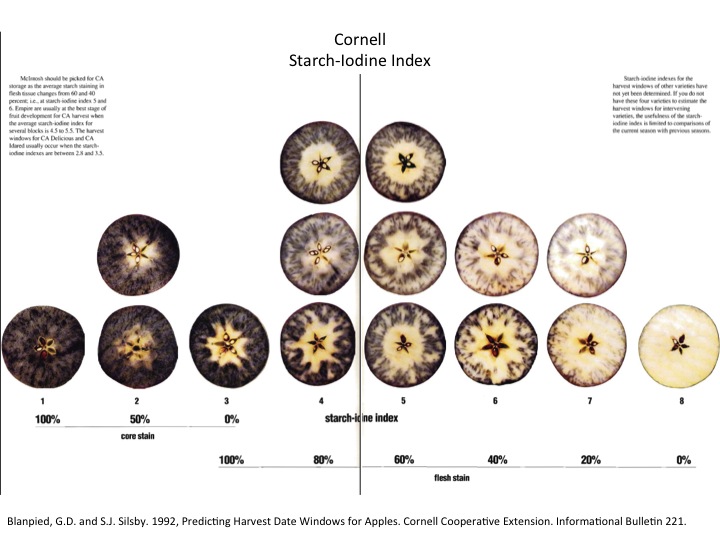
Pre-mixed iodine solution can be purchased through Wilson Irrigation in Yakima, WA. However, you can also make your own starch solution following either of the two recipes below:

Recipe 1: Purchase a 2% alcoholic solution of medicinal iodine from your local drug store and mix with an equal amount of water. (Purchasing the iodine at a drug store will be costly if you are going to need a lot of iodine solution during the harvest season.)

Recipe 2: Add 10 grams of potassium iodide and 2.5 grams of iodine crystals to 1 liter of distilled water. The solution may need to sit overnight before the iodine is fully dissolved. The reagents can be purchased through chemical suppliers such as Sigma-Aldrich or Fischer Scientific.

Store the iodine solution in an opaque container, or wrap the container with aluminum foil to prevent direct sunlight exposure. Sunlight will cause the iodine color to fade over time.

Growers and field managers who are visiting numerous orchards throughout the day often fill spray bottles with the iodine solution to conduct tests in the field. A 10-apple sample from a uniform block will usually suffice as long as proper sampling is conducted. Make sure to pick the samples from trees with an average crop load for that block and at a similar location on each tree to reduce within- and between-tree variability. The apples should be cut through the equator since apples do not ripen uniformly from stem- to calyx-end.

Soluble solid content: Soluble solids are measured in the unit •Brix and are a fairly close approximation for the total sugar content. You can find both handheld digital and optical refractometers through several sources, including QA Supply in Norfolk, VA and Wilson Irrigation in Yakima, WA.

Ethylene: In my lab, we use the internal ethylene method where a hypodermic needle is inserted through the calyx into the core cavity of an apple and a 1 cc gas sample is removed. This sample is analyzed by using a gas chromatograph (GC) that has been calibrated with known ethylene standards. As a rule of thumb, when apples are above about 1 ppm they are considered to have started the autocatalytic process known as climacteric ripening. Once apples begin this ripening process, they will increase many of the desirable eating characteristics (increased flavors, aromas, and sugars, and decreased firmness), but they will also begin to decrease in their capacity to maintain quality during long-term storage. Refrigeration, controlled atmosphere storage, AVG (ReTain), and 1-MCP (SmartFresh) will help to minimize additional ripening during storage. However, once the climacteric ripening process begins, it can not be reversed.

Firmness: Apples can be tested for firmness using a penetrometer. You can find handheld and bench-top instruments through several sources, including QA Supply in Norfolk, VA and Wilson Irrigation in Yakima, WA. While not an exact measure of maturity, firmness does decrease during the ripening process and is a very important apple quality parameter.

Size: For processing fruit, fruit size is often used to as a standard for quality. Many processors desire fruit to be a minimum of 2.75 inches, although market demands may influence that size standard. Sizes will also determine the packout and ultimately the value of the apples using USDA grading standards.

Red and background color: Many varieties have market standards for the percent of red surface or background green to yellow color needed to meet USDA grading standards. In general, cool nights will aid the development of color. Poor coloring strains of Red Delicious, Gala, and Fuji apples may need to be left on the tree for longer than their high coloring counterparts.

Flavor: Although we can use sophisticated instruments to quantify the concentration of individual flavor molecules in apples, the best measure is probably the human mouth. Always sample a few bites of your apples before picking to make sure they have the desired varietal characteristics. Picking good tasting fruit is important for all operations, but for those with direct marketing businesses, flavor might be the most important characteristic for determining harvest maturity.

As always, check with your buyer before picking so that you can ensure that you deliver to your customers the apples that will receive highest return.

I will share harvest maturity information for many of the commercially important apple cultivars found in the Winchester area at tonight’s Commercial Fruit Twilight Meeting and on this blog in a few days.

References

Blanpied, G.D. and K.J. Silsby. 1992. Predicting Harvest Date Windows for Apples. A Cornell Cooperative Extension Publication. Info. Bull. 221.

Anon. 1986. Apple Maturity Program Handbook. Washington State Apple Maturity Program. Wenatchee, WA.