Category Archives: Frost/Freeze Damage

MaluSim Carbohydrate Models for May 16: Winchester and Central Virginia

MaluSim models were run on May 16 for Winchester and Central Virginia.
Slide4Slide3

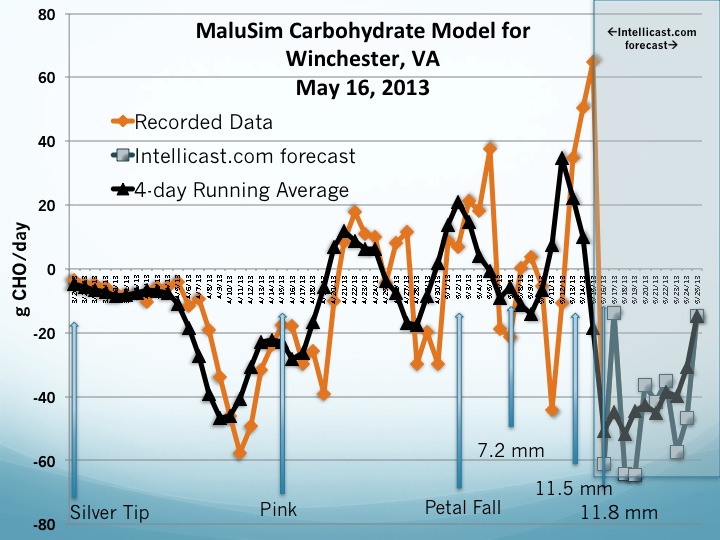
As I spoke about at the Winchester breakfast meeting on Thursday morning, the Winchester forecast is calling for warm and cloudy weather starting today and running through most of next week. From many year’s of research, we know that these are the conditions under which there is a fair amount of natural thinning and that chemical thinners can be particularly active. When the weather data is run through the MaluSim model, we see that there is a carbohydrate deficit between -40 to -60 g CHO/day predicted for the next 10 days. This means that chemical thinners that are applied over the next several days will likely be fairly active. With this in mind, growers should consider reducing rates and/or not using a surfactant. Growers with blocks that sustained freeze damage on Tuesday morning, should consider further reducing rates. As always, you should be checking your trees and making decisions based upon the conditions in your own orchard.

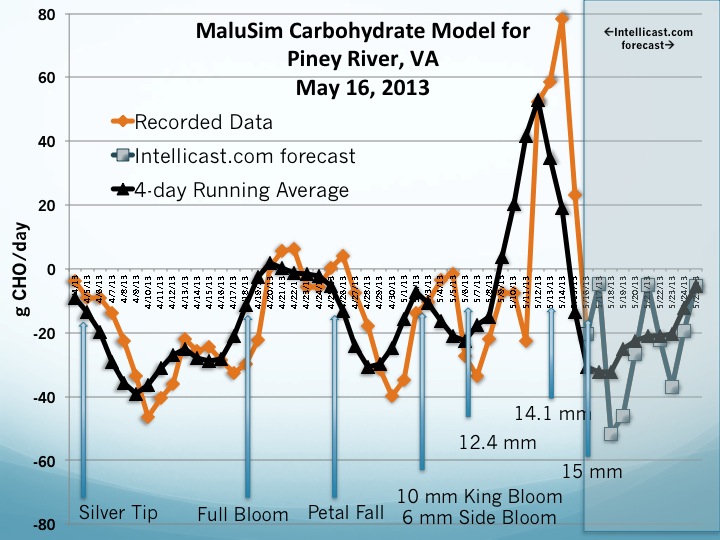
For Central Virginia (Piney River), the carbohydrate deficits over the next week will remain in the negative, but not be as low as the Winchester area. This means that chemical thinners applied from today through the weekend will likely be slightly aggressive when used at standard rates. Growers should be regularly checking their blocks for current conditions. By now, you should be able to see some effect of the cloudy weather that the region experienced early last week.

Here are the pdf files that contain the weather data and the MaluSim models:

Peck Central VA MaluSim 5_16_13

Peck Winchester VA MaluSim 5_16_13
 

MaluSim Carbohydrate Models for May 13: Winchester and Central Virginia

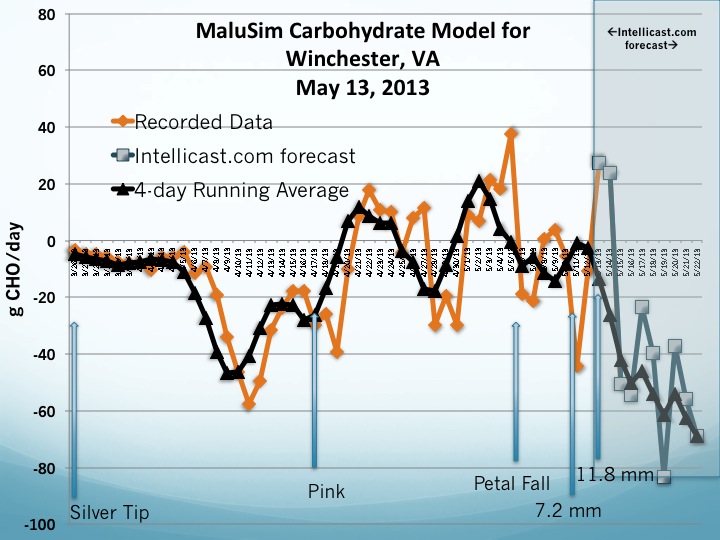
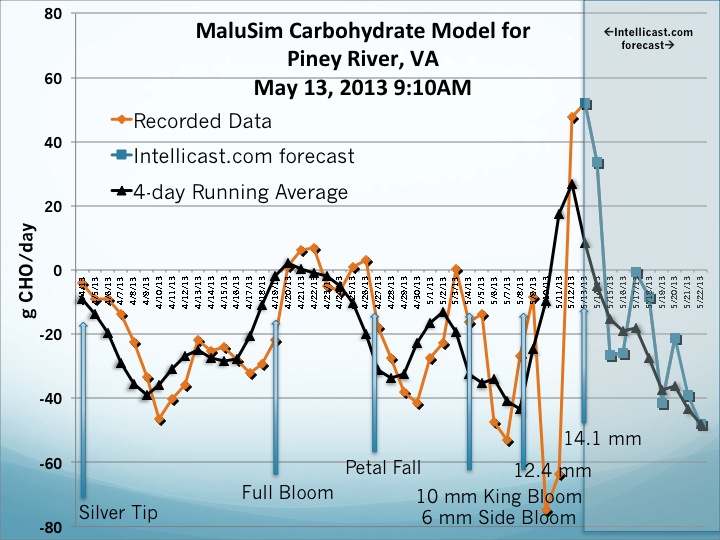
Slide3Slide3The MaluSim carbohydrate model was run on May 13 for both Winchester and Central Virginia.

In Central Virginia, many later blooming cultivars are around 10 mm fruitlet size and can still be chemically thinned. From applications made over the past weekend, growers can expect average responses to chemical thinners. As we move through the week, greater and greater carbohydrate deficits are predicted, which will increase the potency of chemical thinners.

For Winchester, the model is predicting mild carbohydrate deficits early in the week, and much more severe deficits towards the end of the week and over the weekend. Applications made this past weekend through the middle of the week will likely have an average to slightly aggressive response. However, applications make towards the end of the week may result in very aggressive thinning activity. If the weather forecasts hold up, growers should consider reducing rates for applications made towards the end of the week.

I will run the model again on Thursday, May 16.

Fruitlet sizes from the Winchester AREC:

  • Honeycrisp: 8.8 mm
  • York: 8.0 mm
  • Fuji: 8.6 mm
  • Suncrisp: 8.4 mm
  • Pink Lady: 9.2 mm
  • Empire: 11.8 mm

One more note, there are widespread frost/freeze predictions for most of Virginia for Tuesday morning. If a significant frost/freeze event occurs, growers should be cautious with their thinning applications until they can assess if damage has occurred. However, the forecast for Winchester predicts the temperature will only go to 32F, which will not be cold enough to cause significant damage. The forecast for fruit growing regions to the south of Winchester appears to be in the mid-30s to low 40s.

To see more information, click on the linked pdf files below:

Peck Winchester VA MaluSim 5_13_13

Peck Central VA MaluSim 5_13_13

Potential for Cold Temperature Damage in Northern VA

The National Weather Service is predicting temperatures to drop to 22F by the morning of April 4 in the Winchester area. For the bud phenology that I’ve seen in the area, we will probably be spared from having very much damage.

Apples are still dormant with a few early blooming cultivars at silver or green tip. Even at green tip, there should only be 10% damage when temperatures drop to 18F. Peaches with a little pink showing may be susceptible to a low level ~10% of damage. Cherries are still in stage 1 or 2, and should be able to withstand temperatures down to 17F with minimal damage. So, fingers crossed that it doesn’t get any colder than predicted. Temperatures are forecasted to be more “spring-like” next week!

Here are pdf links for the Washington State University fact sheets on the critical temperatures for flower buds:

Additionally, Michigan State University has adapted the WSU critical temperature fact sheets into this easy-to-read fact sheet.

MSU has also put together an excellent set of resources about freezes and frosts in fruit crops.