Category Archives: Uncategorized

Notching and PGRs to induce branching in newly planted, non-bearing and bearing apple trees

Q: Can I do notching for trees right after planting to increase the number of feathers?

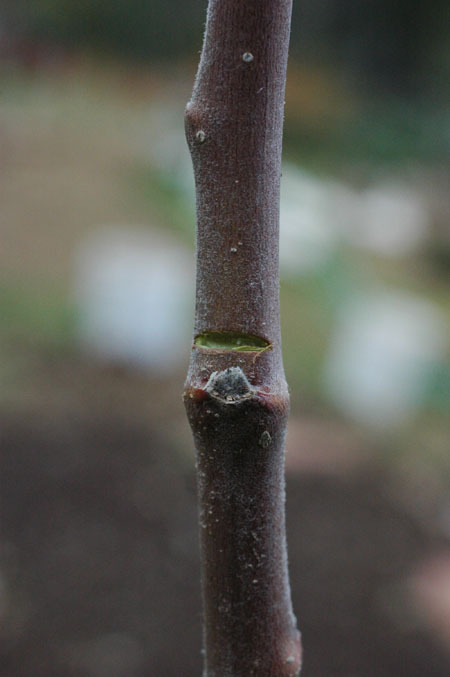
Yes, if you get trees from nursery with a little number of branches (feathers), you can use notching to induce branching. This is mainly important for trees intended for high-density training systems (e.g. tall spindle) and to avoid or reduce the chances of blind wood. Younger trees are more responsive to notching than older trees. You can use a hacksaw or a small knife to cause a notch above the bud as shown in the image attached. In notching, we remove a very small piece of bark without hurting/damaging the wood. This promotes branching by disturbing the hormone (auxin) that prevents the formation of lateral shoots. You should mainly target the area between 30-60 inches above the soil surface for notching. Although you can start notching directly after planting, waiting until new shoots are between 1-3 inches long would be better as you can easily distinguish the buds that failed to break.
Q. Does applying PGRs to the notched area increase branching in the newly planted trees?

That’s right. You may consider adding a 6-BA compound (e.g. Promalin) to the notched area by using a high concentration (12 oz in 5 gallons of water) and a backpack sprayer. Other researchers even suggested mixing Promalin and Maxcel and spraying them together to induce branching and enhance the growth of the new shoots. To do so, you need to mix 5 tablespoons of Maxcel, 1.5 tablespoons of Promalin and 2.4 ml of Regulaid (a surfactant) in a 1-quart spray bottle and spray it as a mist to the notched area. This will enhance branching significantly.

Q. Is notching and PGR applications effective with older apple trees?

For 1 and 2-year old apple trees, notching alone can be effective but again, a mist spray of Promalin alone or Promalin and Maxcel as indicated above will enhance branching and help the tree fill the space much quicker. This time of the year (between the tight cluster and open cluster) is just perfect for both notching and PGR applications. You may still do that until full bloom and after bloom, but the risk of shoot blight increases after bloom and notched areas will serve as entry sites for the fire blight bacterium. This risk can also be partially with seasonal streptomycin sprays. The same rules apply for enhancing branching on the blind wood of older apple trees (> 3 years).

Q. Can I just use PGRs applications without notching to induce branching in non-bearing and bearing apple trees?

Yes, you can use 6-BA products alone but you have to follow the instructions on the label for the concentration and application timing for bearing and non-bearing apple trees. You can use Maxcel at 250-500 ppm (128 oz/40 gal/acre) to induce branching in non-bearing apple trees. Applications should be made when terminal shoots are 28-30 inches long. For bearing apple trees, you can use spray Promalin solution to the blind wood at a concentration of 0.25-1 pint in a 5 gal of water, applied at 1-3 inches of new terminal growth.

Q- I have a lot of blind wood in the top part of the tree; is there anything other than notching and PGRs I can do to fix that?

At the time of dormant pruning, I would suggest you remove 2-3 large limbs by making a bevel cut and follow this with notching and PGR sprays two weeks before bud break. Leaving many large limbs in the tree sucks up the carbohydrate resources from the main trunk and makes it hard for any new branches to develop in the leader, causing blind wood.

Dr. Sherif M. Sherif, Assistant Professor, Virginia Tech, School of Plant and Environmental Sciences, AHS Jr. Agricultural Research and Extension Center, 595 Laurel Grove Road, Winchester, VA 22602. Email: ssherif@vt.edu; Tel: 540-232-6035 

Flower bud development in apples and stone fruits-3/19/2020

Greetings,

               I just wanted to update you on where we are right now in terms of flower bud development in apple and stone fruits and whether we will potentially be affected by the cold weather this weekend (Sunday). As for apples, almost all our apple cultivars in the ASH Jr. AREC’s research farm are in the silver tip, green-tip or ½ inch green now (see the table below). Pink Lady and Zestar are the only cultivars we have that show buds in tight-cluster and first-pink stages. None of the buds I investigated in Pink Lady and other commercial cultivars showed signs of frost damage so far. Based on the weather forecast for the Winchester/Frederick county area, temp-Max will range between 41-78 oF and temp-Min will range between 31-42 oF in the next 10 days. If this turns out accurate, then we should not really be worried about frost damage to our apple blossoms for the next 10 days.

Bud development stages of commercial apple cultivars (3/19/2020)
Schlect Red Delicious/M.26 ½ inch green
Honeycrisp/B.9 Green tip
Ramey York/M.9 Green tip
Pink Lady/M.9 Tight cluster – first pink
Gala/M.9 ½ inch green
Daybreak Fuji/M.9 Silver tip
Elstar/G.16 Swollen bud
Golden Delicious/B.9 Green tip
Zestar/M.9 Tight cluster – first pink
Pixie Crunch/G.935 Green tip
Gold Rush/G.11 ½ inch green
Liberty/B.9 ½ inch green
Granny Smith/M.26 ½ inch green – tight cluster

What about stone fruits? Well, based on the few apricot and plum trees we have in the lab, our plum and apricot trees are in the full-bloom and post-bloom stages now and although we had temp. of 31 oF this past Monday (Mar 16) for a couple of hours, the damage to apricot and plum blossoms that could be due to frost is less than 5%. It’s also unlikely that temps this Sunday would cause any significant damage to apricot and plum flowers unless they will drop below 25 oF. Our sweet cherries, on the other hand, are still between the green-tip and tight-cluster stages and therefore, the risk of frost damage is also minimal. Most of our peach cultivars are moving slowly toward 1-2% bloom and with temps of 78 oF tomorrow (Friday), this percentage might jump to 5-10%. At this stage, the temperature that can kill 90% of buds is 24 oF, which is not the case this Sunday, at least for most parts of the state. For more information about critical temperatures for bud developmental stages, please use this link/PDF (https://www.canr.msu.edu/uploads/396/36740/PictureTableofFruitFreezeDamageThresholds.pdf. You may also need to print a color version of this figure and keep it in your house/office as a reference.

If you are not done with apple pruning yet, for very obvious reasons, and wondering whether you should proceed with the blocks that are not pruned, I would not generally recommend doing any pruning at this stage, for two reasons: 1) trees have already lost their cold hardiness and they would be more sensitive to any low temperatures during and after pruning; 2) there is a high risk of fire blight/shoot blight if the pruned wood did not heal well enough before the full-bloom window. As for peaches and nectarines, I usually recommend pruning the trees 4-6 weeks after full bloom.

If you have any questions or comments, please send them in the “comments” window below, send me an email at: ssherif@vt.edu, or call me at my office number: 540-232-6035 and I will make sure to get back to you as soon as I can.

Stay Safe, everyone.

ReTain inhibits ethylene production in fruit. Hence it is used to delay ripening, reduce pre-harvest drop, and extend the harvest season. Since it’s about the time for the pre-harvest drop control sprays, I wanted to share with you a field trial we conducted last year in one of Galize Apples’s orchards, in Winchester. The purpose of this trial was to examine the effect of different rates and application timing of ReTain on fruit drop of Gala apples. The tables below show the effects of two application timings (1 and 3 weeks before harvest (WBH) and two rates (1/2 and full-rate) on fruit drop and fruit quality. To accurately evaluate fruit drop (%), we assigned 6 trees/treatment, and we flagged 100 fruit/tree. We counted these fruits every week starting 1 WBH and through four weeks after the normal harvest date. Last year, the expected harvest date of Gala was Aug 28, so we applied our sprays on Aug 9 and 23.
– As you can see from Table 1, Retain treatments decreased fruit drop percentage compared to the untreated controls, but the differences between untreated trees and treated trees were not STATISTICALLY significant at 1 WBH, at harvest and 1 WAH. However, for fruits that were left on the tree for 2, 3 and 4 weeks after the normal harvest date, ReTain treatment applied 3 WBH at full-rate (333 g/acre) has shown SIGNIFICANT reductions in the percentage of fruit drop compared to untreated trees (28% vs. 58%). These reductions in fruit drop can be translated to a 40-50% increase in the yield and two weeks extension to the harvest season. We also found that two applications of ReTain (1 and 3 WBH) at half-rate can give a similar effect to a single application (3 WBH) at a full-rate.
– As far as fruit quality is concerned, fruit samples collected from treated trees and untreated trees at harvest indicated that ReTain applied at the full rate 3 WBH has significantly delayed fruit ripening. Fruits treated with ReTain were firmer than untreated controls and had lower sugar, starch, and color values (Table 2). Similar results were obtained when fruits were collected 2 weeks after the anticipated harvest date (Table 3), but the differences between treated and untreated fruits were not statically significant.


Late Thinning Application-May 13, 2019

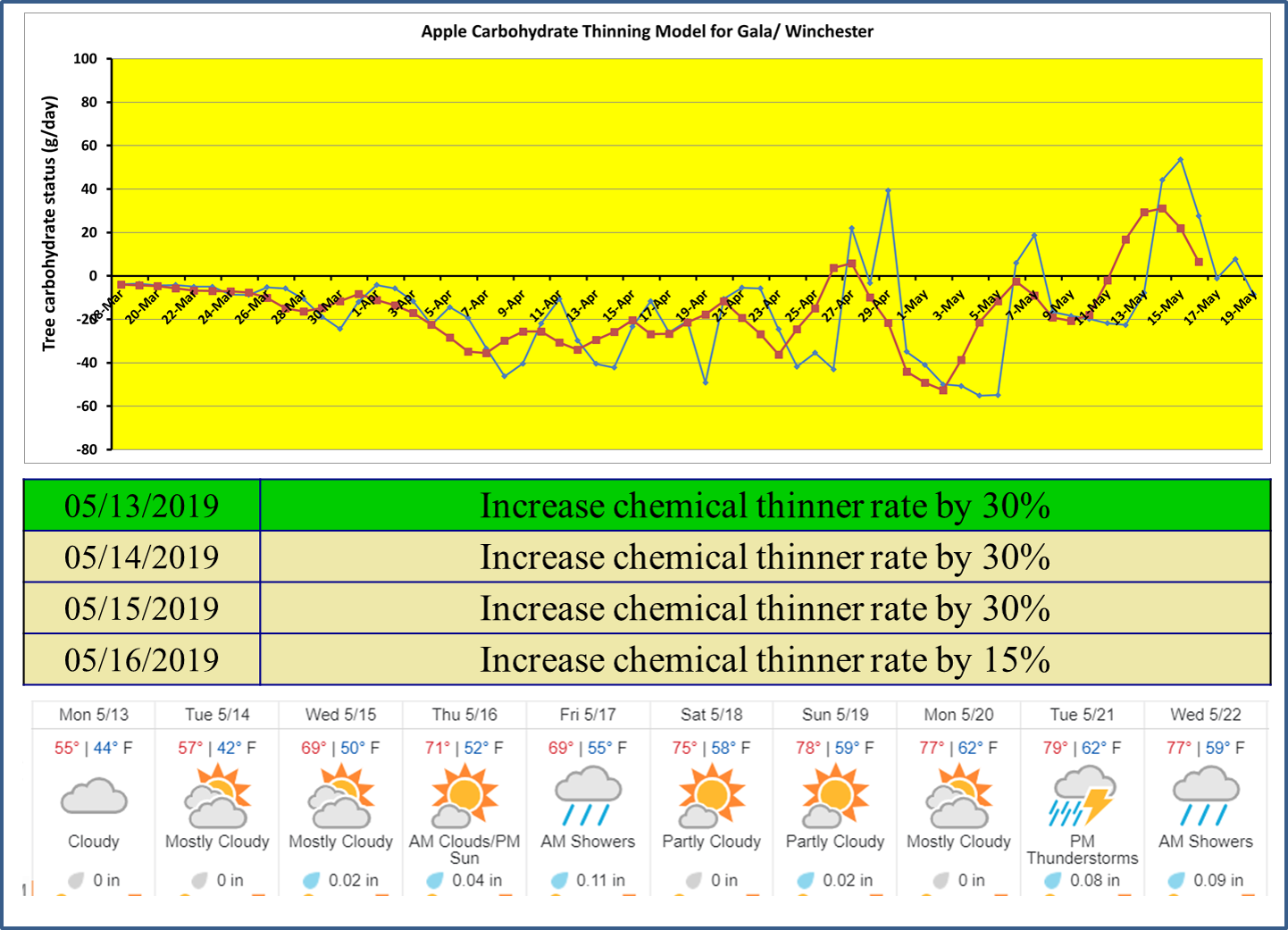
The average fruit size for Pink Lady, Gala, Fuji and Honeycrisp in Winchester is 16.67, 17.02, 16.3 and 16 mm, respectively. At such advanced stage of apple fruit development, 6-BA and NAA will not be effective as chemical thinners and it is the time to start the “rescue thinning” sprays if more thinning work is still needed. Ethephon is the only effective thinner at this stage. Ethephon thins more effectively when the temperature is in the 70s to low 80s. Although the weather forecast predicts relatively cool temperatures this week, increasing the rate of chemical thinners by 30% to compensate for the high carbohydrate levels, as shown below, might mitigate the negative impact of low temperatures.

The recommended materials and rates for late (rescue) thinning are:

  • Ethephon (1- 1.5 pt) +Sevin (1pt)/100 gallon for Fuji and Spur-type Red Delicious.
  • Ethephon (0.75 pt) +Sevin (1pt)/100 gallon for Gala, Cameo, Goldrush and Jonagold
  • Ethephon (0.4-0.5pt) +Sevin (1pt)/100 gallon for Golden Delicious, Rome Beauty and Enterprise.

Fruit Thinning Treatments-May 9, 2019

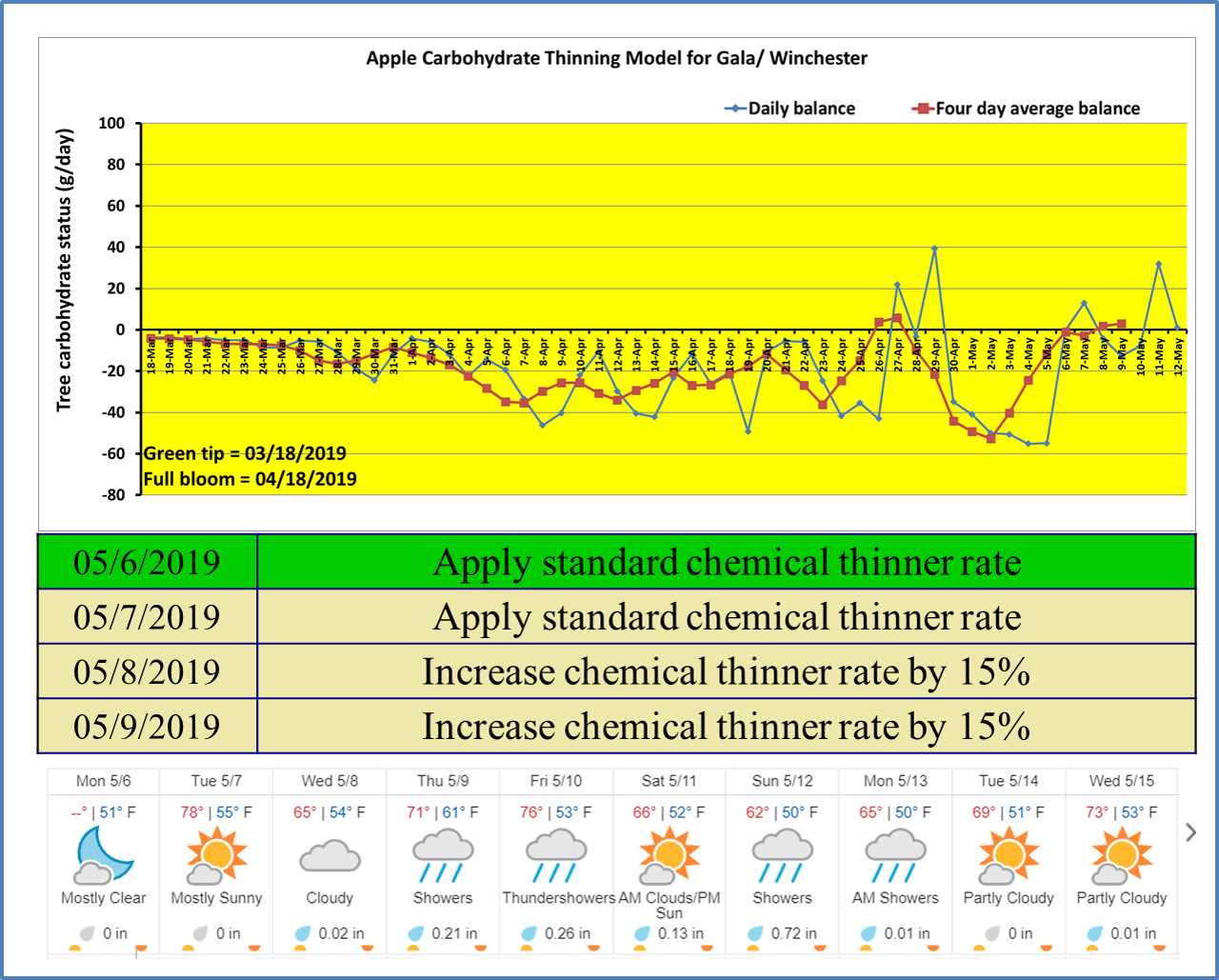
The average fruit size for Gala, Honeycrisp and Pink Lady in Winchester today is 13.19, 13.08 and 14.06 mm, respectively. Although 6-BA-carbaryl or NAA-carbaryl mixes can still be effective at this stage, thinning applications will not be possible during the rest of this week & weekend due to the rain. On the other hand, the thinning model predicts a carbohydrate surplus next week, making thinning a bit challenging. The recommended options for next week are: a) Increase the rate of thinning materials by 15-30% according to the model outputs (note: another update will be posted on my blog on Monday, May 13), b) Wait until your apples approach an appropriate size (19-25 mm) for rescue thinning applications.

Tuesday, May 7: Another Chance For Thinning Applications

If you are not done yet with your thinning sprays and feel that another application is needed, tomorrow, Tuesday-May 7, is another good chance for thinning. Fruit sizes for Gala, Pink Lady and Honeycrisp in Winchester are 12, 12.5 and 10.5 mm which are still within the recommended range for thinning with 6-BA/carbaryl or NAA/carbaryl mixes. Temperatures will drop to 65F this Wednesday making thinning with 6-BA and NAA a bit challenging. The addition of 1 pt/100 gal of oil (e.g. 70-sec superior, JMS Stylet oil) can help increase the response to thinning sprays. However, the addition of oil may cause russeting on some cultivars. Also, Captan should be avoided within 7 days of oil applications, as it may lead to sever russeting. As per the carbohydrate thinning model, the rates of chemical thinners should be increased by 15% for Wednesday applications to compensate for the potential increment in the tree carbohydrate level.

Apple Carbohydrate Thinning-Thursday 5/2/2019

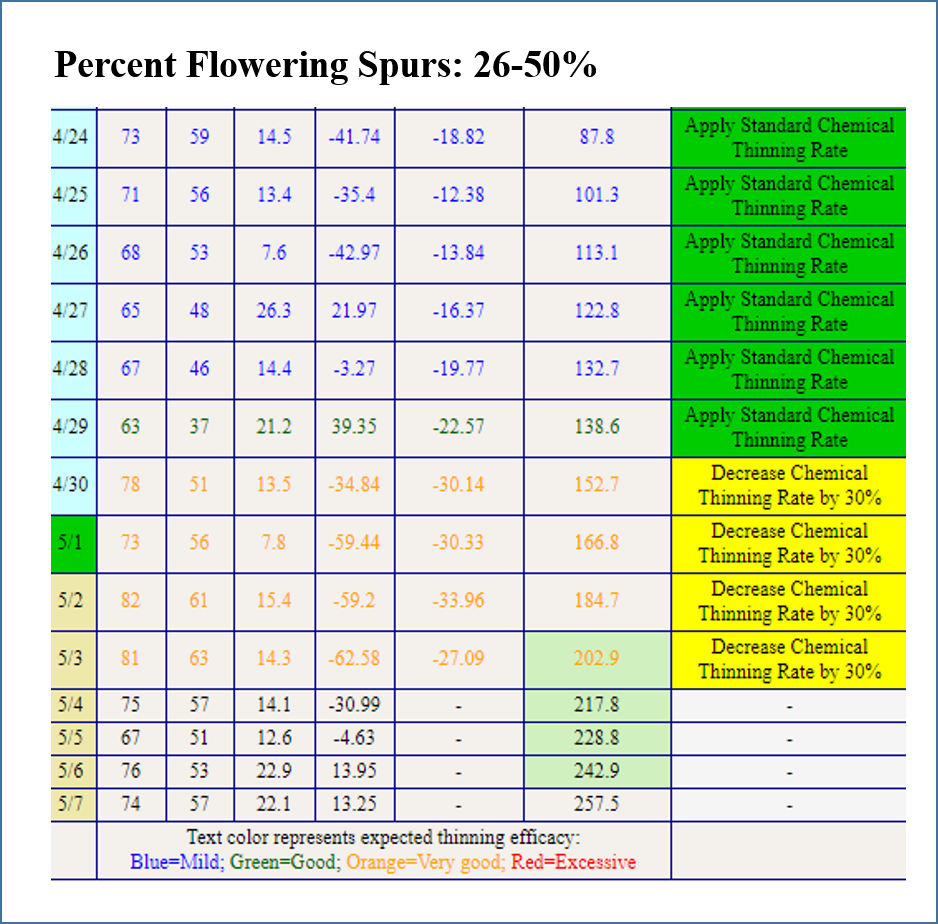
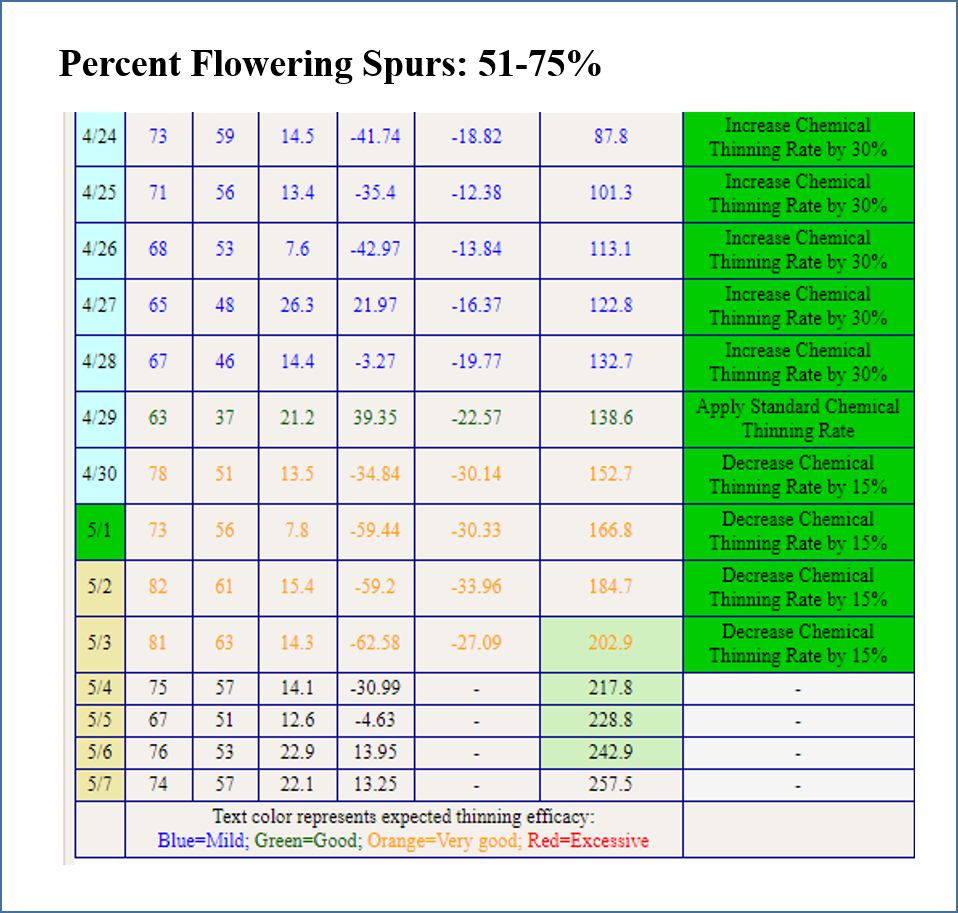
If you are planning to apply thinning treatments tomorrow, Thursday, May 2, it’s recommended to decrease thinning rates by 15-30% based on the % of spurs that are flowering, as indicated below. It’s likely going to rain tomorrow afternoon. Allow 2-3 hours for the thinning sprays to be completely absorbed before the rain occurs.

A new Version of the Malusim Model on NEWA

The following is the message I received today from Dr. Terence Robinson, at Cornell University, regarding the 2019 version of the carbohydrate thinning model (aka; Malusim Model) on the NEWA website.

“We are pleased to announce the official release of the 2019 carbohydrate thinning model (Malusim) on the Newa website. The model will have an updated look and information. The input page will require growers to input the % of spurs that are flowering in one of 4 ranges (0-25, 26-50, 51-75 and 76-100%.). The output data table will have a column of DD base 4°C and will have colors highlighting when we are in the sweet spot for thinning (200-250DD from bloom). The new version will also give a Thinning Index composed of the average carb balance of 2 days before, the day of thinning and the next 4 days= 7 day running average. The thinning recommendations will be based on a new 3 dimensional lookup table taking into account, DD from bloom, % of spurs that are flowering and carb balance over 7 days.  The thinning recommendation cells in the table will also be color coded to indicate red=high risk of overthinning, blue= mild thinning expected, yellow= caution possible aggressive thinning efficacy and green=good thinning efficacy.

We are pleased to announce the official release of the Malusim app, including an android and an iOS versions. You can download the app from the Google Play Store or the iTunes Store, OR use the app from any browser at https://malusim.org (note that speech recognition features are not supported in the browser version of the app).

IMPORTANT: If you used the 2018 beta version of the Malusim app for Android, you must uninstall it from your devices and download the new release from the Google Play Store. The data storage method has changed, and any changes you make to your data in the old app will not be accessible via the new app on any of the supported platforms.

You can continue to access any data that you entered last year – however, remember that when entering data for this year, you should clone any existing locations, rather than editing them and simply updating the year. Cloning will allow you to access data from previous years in the future”.


Good Thinning Conditions This Week

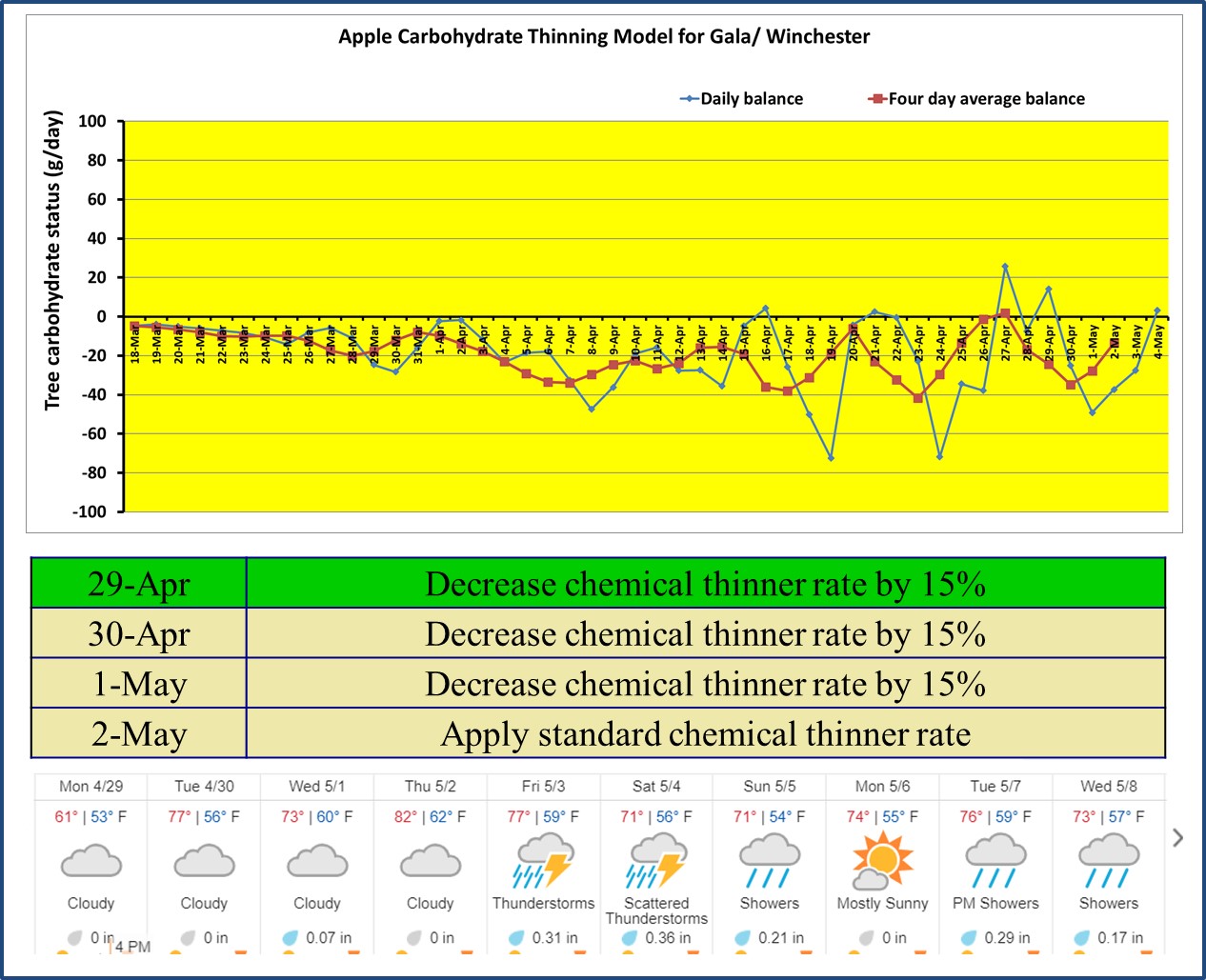
Cloudy and warm weather in the next three days (April 30-May 2) along with the tree carbohydrate status and average daily temperatures as shown in Figure 1 all predict an excellent response to chemical thinners this week. Due to carbohydrate deficits, the carbohydrate thinning model recommends reductions in thinning material rates by 15% for Tuesday and Wednesday applications to avoid over-thinning. 

  Figure 1: The carbohydrate thinning model and weather forecast for the week of April 29

Note: The fruit size averages for Pink Lady, Gala, and Honeycrisp in Winchester are 7.1 mm, 6.2 and 5.3 mm, respectively. 

Carbohydrate Thinning Model-4-26-2019

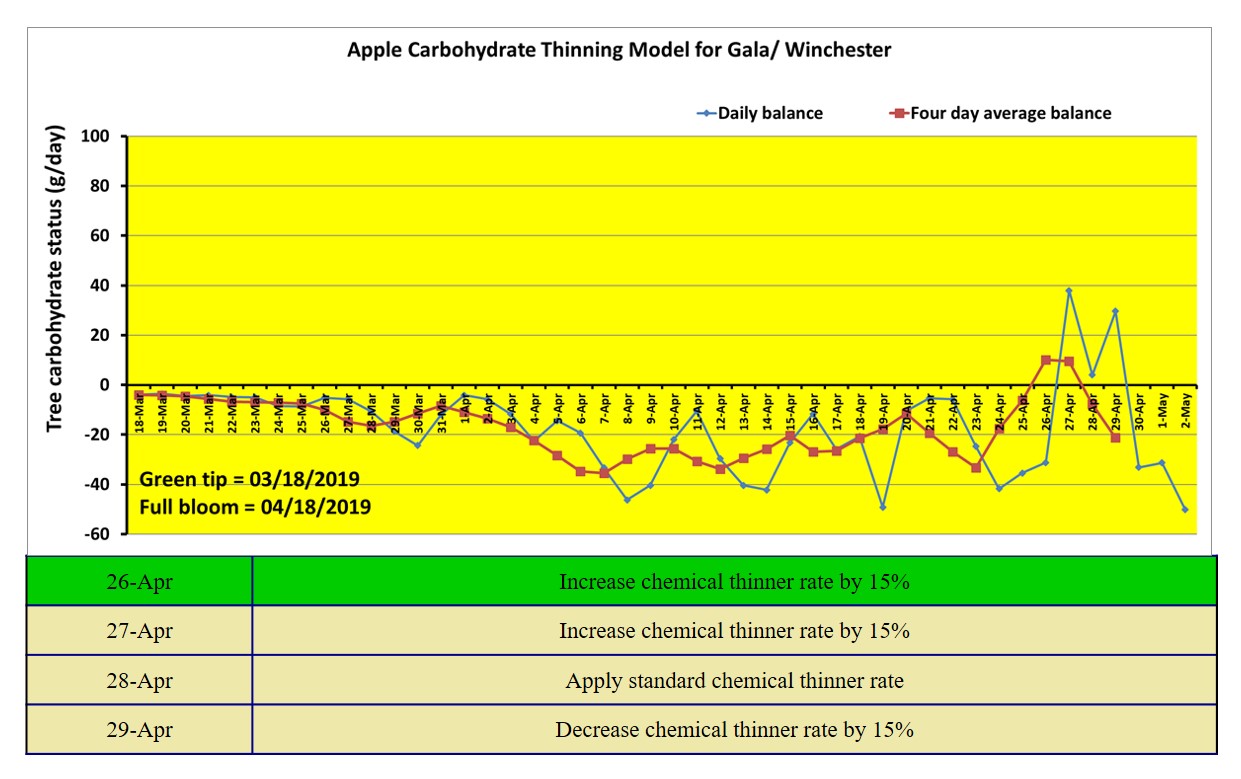
The Figure below illustrates the model outputs for Gala in Winchester/Frederick County. I used the weather station in Winchester-AREC. However, the same outputs were obtained when I used Washington-Gadio Cellar weather station. For Central Virginia, the bloom date for Gala was April 16, so the model outputs are almost similar to that of Winchester.

Based on Winchester 10-day weather forecast and the outputs of the carbohydrate model, I would suggest Tuesday (April 30) or Wednesday (May 1) for fruit thinning sprays. The expected carbohydrate deficit on April 29 and the two cloudy/rainy days on May 2-4 predict high responsiveness to thinning materials, particularly 6-BA and NAA. The rates of thinning chemicals should be adjusted based on the degree of carbohydrate deficit after thinning applications. Therefore, I will rerun the model on Monday (April 29) to provide more recent information on thinning rates.