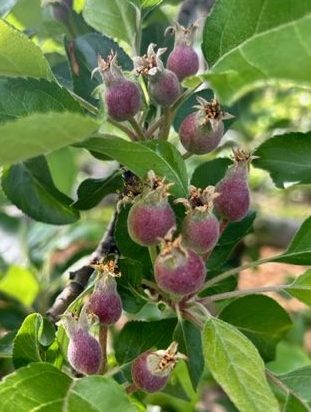
Depending on your location and the level of damage from the freeze events on April 8 and April 21, you should now have a reasonably informed idea of your apple crop potential. At this point, most growers likely know whether they have a light crop, a decent crop that still needs some thinning, or little to no fruit at all. In my case, at the Winchester AREC research farm, most blocks appear to have no meaningful crop. However, even here, a few sections of the orchard at relatively higher elevation may still need some thinning.
The purpose of this post is to provide general guidance for thinning decisions in the Winchester/Frederick County area and in Central Virginia, where some orchards still have enough crop to justify thinning.
In both areas, the carbohydrate model showed a very severe carbohydrate deficit between April 11 and April 16. This level of stress was enough to promote natural fruit abscission, which is why I was reluctant to recommend chemical thinning during that period. Growers who applied thinning sprays during that window have likely already seen a very good – strong thinning response, including fruitlets on the ground.
For those who applied thinning treatments last week, between April 22 and April 24, the thinning response may take a little longer to become visible. With the cool weather we are currently experiencing, fruitlet growth and size separation within clusters will likely move slowly. In other words, the difference between fruitlets that will be retained and those that will eventually abscise may not be obvious right away.
For growers who have not applied any thinning treatment yet but still have a crop that requires thinning, there are two possible scenarios:
- If your local forecast shows at least one day this week with temperatures above 70°F, no major rain events, and your average fruit size is still below 18 mm, you can still consider using 6-BA and/or NAA. Under these conditions, I would increase the rate by about 30% and include Regulaid or oil to improve thinning activity. These materials are generally less effective when temperatures remain below 70°F on the day of application.
- if the weather remains cool and rainy for the rest of this week, it may be better to wait until early next week, around May 4–6. By that time, many blocks will probably have fruitlets larger than 18 mm, and Accede or ethephon-based thinning programs may be more appropriate. The only exception would be blocks where the average fruit size is still below 18 mm; in that case, 6-BA and NAA may still be useful.
As always, please base your thinning decisions on your own block conditions, including actual crop load, fruit size, cultivar, tree vigor, and the amount of freeze damage. This season is highly variable, and the best thinning decision will depend on what you are seeing in each individual block.