
The Central Virginia Fruit School has been rescheduled for Tuesday, March 11 at the Nelson Center in Lovingston. Registration will start at 8:30AM. Specialists will be covering the same topics listed in the original program. Contact Michael LaChance for more details or questions.
Rappahannock-Madison Winter Fruit School Rescheduled for March 6
The Rappahannock-Madison Winter Fruit School has been rescheduled for March 6 at Grave’s Mountain Lodge. The start time is 8:15AM and agenda will remain the same. Contact Kenner Love (klove@vt.edu) with questions or for more details.
A rescheduled date for the Central Virginia Fruit School is still being determined.
Winchester Regional Fruit School
Due to the continued winter weather, we have decided to delay the start of the Winchester Fruit School.
9:30am – Registration
10:00am – Presentations begin
Location remains the Lee Jackson (Best Western) Conference Center, 711 Millwood Avenue, Winchester, VA. 22601
Please pass on this information to others that were registered with you.Mark Sutphin
Associate Extension Agent | Agriculture and Natural Resources, Horticulture | Unit Coordinator (Frederick)
Virginia Cooperative Extension – Frederick County Office | 107 North Kent Street | Winchester, VA 22601
Phone – 540.665.5699 | Fax – 540.722.8380 | Cell – 540.398.8148 | Email – mark.sutphin@vt.edu |http://offices.ext.vt.edu/frederick/
Serving the counties of Frederick, Clarke, Page, Shenandoah, & Warren
VIRGINIA POLYTECHNIC INSTITUTE AND STATE UNIVERSITY
Extension is a joint program of Virginia Tech, Virginia State University, the U.S. Department of Agriculture, and state and local governments.
Winchester Winter Fruit School Meeting is Still Scheduled to Occur on Friday
From Mark Sutphin:
Despite the expected weather, we are planning to continue with the Winchester Regional Tree Fruit Production School as scheduled for Friday, February 14th at the Best Western Lee/Jackson banquet hall. All that said, please use your own best judgement and do not put yourself at risk if you feel you are not able to attend.
Should our plans for the event in Winchester on Friday change, I will email those who have registered for which I have electronic contacts and attempt to call all others who are pre-registered.
If you have any questions, you may reach me on my cell: 540.398.8148
Thanks and be safe.
Mark Sutphin
Associate Extension Agent | Agriculture and Natural Resources, Horticulture | Unit Coordinator (Frederick)
Virginia Cooperative Extension – Frederick County Office | 107 North Kent Street | Winchester, VA 22601
Phone – 540.665.5699 | Fax – 540.722.8380 | Cell – 540.398.8148 | Email – mark.sutphin@vt.edu |http://offices.ext.vt.edu/frederick/
Serving the counties of Frederick, Clarke, Page, Shenandoah, & Warren
VIRGINIA POLYTECHNIC INSTITUTE AND STATE UNIVERSITY
Extension is a joint program of Virginia Tech, Virginia State University, the U.S. Department of Agriculture, and state and local governments.
Nelson and Rappahannock County Fruit School Meetings are Cancelled
Due to the approaching snow storm, we have decided to cancel the Nelson and Rappahannock County Winter Fruit School meetings that were scheduled for Wednesday evening and Thursday, respectively. At this time, we still plan to hold the Roanoke and Winchester Fruit Schools as scheduled.
More details will be forthcoming regarding the rescheduling of these meetings.
Here is the link to the original Fruit School Meeting schedule.
Stay safe, and stay warm.
Dr. Greg Peck
A Review of the 2013 Growing Season
At the annual Cumberland-Shenandoah Fruit Workers Conference in Winchester, researchers and extension personnel from each of the attending states prepares a review of the past growing season. These reports are published in the Conference Proceedings, but we thought that a broader audience might also be interested in our assessment of the 2013 growing season. Please contact us if you have any additional thoughts or comments.
Call of the States – Virginia
Horticulture- Greg Peck
The 2013 growing season was marked with abundant rains in May, June, and July and relatively cool conditions from mid-August through to the end of harvest. Spring conditions were generally favorable for planting, and many acres of new orchard have been established in Virginia over the past year. On April 22 and May 15 there were light spring frosts in the Winchester area. Additionally, there was cool weather with reduced honeybee flight when many fruit trees were flowering. With the exception of russetted fruit in some low-lying areas, neither the peach or apple crops appeared to be significantly negatively affected by the frosts. In fact, many growers reported having fewer superficial blemishes and russets than would be expected from the cool humid conditions. However, the sweet cherry crop in Winchester, as well as many other locations in the mid-Atlantic displayed severe fruit drop due to these environmental factors, as well as potentially low light levels that occurred prior to pit hardening. Amongst the tree-fruit crops in Virginia, sweet cherries once again proved to be the most disappointing. In general, apple fruit set was more than adequate and most growers had a full crop.
Growers throughout the Commonwealth reported above average yields for both peaches and apples. Indeed, it would not be surprising if Virginia’s statewide apple yields in 2013 were greater than from any year in the past decade, if not longer. Indeed, many growers had difficulty sourcing sufficient labor and towards the end of harvest enough bins into which to pick their crop. However, excellent crop conditions were also reported in Pennsylvania, New York, Michigan, and elsewhere in the Eastern US, so prices were lower than grower expectations. In addition to the abundant yields, fruit size, color, and overall quality were quite good.
Entomology- Chris Bergh
Oriental Fruit Moth biofix was April 11, Codling Moth on May 2; both within historical norms since 2000. Cool wet weather following biofix resulted in slow Degree Day accumulation. There was very low internal worm pressure in 2013; was this effects of weather? Cool spring also resulted in prolonged activity of Plum Curculio and injury well into the summer. There was an unusual instance of lots of pansy spot on some apple varieties throughout central and northern VA and extending further north. Also foliar injury: Western Flower Thrips and/or soybean thrips.
Brown Marmorated Stink Bug (BMSB) populations were very high by late summer, based on captures in traps. Ideal growing conditions maintained lush condition of wild hosts, prompting the question,” Did BMSB stay longer on them? (considering the huge amount of vegetative growth on peach).” BMSB injury at harvest managed quite well in most orchards in which targeted sprays used. Many growers are now using Alternate Row Middle sprays. There were examples of high levels of BMSB injury to late-season apples when BMSB was not targeted as in processing blocks. San Jose Scale is an increasing concern behind BMSB programs. Mites continue not to be an issue. The biggest secondary pest concern is late-season Woolly Apple Aphid outbreaks; Diazinon worked very well, but not Movento, Provado or Closer. There was Issue with Diazinon restrictions on fruit for baby food; Also there was a potential issue with compatibility between diazinon and captan.
Pathology- Keith Yoder
2013 was an “average” disease year in the Winchester area, but with progressively heavier pressure farther south. There was no apple scab infection period in the Winchester area until Apr 17. Scab lesions from April 17 were present by May 6, and then heavier secondary occurred May 6-24. Sterol inhibiting fungicide resistance and QoI resistance, confirmed in 2012, are being dealt with in the Winchester area. Cedar-apple rust spores were released as early as April 12 and discharge continued into June; but for the most part, susceptible blossoms escaped quince rust infection. Our test treatments in 2013 again bore out the value of following likely cedar rust infection periods with an SI fungicide for after-infection control. In 2013, mildew conidia were available April 11 a week ahead of scab infection, and we had 42 dry weather “mildew infection days” from April 11-June 14. Summer rains prolonged growth and the length of shoot susceptibility, and secondary mildew infection was common on susceptible varieties. In spite of some earlier indications, some (Maryblyt) predicted fire blight days fell short of the requirements for infection and most infection events occurred mostly only on late bloom.
For purposes of predicting development of the sooty blotch and flyspeck (SBFS) fungal complex, we started wetting hour accumulation from May 13, and by July 1, and had reached the 250-wetting hour threshold for specific treatment against the SBFS fungal complex, about five weeks later than last year. Leaf spot problems on Golden Delicious in the Winchester area were primarily necrotic leaf blotch, not the Glomerella leaf spot which suddenly became prominent in late August 2012. The late season was not conducive to rot development in the Winchester area; however, with heavy rainfall in southern VA and western NC, Glomerella was again a problem in those areas in 2013. Some samples of rot spots from those areas developed into bitter rot and some were white (Bot) rot.
Grape disease development followed a similar pattern, with generally heavier disease pressure by wet weather diseases farther south into Virginia.
Cornell to Offer an In-depth School for Fruit Growers in the Eastern US
An In-depth School for Fruit Growers
March 25, 2014
“The Application of Physiological Principles to Fruit Crops”
The Cornell Fruit Team is pleased to announce an in-depth school for tree fruit growers, extension educators and crop consultants on March 25, 2014, at the Ramada Inn in Geneva, NY.
This meeting will be a one-day intensive school focusing on fruit crop physiology and the applications of physiological principles in the orchard. The meeting will feature 6 scientists who have been the leaders of fruit physiology for the last 35-40 years and who are all retiring (alphabetically, Ted DeJong, University of California-Davis; James Flore, Michigan State University; Duane Greene, University of Massachusetts; Alan Lakso, Cornell University; John Palmer, Plant and Food Research, NZ; and James Syvertsen, University of Florida). We invite you to attend and learn how to better manage orchards from their collective knowledge.
The meeting attendance will be limited to 200 people so we urge to register early before the space is filled up. The meeting is being advertised to members of the fruit production industries in the eastern US.
The in-depth school will serve as a vehicle for fruit industry leaders to hear presentations on practical physiology as it relates to orchard management but also will allow time for networking and discussion.
Details and registration information are available at the Web site: http://events.cals.cornell.edu/indepthschool2014 For more information call Gemma Osborne at 315-787-2248, fax number 315-787-2443 or email at gro2@cornell.edu
Click here to download the brochure.
2014 Virginia State Horticultural Society Meeting to Meet at the Mid-Atlantic Fruit and Vegetable Convention in Hershey
The Virginia State Horticultural Society will hold its annual membership meeting at The Mid-Atlantic Fruit and Vegetable Convention in Hershey, PA. on Thursday morning at 7:30 a.m. in the Cocoa Suites (lower level). All Virginia fruit producers are encouraged to attend.
Mark Sutphin (VCE-Frederick County) has obtained approval for Virginia private pesticide applicator re-certification credits (full 90 and partial 91) for meeting attendees. The approval is for Categories: 1-A, 3-A, 4, 10, and 60. Once at the conference, please seek out Mark for paperwork and instructions (due to the size of the conference the process is more complex than usual). To receive recertification credits, paperwork must be completed at both the beginning and the end of the conference.
Mark will spend much of the conference at the Virginia State Horticultural Society table. If you cannot find him there, you may track him down on his cell phone 540.398.8148.
Feel free to contact Mark with any questions regarding Virginia pesticide applicator re-certification at the MAFVC.
The full program for the MAFVC can be viewed at their website.
2014 Winter Fruit School Meeting Dates
The 2014 Winter Fruit School dates, times and locations have been set. These in-depth meetings focus on commercial tree-fruit production. The schedule will be similar to the 2013 schedule, with the Patrick-Carroll meeting occurring on Tuesday morning, and the Central Virginia meeting occurring on Wednesday evening. The full list of locations is below, as well as the local contact for each meeting.
Presentations by Extension Specialists will include, woolly apple aphid control, minimizing pre-harvest fruit drop in apple orchards, thrips management in orchards, a spotted winged drosophila update, and disease management updates with a focus on Glomerella leaf spot. Additional programing is still being developed at each location and more details are forthcoming. Pesticide recertification credits are usually available, check with the local contact for more information.
| Date | Location |
Registration opens |
Local Contact | Contact’s phone number | Contact’s email |
| Tuesday February 11 |
Prime Sirloin 1018 Rockford Street Mt. Airy, NC 27030 |
9:00AM |
Steve Pottorff | 276-730-3113 | pottorff@vt.edu |
| Wednesday February 12 |
Brambleton Center 3738 Brambleton Avenue SW Roanoke, VA 24018 |
8:00AM |
Andy Allen | 540-864-5812 | geallen@vt.edu |
| Wednesday February 12 |
The Nelson Center 8445 Thomas Nelson Highway Lovingston, VA 22949 |
4:00PM |
Michael Lachance | 434-263-4035 | lachance@vt.edu |
| Thursday February 13 |
Grave’s Mountain Lodge Rte. 670 Syria, VA 22743 |
8:30AM |
Kenner Love | 540-675-3619 | klove@vt.edu |
| Friday February 14 |
Best Western Lee Jackson Banquet Hall 711 Millwood Ave. Winchester, VA 22601 |
8:00AM |
Mark Sutphin & Marsha Wright |
540-665-5699 | mark.sutphin@vt.edu mawrigh4@vt.edu |
Fruit Bud Damage from Cold Temperatures
Cold temperatures in the winter, such as we’re experiencing over the next couple-few days with a polar vortex can cause damage to plants, people, and livestock. 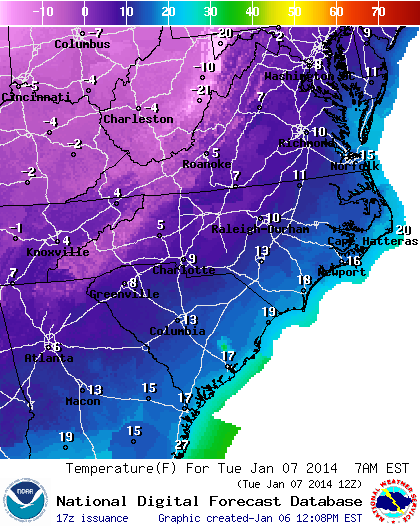 At this time of year, fruit buds on our main tree-fruit crops (apple, peach, cherry, and pear) are still in their winter dormant state (endodormancy). During endodormancy, buds have a very low water content and tend to be more cold tolerant. However, absolute lows are not the only factor to consider. If warm temperatures precede a cold spell, then tree buds tend to be less cold tolerant and are more likely to be damaged. There is also considerable variation amongst species and cultivars. For this reason, critical temperature thresholds, like those developed for spring frost damage to flower buds, are not well defined. However, from an ongoing discussion among pomologists in the Eastern part of North America, the consensus seems to be that peach flower buds start to be damaged at -10F and complete crop failure and/or tree loss occurs at -20F. Cherry and plum flower buds are slightly more cold hardy than peach buds and damage will likely occur at -20F. Apple flower buds can withstand temperatures down to -25F. As of now, the forecast for most of Virginia does not show temperatures dropping below 0F. Hopefully, this means that fruit buds in Virginia will not be damaged by the polar vortex.
Plants are not affected by wind chills (plants do not lose heat to the wind). But people and animals will be impacted by the heat loss from the high winds that are accompanying this storm. I’ve seen several wind chill forecasts for Tuesday in the -10 to -20F range. If your pruning crews are outside, make sure they are dressed appropriately for the cold. Also, make sure that your farm animals at least have shelter from the wind. For more information on protecting farm animals and equipment from the cold, read Cory Childs’ (VCE-Warren Co.) blog post from earlier today.