Greetings,
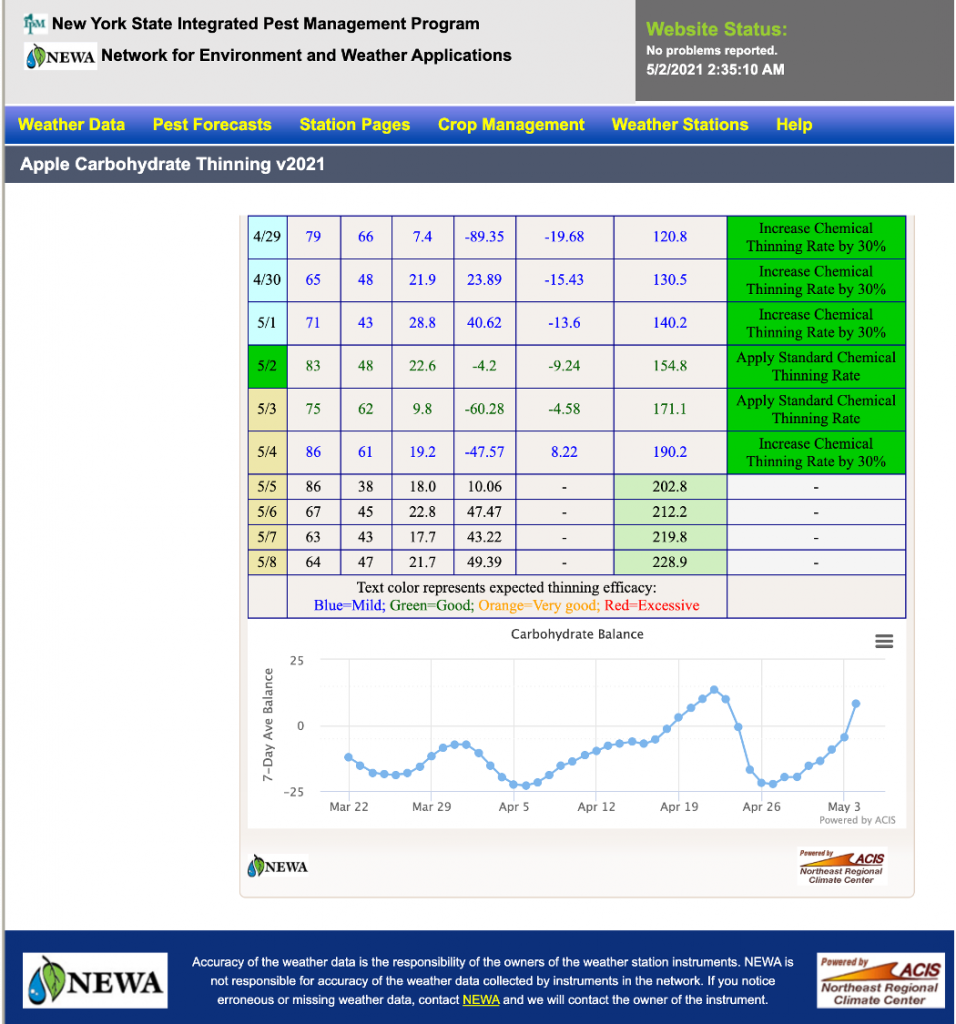
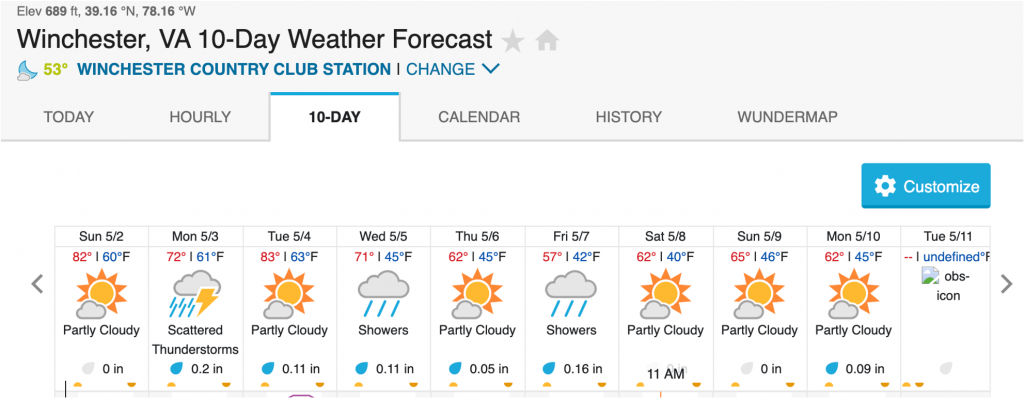
Looking at the carbohydrate thinning model and weather forecast for this week (May 2- May 9), you can realize that we, at Winchester/Fredrick county area, have only a couple of days that could be suitable for our primary fruit thinning applications. As shown in the carbohydrate model below, we are approaching the recommended degree days of 200-250 DD by this Wednesday (May 5), which would be perfect for applying our regular thinning treatments if it’s not raining that day. However, it will be apparently cold and/or rainy for the rest of the week, leaving us with only two days with temperatures above 80 oF (Sunday, May 2 and Tuesday, May 4), which is good for the activity of our main thinning materials, 6-BA and NAA. These thinners don’t work well when temperatures are below 70F. Therefore, I would recommend targeting these two days (May 2 and 4) for thinning applications. Although our current DD is slightly under the recommended range, our fruit sizes lie within the perfect range (7-13 mm) for thinning applications. In our last zoom meeting this past Wednesday, we discussed the materials and rates you can use for thinning Gala, Fuji, Honeycrisp and several other cultivars. You can access this information by following this link: https://treefruithorticulturevaes.wp.prod.es.cloud.vt.edu/2021/04/20/apple-fruit-thinning-scenarios-2021/
As you can see in the model page below, the last column refers to the recommended application rate based on the 7-day carbon balance. The model suggests a standard rate of thinning material for Sunday applications and 30% increase in thinning rates for Tuesday. In other words, if your standard rate for MaxCel is (64 fl oz + 2 pt of carbaryl/acre); you need to add (83 fl oz of MaxCel + 2.6 pt of carbaryl/acre) on Tuesday. This 30% increase doesn’t apply to the surfactants you apply with the thinning mix. Please also note that some forms of 6-BA (such as Exilis 9.5) have 5X active ingredient and therefore the amounts used in the example above will be different. Similarly, for NAA there are two forms of Refine (Refine 3.5 and Refine 6.25) that contain different concentrations of ai. Please read the product label before applying any of these chemicals. Finally, feel free to approach me via the email and telephone number mentioned below.