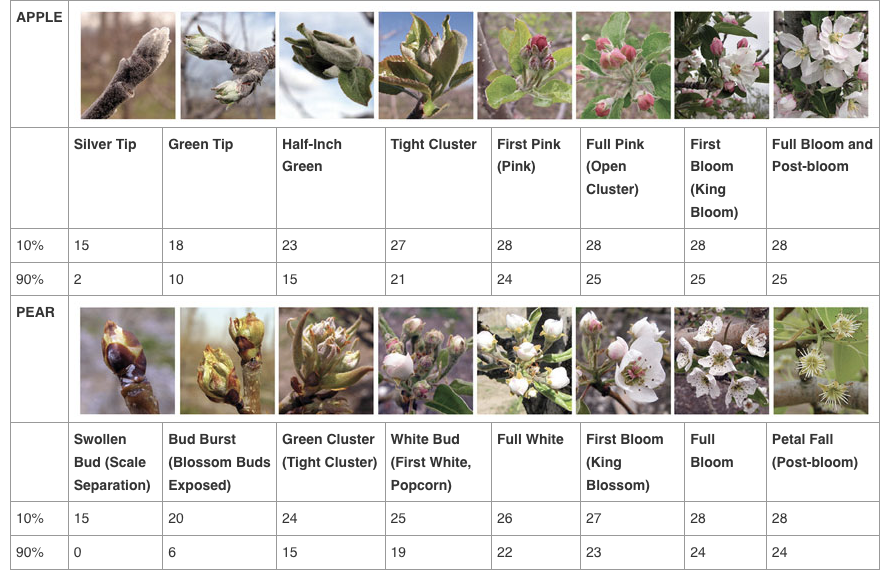
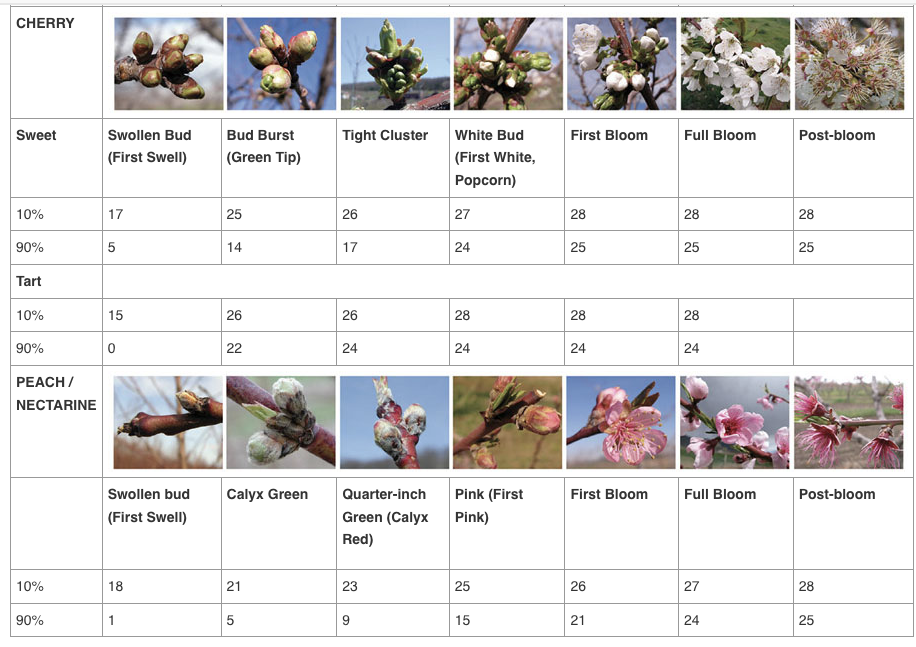
Based on the weather forecast for Tuesday, March 29, temperatures will drop to 19 oF for a couple of hours (6:00 – 8:00 am) in the Frederick County and Rappahannock-Madison area, which could be devastating for the majority of apple cultivars and some early-bloom peach cultivars grown in these locations. Our apple cultivars in Winchester are currently in the tight-cluster stage, and some (e.g. Pink Lady and Zestar) are in the full pink-stage now. The majority of peach cultivars are in the pink stage now, with some early-blooming cultivars (e.g. John Boy) are already in bloom. Sweet cherries, on the other hand, are still in tight-cluster stage. Based on the critical temperature tables below, 90% of apple buds at tight-cluster can be killed if exposed to temperatures at 21oF and below for more than 30 min. Similarly, peach flowers at full bloom can be killed at the temperatures forecasted for Tuesday. Sweet cherry cultivars that are still in tight cluster will be likely OK, and only 10% can be damaged by this freeze event.
This is a typical advective freeze, accompanied by wind > 5 mph and dry air. Unfortunately, none of our frost mitigation measures, e.g., wind machines, overhead and under-tree sprinklers, can be of utility with this type of frost. Using any sprinklers, or spraying the tree with water using an air-blast or any other sprayer, will cause more damage than benefit. Heaters, on the other hand, can provide some protection if used for several hours, probably starting from midnight.
Tree fruit growers in the Nelson County may also face a brief, less damaging frost event, with the lowest temperature predicted to reach 24 oF before sunrise. Based on the current forecast, no frost/freeze is predicted for Roanoke and Carroll-Patrick counties.