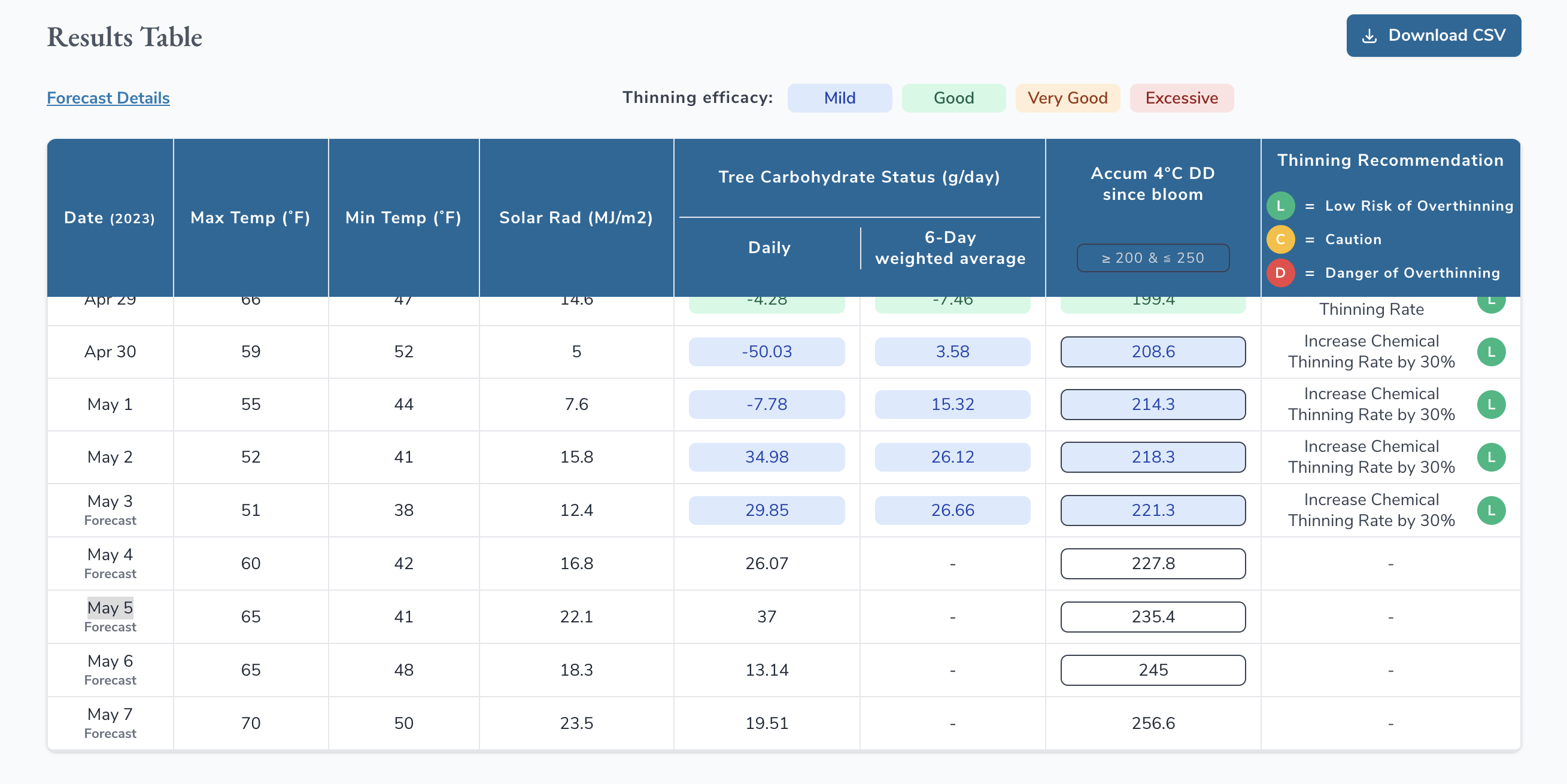
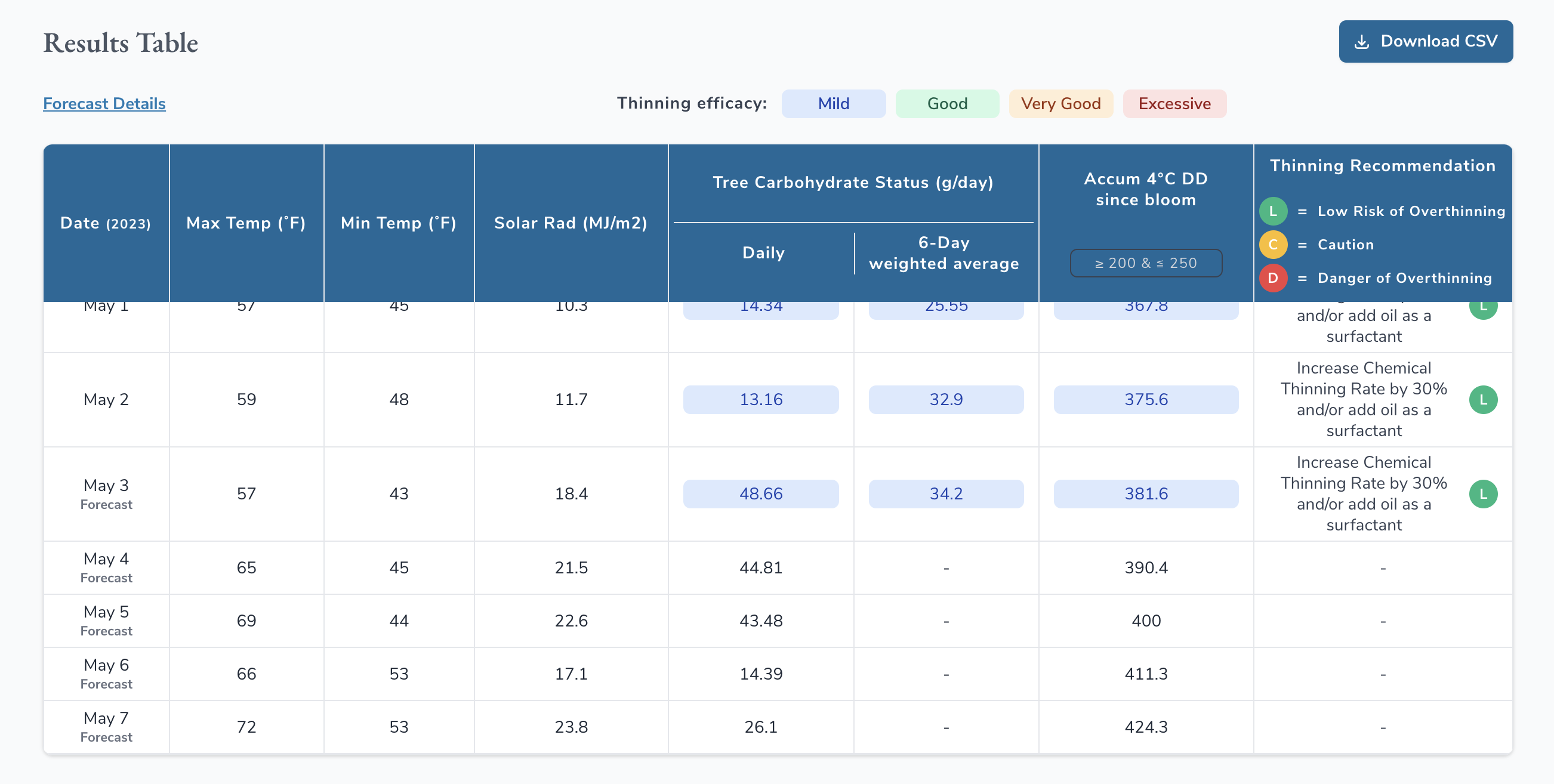
If you haven’t applied any thinning treatments yet and are planning to start this week, I’ve run the carbohydrate thinning model for both Winchester and Central Virginia to guide your decisions.
For Winchester/Frederick County: Last week offered ideal thinning conditions—fruit size ranged from 6–15 mm, the carbohydrate model indicated a deficit (favorable for thinning), and the temperatures were warm enough for effective 6-BA and NAA activity. If you applied thinning sprays last week, you’re in great shape—no further action is needed this week or until at least next Monday. Keep in mind that it usually takes 10–14 days under current weather conditions to evaluate thinning response. If you didn’t thin last week and want to start now, here are your options:
Before applying anything, I recommend closely inspecting your trees and gently shaking some branches to check for natural fruit drop. If you still believe thinning is needed, don’t delay—waiting until next week may be too late.
Cornell Apple Carbohydrate Thinning Model for Winchester, VA. Green tip date is March 16, and full-bloom date is April 12.
For Central Virginia: The same guidance applies. If you applied thinning sprays last week, no action is needed this week. If not, refer to the thinning recommendation table below for this week’s guidance.
Cornell Apple Carbohydrate Thinning Model for Roseland, VA. Green tip date is March 14, and full-bloom date is April 10.
As you know, despite the freeze damage we experienced on April 9, several apple cultivars across multiple locations are still carrying at least a few times more fruit than desired. Chemical fruit thinning remains our best option before it’s too late and we are left with the laborious task of hand thinning. The best timing for applying 6-BA and NAA for fruit thinning is during the 6–18 mm fruit size window, and we are currently within that window for ‘Gala’ and most other apple cultivars in the Winchester/Frederick County area. To help guide thinning applications and ensure trees are responsive to treatments, I ran the Cornell Apple Carbohydrate Thinning Model (https://newa.cornell.edu/apple-carbohydrate-thinning). Based on key parameters, the model helps determine both the timing and rate of thinning applications. Using data from the weather station located at our research center in Winchester, and with a green tip date of March 16 and a full bloom date of April 12 for ‘Gala’, the model predicts that starting tomorrow—Tuesday, April 29—and continuing through the end of the week, conditions will be ideal for thinning treatments. The trees’ accumulated carbohydrate balance is generally negative, which is exactly what we want for effective thinning, and temperatures—especially on Wednesday and Friday—will be perfect for the performance of 6-BA and NAA. The model also recommends using the standard rate for thinning materials.
Cornell Apple Carbohydrate Thinning Model for Winchester, VA. Green tip date is March 16, and full-bloom date is April 12.
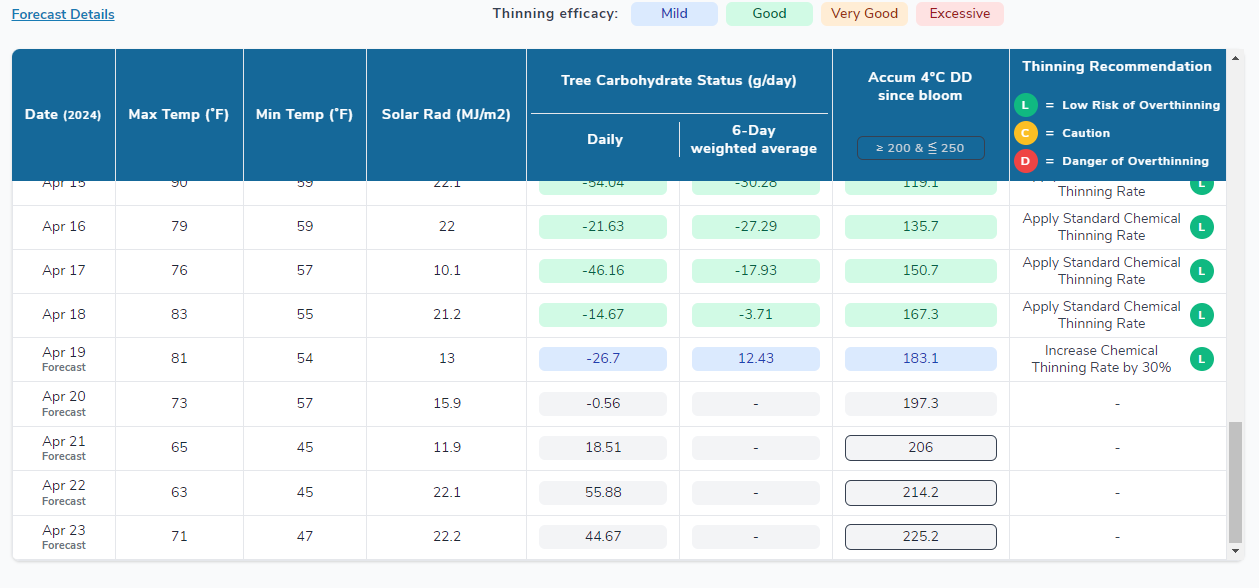
For growers in Central Virginia, I also ran the model using the Roseland, VA weather station, with ‘Gala’ green tip and full bloom dates set as March 14 and April 10, respectively. As shown below, if you haven’t already applied your thinning sprays, we are still within the optimal thinning window. The model suggests that if you apply tomorrow (April 29), you should increase the thinning rate by 30%. However, based on the daily carbohydrate balance, I believe that applications made this Wednesday and Thursday will likely require only the standard rate.
Cornell Apple Carbohydrate Thinning Model for Roseland, VA. Green tip date is March 14, and full-bloom date is April 10.
The Apple Carbohydrate Thinning Model uses key environmental variables—primarily temperature and solar radiation—to estimate the carbohydrate status of apple trees. This status helps predict how responsive trees will be to chemical thinning agents. When trees are carbohydrate-deficient, they are more likely to shed fruit, making them more responsive to thinning. Conversely, when conditions are favorable for photosynthesis—sunny and warm—trees tend to retain their fruit and respond less to thinning applications.
Importantly, the model does not rely on a single day’s data. Instead, it calculates a six-day weighted average of carbohydrate balance to determine whether the tree is in a state of surplus or deficit. This running average guides decisions on whether thinning materials should be applied, what kind of response to expect, and how much product to use to avoid over- or under-thinning. You can refer to Column 6 in the table below to view the six-day average.
In addition, the model tracks accumulated degree days (DD) from full bloom, which is why recording the exact date of full bloom is essential. The optimal thinning window usually occurs between 200 and 250 DD—coinciding closely with the 6–18 mm fruit size window. See Column 7 in the table below for the current degree-day accumulation.
Based on weather data from the Roseland, VA station and the growth stage of ‘Gala’ apples, the model projects that trees will reach approximately 200 DD by Saturday, April 26. This signals the start of the ideal thinning window, which will extend through the 250 DD threshold. With forecasted temperatures staying above 75°F from Saturday through Wednesday, conditions are favorable for effective uptake of thinning agents such as NAA and 6-BA.
However, the model also indicates a carbohydrate surplus from April 26 through at least the next three days. As a result, it recommends increasing the thinning material rate by 30% above standard. You can find these suggested rates in the last column of the table below. Under surplus conditions, the risk of over-thinning or excessive natural fruit drop is reduced. Still, conditions may shift by Tuesday or Wednesday, so rate adjustments might be necessary.
I’ll re-run the model early next week and share updated guidance. In the meantime, you can run the model yourself at: https://newa.cornell.edu/apple-carbohydrate-thinning This will allow you to select the closest weather station and enter your specific green tip and full bloom dates for a more localized prediction.
Bottom line: The thinning window begins this Saturday and will continue through the coming week. Plan your applications accordingly.
Apple Carbohydrate Thinning Model-Weather Station (Roseland, VA), Gala- Green tip (March 14), Full Bloom (April 10)
In the Winchester/Frederick County area, it appears that apple trees may be overly responsive to thinning treatments applied this week (May 6-10). Therefore, I generally advise against implementing any thinning treatments during this period, especially if you have already done so at petal fall (April 25-26) or the previous week (April 29-May 3). Examining the carbohydrate balance chart below, it’s evident that trees have been consistently deficient since April 24. While this deficiency is typically conducive to chemical thinning treatments, it also poses a risk of natural fruit abscission. Given the forecasted temperatures exceeding 80°F with mostly cloudy days this week, I anticipate further carbohydrate deficiency. If you administered the first thinning treatment on April 25-27, you should observe its effects this week (May 7-8). However, if your initial treatment was conducted last week (April 29-May 2), simply wait until May 12-13. By then, you should notice some fruits dropping off easily upon touch, with a noticeable difference in size between retained and dropping fruits.
Apple Carbohydrate Thinning Model-Weather Station (Winchester, VA), Gala- Green tip (March 7), Full Bloom (April 14)
The situation in Central Virginia presents less risk, with more days of carbohydrate surplus following full bloom. Nevertheless, there has been a significant decline in carbohydrate balance this past week, likely to persist due to high temperatures and reduced solar radiation on certain days this week. Hence, I also advise against thinning treatments this week, recommending waiting until May 10th to ascertain if carbohydrate levels stabilize. Growers who have already applied two thinning treatments (at petal fall and last week) likely have completed thinning for the season, achieving an optimal crop load. For those who applied their first treatment on April 28-30, trees are likely to respond favorably to thinning materials, with a noticeable size separation expected this week (May 8-10).
Apple Carbohydrate Thinning Model-Weather Station (Roseland, VA), Gala- Green tip (March 12), Full Bloom (April 12)
With the high daily temperatures we’re experiencing this week, the degree days for Gala and most other apple cultivars in the Winchester/Frederick County area will likely reach the 200DD mark today. This signals the optimal timing for chemical fruit thinning using 6-BA-carbaryl and NAA-carbaryl mixes. I utilized the carbohydrate thinning model on NEWA (https://newa.cornell.edu/apple-carbohydrate-thinning), based on a green tip date of March 7 and full bloom date of April 14 for Gala in my location. The model indicates a severe carbohydrate deficiency, which is very conducive to thinning conditions. It also recommends reducing the chemical thinning materials by 15% compared to standard rates. Please refer to my previous posts ((https://treefruithorticulturevaes.wp.prod.es.cloud.vt.edu/2024/04/18/apple-fruit-thinning-general-notes-and-specific-recommendations-for-central-virginia/) for the standard rates I’ve recommended and adjust your calculations accordingly. You have a four-day window (April 30 to May 3) to complete your thinning applications. The temperatures over the next few days are expected to be above 80 degrees Fahrenheit, which is ideal for both the uptake and activity of 6-BA and NAA products.
Apple Carbohydrate Thinning Model-Weather Station (Winchester, VA), Gala- Green tip (March 07), Full Bloom (April 14
I believe this is the ideal time to schedule your thinning applications for Gala and other cultivars with a green tip date around March 12 and a full bloom date of April 12. In some areas, Honeycrisp and Fuji reached full bloom a week after Gala. Therefore, make sure to check the Carbohydrate Thinning Model on the NEWA website (https://newa.cornell.edu/apple-carbohydrate-thinning) and input the exact dates for your cultivars. Using the weather station data from Roseland and Gala’s phenology data, I ran the model and here are the outputs: three positive indicators for good thinning conditions. First, the accumulated degree days are expected to reach the optimal range of 200-250 DD by this Sunday, April 28. Second, the 6-D weighted average of tree carbohydrate balance is showing a promising decline as we approach April 28. Third, the current weather forecast predicts next week’s temperatures will exceed 80°F, which is ideal for the effectiveness of 6-BA and NAA treatments, with partially cloudy days contributing to the carbohydrate deficiency needed for effective thinning. If this is your first thinning treatment for Gala this year, aim for Sunday, April 28 through Tuesday, April 30. However, if you have already applied a thinning treatment at petal fall, delay your next treatment until the end of next week, around May 2 and May 3, to observe the effects of the initial application.
Apple Carbohydrate Thinning Model-Weather Station (Roseland, VA), Gala- Green tip (March 12), Full Bloom (April 12)
In the scenic Winchester/Frederick County area, apple growers are witnessing varied stages of growth across different apple cultivars. Currently, cultivars such as Fuji and Honeycrisp are at the partial petal fall stage, while Gala and Red Delicious have reached complete petal fall. Most notably, the Pink Lady cultivar has reached the critical >6 mm diameter stage, making it the ideal time for fruit thinning.
It’s important to time the application of chemical thinning agents, such as 6-BA and NAA, accurately. According to the Apple Carbohydrate Thinning Model on Cornell’s NEWA website (https://newa.cornell.edu/apple-carbohydrate-thinning), the current predictions for accumulated degree days (DD) for Pink Lady apples in Winchester suggest reaching the 200-250 DD window by Thursday, April 25, and continuing through most of the next week. While the model indicates a daily carbohydrate surplus, which isn’t ideal for thinning, a forecasted drop in carbohydrate levels by April 27 should be closely monitored. This dip, though minor, will likely influence the 6-D weighted average, which is a crucial metric for thinning effectiveness.
If you’re targeting a thinning application for cultivars like Pink Lady, which had a green tip date of March 2nd and a full bloom date of April 8, post-April 25th is advisable for starting treatments. The weather forecast suggests that April 28, April 29, and May 1 will offer optimal conditions—both temperature-wise and in terms of carbohydrate levels—for the effectiveness of 6-BA and NAA treatments.
Apple Carbohydrate Thinning Model-Weather Station (Winchester, VA), Pink Lady- Green tip (March 2), Full Bloom (April 8)
Turning our attention to the Gala cultivar, it hasn’t yet reached the 200-250DD window. However, for those keen on applying a thinning treatment at petal fall, the upcoming Sunday or Monday is recommended. Following this initial treatment, it’s advisable to wait at least 10 days before the subsequent application, ideally timed for when the cultivar enters the 200-250DD window.
Apple Carbohydrate Thinning Model-Weather Station (Winchester, VA), Gala- Green tip (March 7), Full Bloom (April 14)
In various parts of Virginia, apple orchards are currently transitioning through stages ranging from full bloom and petal fall to having fruits about 6-18 mm in size. Given this period of active growth, it’s an ideal time to discuss the crucial practice of apple fruit thinning—especially vital this year due to the heavy bloom and minimal spring frost damage. Proper thinning is essential; without it, the excess blossoms and small fruitlets from this year could negatively impact both next year’s yield and the quality of this year’s harvest. The development of next year’s flowering buds in apples is largely determined during the first four to five weeks post-full bloom. In years with heavy bloom and fruit set, like this one, failing to adequately thin can lead to too many fruits drawing on the tree’s carbohydrates. This overburden can drastically reduce the number of viable buds for the following year, potentially resulting in no crop for varieties prone to alternate bearing, such as Honeycrisp, Fuji, and Winesap.
Moreover, maintaining too many fruits on the tree can also degrade fruit size and overall quality at harvest—particularly for the Gala variety. It’s important to note that fruit size at harvest is primarily influenced by the rate of cell division and the total number of cells per fruit, rather than merely by cell expansion. This cell division occurs mainly in the initial weeks following full bloom, making it critical to reduce competition among the fruitlets so that more resources are directed to fewer fruits, thus enhancing their growth and quality.
With these points in mind, I’d like to offer some specific recommendations for thinning applications at petal fall and the 6-18 mm fruit size window (the main thinning window). At the end of this post, I will also share outputs from the Carbohydrate Thinning Model and my personal advice for apple growers in Central Virginia and other regions currently within the 6-18 mm fruit size stage. For those in the Winchester and Frederick County areas, where orchards are still transitioning between full bloom and petal fall, other posts will follow as needed.
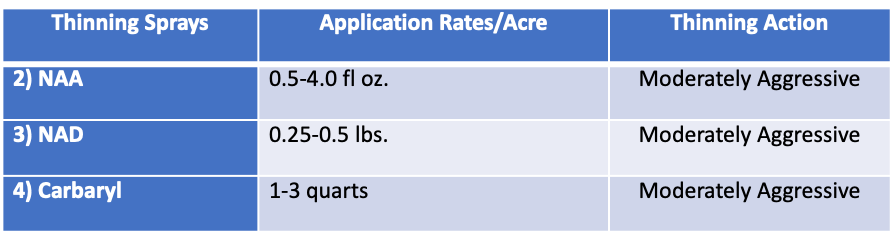
Effective thinning sprays at petal fall to 5 mm fruit diameter.
Notes: • To prevent the formation of pygmy fruit, avoid applying NAD and NAA to Red Delicious and Fuji apples after petal fall. • When using NAD as a thinning spray, ensure that the spray volume is at least 100 gallons per acre, as lower spray volumes may decrease efficacy. • Carbaryl can be used alone as a thinning spray between petal fall and when the fruit diameter reaches 15 mm. However, it is more commonly used in combination with either NAA or 6-BA when the fruit diameter is between 7 and 15 mm. • When using carbaryl alone, increasing the rate of application will not enhance thinning activity, as carbaryl’s effectiveness is not highly responsive to changes in application rate.
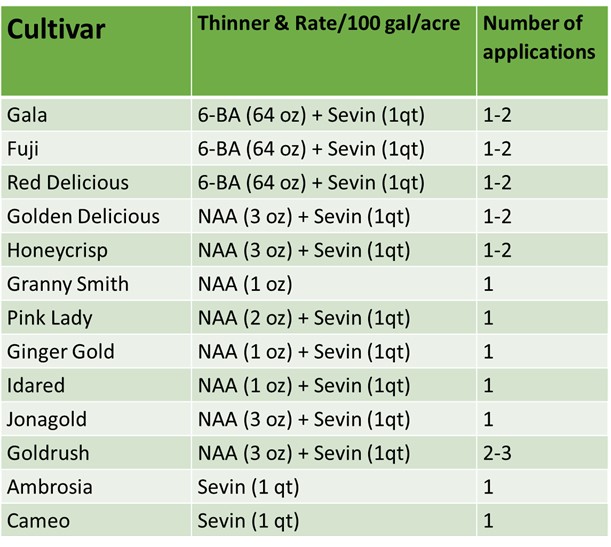
Recommended chemical materials and rates for thinning fruits (6-15 mm)
Notes: • Exilis 9.5 SC contains a high concentration of 6-BA (9.51%) compared to Maxcel (1.9%) and Exilis Plus (2%). Refine is available in two concentrations: Refine 3.5 and Refine 6.25, with the latter having a higher concentration of NAA. All dosages in the table are based on the concentrations found in Maxcel (6-BA) and PoMaxa (NAA). • The recommended application rates in the table are for mature trees (6 years or older). For younger trees (4th and 5th leaf), reduce the rate by 25% to 50%. • Do not use less than 100 gallons per acre for thinning treatments. • Thinning is more difficult in the upper parts of the canopy compared to the lower parts. • Thinning is easier when the crop is heavy, as opposed to when the crop is light. • Use the carbohydrate thinning model to time your thinning applications. Alternatively, as a general rule of thumb: Thinning is more challenging when it is sunny; overcast conditions for 2 to 3 days facilitate easier thinning; thinning materials are less effective in cool weather (below 65°F) and more effective in warm weather (above 70°F).
Apple Carbohydrate Thinning Model Outputs-Pink Lady- Roseland-VA
The Carbohydrate Thinning Model uses critical environmental factors such as temperature and solar radiation to assess the carbohydrate status of trees. This status helps determine how trees will respond to chemical thinning agents. When trees are in a carbohydrate-deficient state, they are more likely to shed fruit, making them more receptive to thinning applications. Conversely, when conditions are favorable for photosynthesis—sunny and warm—trees are less likely to respond to thinning as they prefer to retain their fruits. Remember, fruits carry seeds, and seeds represent the future generation of trees—an easy concept to grasp. The model doesn’t rely on a single day’s data; instead, it averages the carbohydrate balance over six days to decide if a tree has a deficiency or surplus. This helps determine whether to apply treatments, how much response to expect from the trees, and whether to adjust the quantity of thinning materials to avoid over- or under-thinning. The model also tracks accumulated degree hours from the time of bloom, which is why knowing the exact day of full bloom is crucial. It predicts the optimal thinning period, which usually occurs between 200 to 250 degree days (DD)—coinciding nearly perfectly with the 6-18 mm fruit size window.
Based on data from the weather station in Roseland, VA, and the growth stages of Pink Lady and Gala apples, the model predicts that by Saturday, April 20, Pink Lady trees will reach about 200DD. This is the ideal time to start applying thinning materials, continuing through the 250 DD mark. However, the model also indicates a carbohydrate surplus on April 19 and the following three days. Therefore, it recommends increasing the thinning material rate by 30% above standard. Since the forecast predicts temperatures above 70°F this Saturday, which enhances the uptake and efficiency of agents like NAA and 6-BA, thinning applications are best done on that day.
Apple Carbohydrate Thinning Model-Weather Station (Roseland, VA), Pink Lady- Green tip (March 4), Full Bloom (April 6)
For Gala apples, which reached green tip on March 12 and full bloom on April 12, the 200-250DD window has not yet been reached. Nonetheless, if you wish to apply chemical thinning now using 6-BA and carbaryl to promote cell division, you can use 48 fl oz of 6-BA and 1 pt/100 gal of carbaryl. However, it’s important to wait at least 10 days to observe the effects of this treatment before proceeding with another. Based on the current weather forecast and degree days, the 6-18 mm fruit size window should still be open in 10 days if you decide on a second thinning application.
Apple Carbohydrate Thinning Model-Weather Station (Roseland, VA), Gala- Green tip (March 12), Full Bloom (April 12)
As we enter the optimal window for thinning treatments in the Winchester/Frederick County area, it’s important to consider the best options for your apple trees. In a follow-up to our previous post, we have some important updates for those who chose option A or B.
If you went with option A, and applied your thinning treatments last week (April 25-27) because you had larger fruit, you won’t need to do any further treatment for at least two weeks after this treatment. Wait until you can see signs of fruit abscission and/or fruits showing distinct segregation in size before deciding if another thinning treatment is necessary. For those who went with option B due to the low temperatures, this Friday and over the weekend may provide better thinning conditions. Temperatures are expected to rise above 65F on Friday and reach 72F on Sunday, with even higher temperatures on Monday. If your average fruit size is 15mm or above, start thinning on Friday and Saturday. If your fruits are less than 15mm, wait until Monday when temperatures are expected to reach around 78F and remain warm and cloudy for the rest of the week. Trees are currently in a carbohydrate surplus state, which could sustain until Friday, so you may need to pump up the rate to 30% more than the standard rate. Check the model the day before the application to see the recommended rate in the last column.
Green tip (Mar 7), full bloom (April 12), weather stations (Winchester, VT AHS AREC), percent flowering spurs (51-75%). The carbohydrate thinning model can be accessed at: https://newa.cornell.edu/apple-carbohydrate-thinning
For apple growers in Central Virginia, the same advice applies, except that you can start thinning treatments on Thursday if the forecasted temperature stays at 65F or higher. If your current fruit size is less than 15mm, consider Monday (5/8) as the main thinning day. Use the model to determine whether to apply the standard rate or increase it. If the model suggests adding oil to the tank to increase efficiency, it’s worth considering, especially if your fruits have exceeded 15mm and this is your final chance to get the top part of the canopy in shape. However, keep in mind that Captan should not be used 4-5 days before and after applications containing oil, as this can cause significant damage to fruit quality. In summary, timing and temperature are critical when it comes to thinning treatments for apple trees. Follow these guidelines to ensure optimal results for your fruit harvest.
Green tip (Mar 6), full bloom (Mar 29), weather stations (Crozet, Chiles peach orchard), percent flowering spurs (51-75%). The carbohydrate thinning model can be accessed at: https://newa.cornell.edu/apple-carbohydrate-thinning
When it comes to thinning apple trees, it’s important to consider the optimal thinning conditions that increase return bloom, especially for cultivars with a tendency for biennial bearing, such as Honeycrisp, Golden Delicious, and Fuji. If you’re looking to improve return bloom for Honeycrisp and Golden Delicious, we have a recipe that has been endorsed by many and is based on our own research over the past few years.
First, use NAA applications for fruit thinning at a fruit size of 6-15 mm, or within 30 days of full bloom. The recommended mixture is NAA @ 3 oz + Sevin @ 1 qt + Regulaid @ 1pt/100 gal/acre. In addition to NAA applications for thinning, NAA applications (@ 2-4 oz/100 gal without carbaryl or oil) should start at a fruit size of 30-35 mm and repeated 2 times at 7-10 day intervals. The rates of NAA are based on Refine 3.5 and PoMaxa. Make rate adjustments if using Refine 6.25.
For improving return bloom in Fuji and Red Delicious, we recommend using ethephon. Don’t use NAA with Fuji and Red Delicious. Apply 1-4 applications of ethephon at 0.5 pt/100 gal (without carbaryl or oil) starting at a fruit size of 30-35 mm in diameter and repeated at 7-10 day intervals. A surfactant is not necessary if ethephon is applied with cover sprays. Ethephon at this low concentration and stage of fruit development will not cause any thinning, but it should improve return bloom.
Despite the frost damage we witnessed on March 20 statewide and in some locations on April 8-9, you might be astonished by the quantity of fruits that still need chemical or hand thinning to attain the targeted size and quality. That being said, it is crucial to assess the extent of frost damage in your various blocks and varieties before deciding whether thinning treatments are necessary this season. To learn about the materials used for apple fruit thinning and the stages at which these chemicals are applied, please refer to my previous blog article. The present blog post aims to share the results of the apple carbohydrate thinning model and provide recommendations on timing, rates, and other considerations for orchards in Central Virginia and the Winchester/Frederick County area.
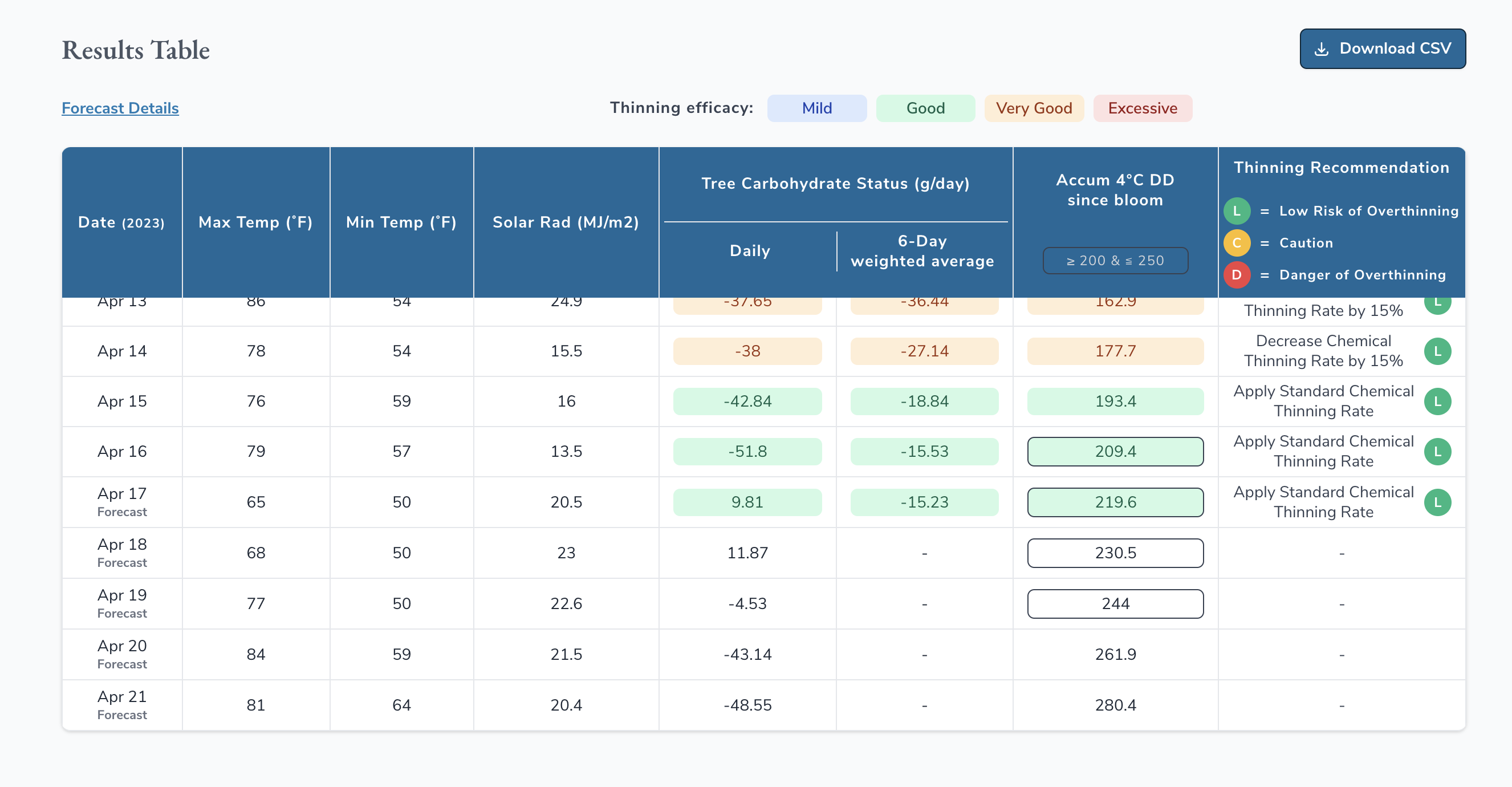
For Central Virginia, I ran the model today (April 16 at 12:00 pm) using the green tip and full bloom dates for Gala as March 6 and March 29, respectively. You should take into account your own dates and varieties when running the model. However, I believe these two dates are suitable for most apple varieties and orchards in Central Virginia. According to this data, we have already reached an accumulated growing degree day (base temperature = 4C) of 209, which falls within the optimal range (200-250) for thinning applications. This range often coincides with a fruit size of 6-15 mm, traditionally considered the most favorable period for fruit thinning. In terms of carbohydrate status, the daily carbohydrate level is predicted to experience a surplus for the next two days (April 17-18), but the 6-day weighted average will reach -15 g/day tomorrow. Trees generally respond more effectively to thinning materials when the 6-day weighted average values range from -10 to -40 g/day. Furthermore, the current forecast indicates temperatures between 65 to 85F this week (Monday to Friday), which is ideal for NAA and 6-BA uptake and effectiveness.
Considering all these factors, I strongly recommend applying your main fruit thinning application within the next four days. If you can complete all thinning applications within two days, opt for Wednesday and Thursday, as temperatures are expected to be around 80F. For tomorrow’s treatment, a standard rate of thinning materials is advised. For example, if you typically apply 64 fl oz of 6-BA (e.g., Maxcel or Exilis plus), 1 qt of Sevin or Carbaryl, and 1 pt of Regulaid per 100 gal/acre as the standard rate, use the same rate tomorrow. For applications on Wednesday and Thursday, more carbohydrate deficiency is expected which may lead to a recommended 15% reduction in your standard rate. However, this cannot be confirmed yet, as it is based on the 6-day average (2 days before thinning and the following four days). Nevertheless, with a projected carbohydrate surplus on Monday and Tuesday and a deficit in the subsequent three days, I believe a standard rate should be used for Wed and Thu applications.
The apple carbohydrate thinning model outputs for Gala apples, incorporating data from the Crozet (Chiles Peach Orchard) weather station, a green tip date of March 6, a bloom date of March 29, and a flowering spur percentage range of 51-75%
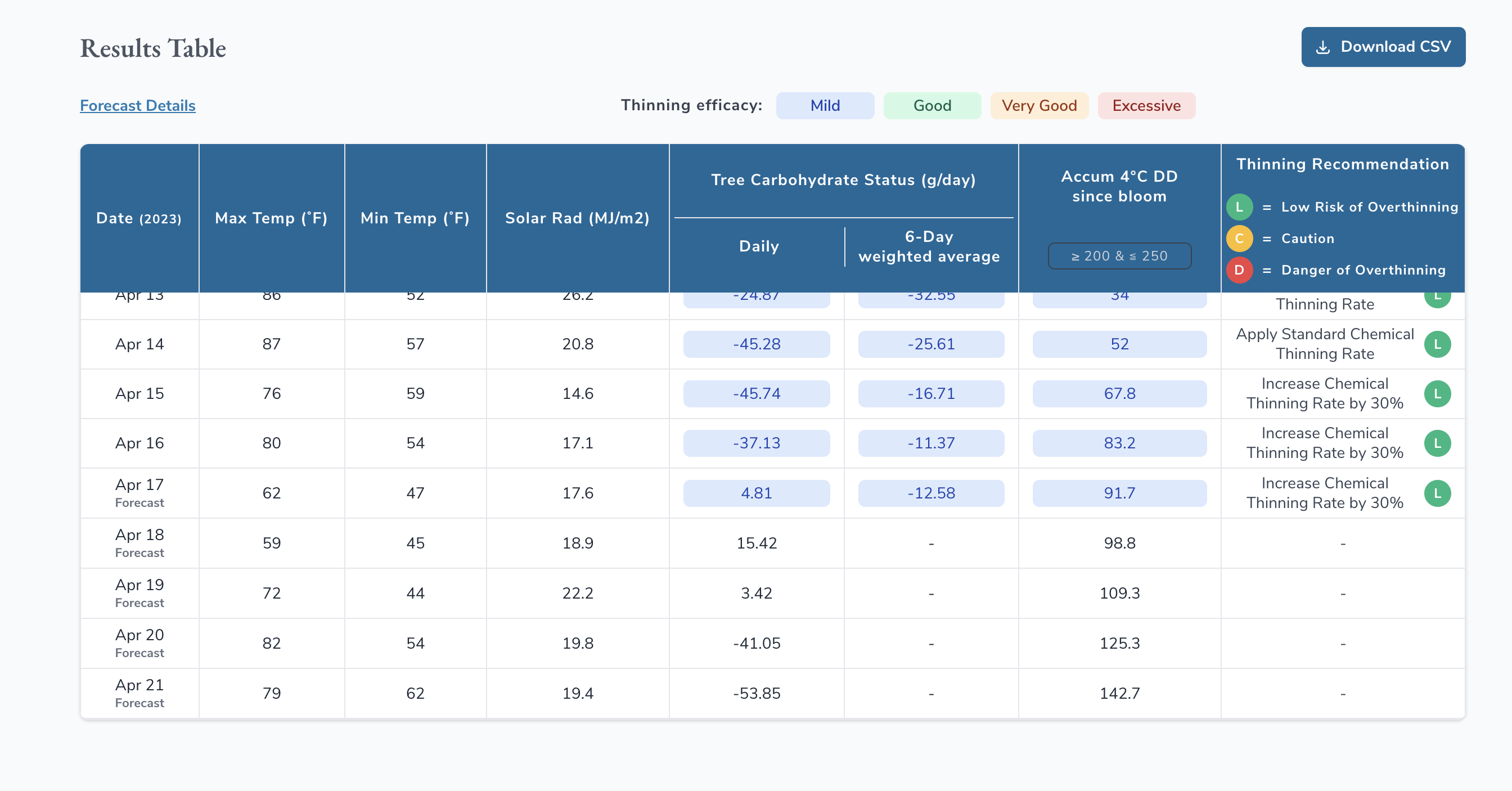
For orchards in the Winchester/Frederick County area, I ran the model for Gala with green tip and bloom dates of March 7 and April 12, respectively. As the model outputs below indicate, the optimal thinning window has not yet arrived. The accumulated DD is below the recommended 200 value, and our average fruit size is still under 5 mm. Therefore, I anticipate that our main thinning window will be around Monday-Tuesday next week (April 24-25), but I will keep you updated if conditions change.
The apple carbohydrate thinning model outputs for Gala apples, incorporating data from Winchester (VT AHS AREC) weather station, a green tip date of March 7, a bloom date of April 12, and a flowering spur percentage range of 51-75%