Category Archives: Thinning

Notice of Date Change for Central Virginia Orchard Meeting

April 29, 2014

Dear Central Virginia Fruit Producer:

Due to the quick progress of our trees this spring, our third orchard production meeting of this year HAS BEEN MOVED FORWARD TO THIS THURSDAY, May 1st. We will be meeting at 11:00 a.m. at the office of Saunders Bros. Nursery, located at 2717 Tye Brook Hwy, Piney River, VA 22964; Tel.: (434) 277-5455; http://www.saundersbrothers.com/. Bennett Saunders will be our host.

A special focus of this meeting with be crop thinning considerations provided by Extension specialist Gregory Peck. In addition, Drs. Yoder and Bergh will be on hand to discuss disease and insect pest issues, respectively. Please come to discuss fruit production issues and concerns with other fruit growers and Extension fruit specialists. You are encouraged to bring plant and insect samples for identification, but please have these contained in a plastic bag.

Please bring your own bagged lunch to this meeting. Cold drinks will be provided by the host orchard.

Orchard Events Website:

www.anr.ext.vt.edu/tree-fruit/

Remaining 2014 Central Virginia Orchard Meeting Schedule

· May 20th Fitzgerald Orchard Lowesville, VA

· June 3rd 7K Farm Rustburg, VA

Sincerely,

Michael W. Lachance

Extension Agent

If you are a person with a disability and desire any assistive devices, services or other accommodations to participate in this activity, please contact the Nelson County Extension Office at (434) 263-4035 to discuss accommodations five days prior to the date of the meeting.

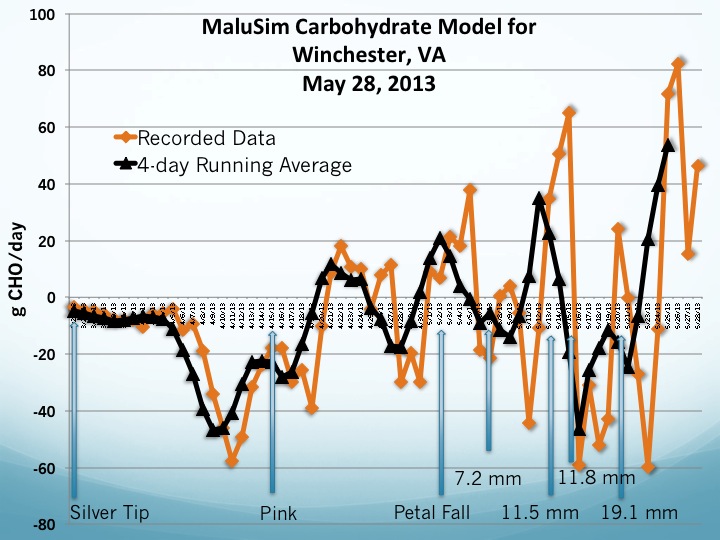
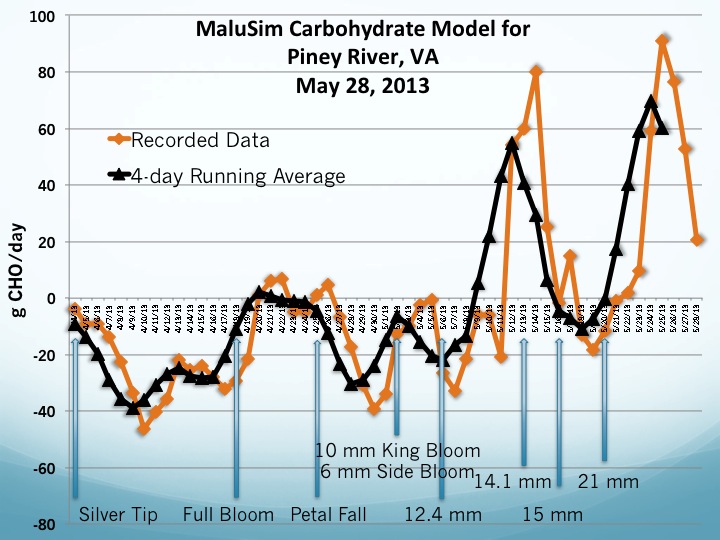
MaluSim Carbohydrate Models: 2013 Season Recap for Winchester and Central Virginia

Slide3 Slide3Attached are the final MaluSim carbohydrate models that I will run for 2013.

Please print out a copy of the below pdf file to add to your records. Later in the season, I will be asking for feedback from you about how you used the model, how well the model predicted thinner response in your orchard, and if I should continue running the model in future years. Please feel free to send me additional feedback at anytime.

Peck Central VA MaluSim 5_29_13

Peck Winchester VA MaluSim 5_28_13

Suggestions for late thinning and return bloom applications

By this time, apples in most of Virginia are 13-20 mm in fruit size. Once apples reach this size, the trees tend to be less responsive to the typical 10 mm (carbaryl plus NAA or 6-BA) applications. However, if additional thinning is needed, growers can still use ethephon (sold under the trade names Ethrel and Ethephon 2). Ethephon is most effective when fruit size is 14 to 28 mm in diameter. In most years, it is difficult to chemically thin apples larger than 24 mm.

Ethephon has variable responses due to air temperature and humidity, as well as spray water volumes. Overthinning is more likely with this material than with other thinners. For this reason, ethephon has been primarily used when earlier thinning applications were not successful, on very difficult to thin cultivars, and/or when return bloom has been a severe problem. Thinning results with ethephon varies amongst cultivars. Ethephon is not very effective on Gala, but it is very effective on Golden Delicious and Rome. Where water is alkaline, buffering the spray solution to a pH of 3 to 5 will increase chemical stability and effectiveness. Do not use before a light rain or dew or when post-application temperatures are predicted to be greater than 90˚F because excessive thinning may occur.

Ethephon is usually combined with carbaryl or oxamyl (Vydate L). For greater thinning activity, ethephon can also be tank mixed with NAA and/or spray oil.

I have several research trials underway to look at alternative and hopefully more consistent late thinning materials. However, at this time, ethephon is still the standard material when fruit size is greater than 14 mm.

Once fruit is larger than 28 mm, hand thinning will need to be used to remove additional fruit. Hand thinning will have a positive impact on final fruit size and return bloom for up to about 45 days after full bloom. In 2013, this is around the first week of June for central Virginia and the second week of June for the Winchester area.

PROMOTING RETURN BLOOM IN APPLE

Ethephon (sold under the trade names Ethrel and Ethephon 2) can promote flower bud formation when applied from petal fall to about 6 to 8 weeks after full bloom. The greatest effect is from applications made 0 to 4 weeks after bloom. However, since ethephon can cause substantial fruit thinning, multiple weekly applications at rates 1/2 that of the thinning rate are recommended starting when fruitlets are greater than 30 mm. When possible, it is best to wait until after “June” drop has occurred. At a minimum, wait 7-10 days after the last thinning application before starting ethephon return bloom sprays. Additionally, do not apply ethephon to trees that are stressed or trees that are low in vigor.

A single ethephon application can be used at a high rate (up to 900 ppm). However, more consistent results are often obtained from multiple (3-4) applications made at 10-14 day intervals using lower rates (150-300 ppm). One common, and often effective strategy, is to make two applications in June and two applications in July.

Another strategy is to make 2-4 applications of ethephon at 150 ppm tank mixed with NAA at 5-10 ppm (or 2.5-5 ppm when tank mixed with spray oil). This approach has been beneficial for strongly biennial cultivars.

Sensitivity to ethephon is very different amongst cultivars, thus it is important to choose a rate specific to each variety. Do not exceed 8 pints per acre per year. If trees are over-cropped ethephon may not effectively give adequate return bloom the following season. Higher soluble solids and lower starch levels at harvest may be expected with some cultivars, particularly with high rates and/or late season applications. No loss of firmness has been detected with ‘Red Delicious’ at the optimum harvest date.

Ethephon sprays can reduce tree growth (dependent on timing and amounts used) and thus may not be desirable for young non-bearing trees if maximum tree growth is desirable.

HAND THINNING PEACHES

Hand thinning peaches to 6-8 inches apart on the branch will result in increased final fruit size and help prevent limb breakage. This activity will be most effective when completed over the next couple-few weeks. Hand thinning peaches later in the season will not have as much of an impact on final fruit size.

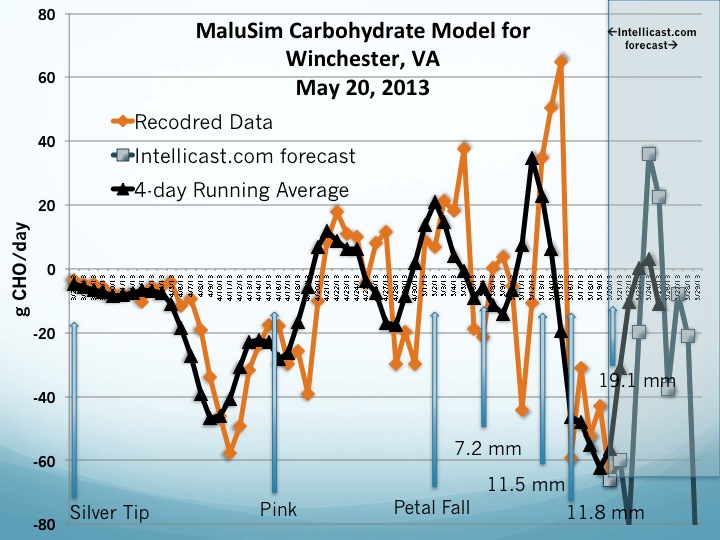
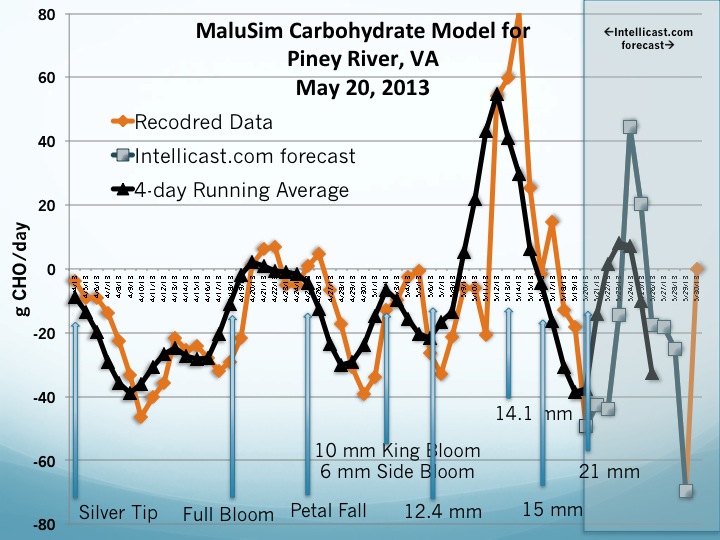
MaluSim Carbohydrate Models for May 20: Winchester and Central Virginia

On May 20, I ran the MaluSim carbohydrate model for Winchester and Central Virginia. This will be the last MaluSim posting using forecasted data for the season. Sometime in the week or two I will post a season recap using only recorded data.

Slide3Slide3In Winchester, as predicted, we have been experiencing hot and cloudy weather over the last few days. Thinning applications made from late last week through Monday will likely be fairly active, with some easy to thin cultivars (e.g. Red Delicious) potentially having significant fruit drop. However, from Tuesday through the end of the coming week, growers should expect an average response from their thinning applications.

In Central Virginia, there was a similar trend but with somewhat cooler daytime temperatures, the carbohydrate deficits were less severe. Similar to Winchester, thinning applications made over the next several days should have a fairly typical response.

Peck Winchester VA MaluSim 5_20_13

Peck Central VA MaluSim 5_20_13

Fruitlet sizes and growth rates at the Winchester AREC:

  • Empire: 19.1 mm; 1.5 mm/day
  • Fuji: 13.6 mm; 1 mm/day
  • Gala: 13.8 mm; 0.8 mm/day
  • Pink Lady: 14.1 mm; 0.9 mm/day
  • Red Delicious: 13.8; 0.9 mm/day


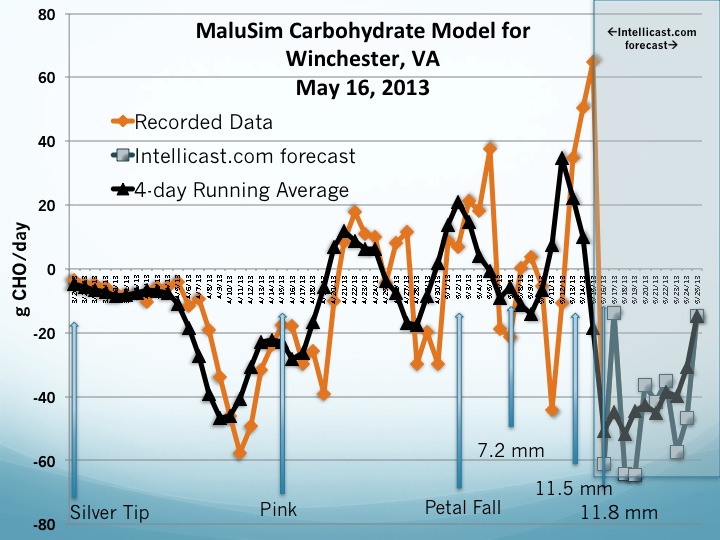
MaluSim Carbohydrate Models for May 16: Winchester and Central Virginia

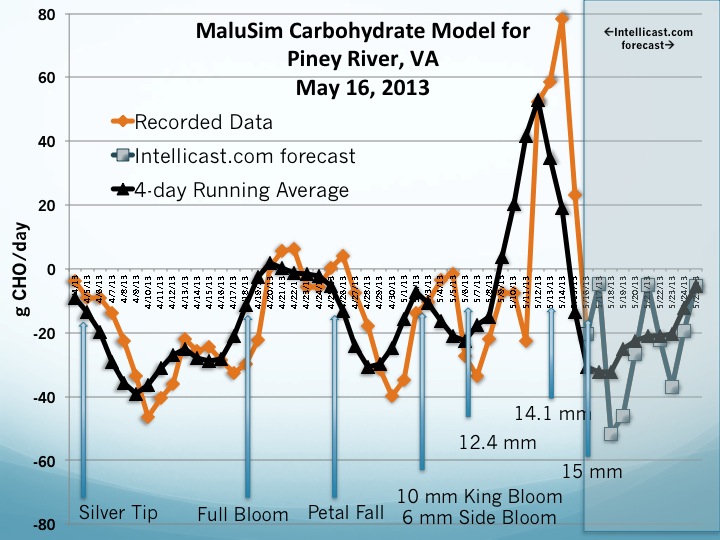
MaluSim models were run on May 16 for Winchester and Central Virginia.

Slide4Slide3

As I spoke about at the Winchester breakfast meeting on Thursday morning, the Winchester forecast is calling for warm and cloudy weather starting today and running through most of next week. From many year’s of research, we know that these are the conditions under which there is a fair amount of natural thinning and that chemical thinners can be particularly active. When the weather data is run through the MaluSim model, we see that there is a carbohydrate deficit between -40 to -60 g CHO/day predicted for the next 10 days. This means that chemical thinners that are applied over the next several days will likely be fairly active. With this in mind, growers should consider reducing rates and/or not using a surfactant. Growers with blocks that sustained freeze damage on Tuesday morning, should consider further reducing rates. As always, you should be checking your trees and making decisions based upon the conditions in your own orchard.

For Central Virginia (Piney River), the carbohydrate deficits over the next week will remain in the negative, but not be as low as the Winchester area. This means that chemical thinners applied from today through the weekend will likely be slightly aggressive when used at standard rates. Growers should be regularly checking their blocks for current conditions. By now, you should be able to see some effect of the cloudy weather that the region experienced early last week.

Here are the pdf files that contain the weather data and the MaluSim models:

Peck Central VA MaluSim 5_16_13

Peck Winchester VA MaluSim 5_16_13


MaluSim Carbohydrate Models for May 9: Winchester and Central Virginia

Slide3

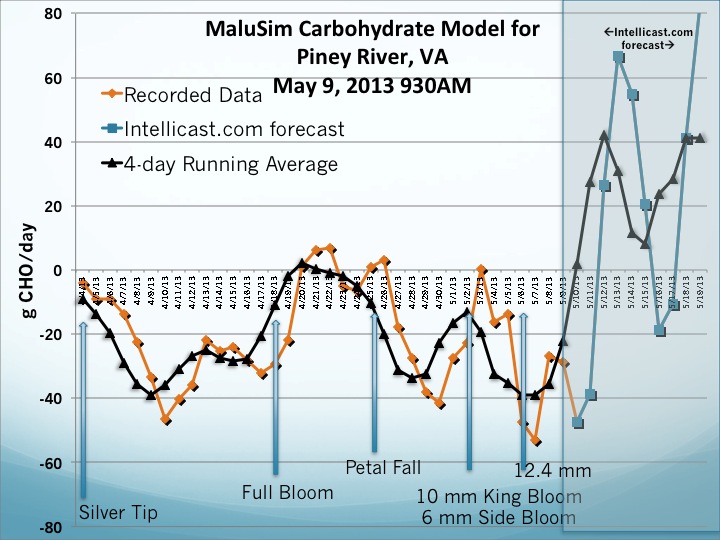
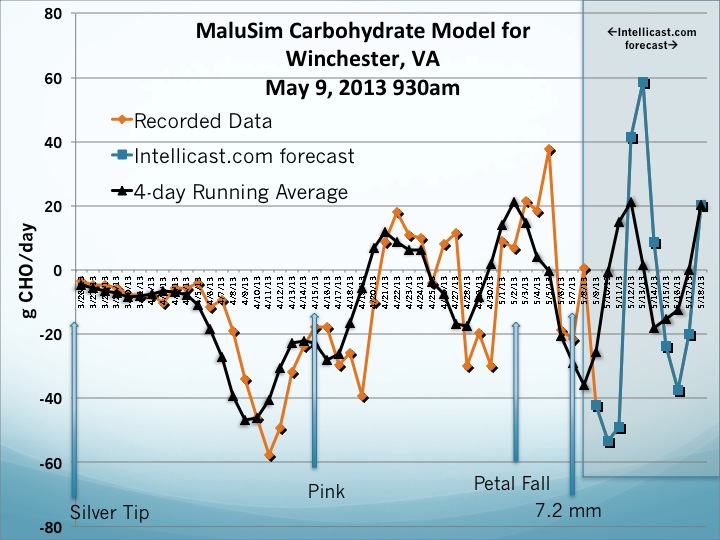
MaluSim carbohydrate models for Winchester and Central Virginia were run on Thursday morning.

Slide3

Over the next day or so, for Central Virginia, the carbohydrate balance will remain in the negative, but quickly move to the positive over the weekend. From thinning applications made Thursday (5/9) or Friday (5/10), growers should expect a fairly “normal” response. However, forecast data from Intellicast.com, suggests that sunnier, but cooler weather will move into Virginia early next week, followed by a warming trend starting on Wednesday. Based on the MaluSim model, this weather pattern will cause apple trees to have positive carbohydrate values through the early part of next week, and thus standard rates of thinners used on Saturday or Sunday will be less effective than expected. In blocks where heavier thinning is needed, growers should consider holding off on their 10 mm thinning application until Tuesday or Wednesday when warmer temperatures return. However, once fruit gets to be 15 mm or larger, NAA and 6-BA are less effective thinning agents. The other approach is to increase the rates used in thinning applications made over the weekend through Monday.

The above scenario is similar for Winchester but since fruit size is smaller (generally 6-8 mm), growers can wait for next week’s warming trend to make the 10 mm thinning applications. Additionally, with the smaller fruit size in Winchester, the cloudy weather that we’ve experienced over the last few days should cause less natural thinning than what might occur in Central Virginia.

I’ll run the model again on Monday.

Current fruitlet sizes at the Winchester AREC:

  • Empire: 8.0 mm
  • Golden Supreme: 6.3 mm
  • Fuji: 6.5 mm
  • Golden Delicious: 5.7 mm
  • Suncrisp: 6.0 mm
  • Pink Lady: 7.2 mm
  • Idared: 7.1 mm
  • York: 6.0 mm

For more information, download pdfs of the models:

Peck Central VA MaluSim 5_9_13

Peck Winchester VA MaluSim 5_9_13

MaluSim Carbohydrate Models for May 6: Winchester and Central Virginia

Slide3Slide3


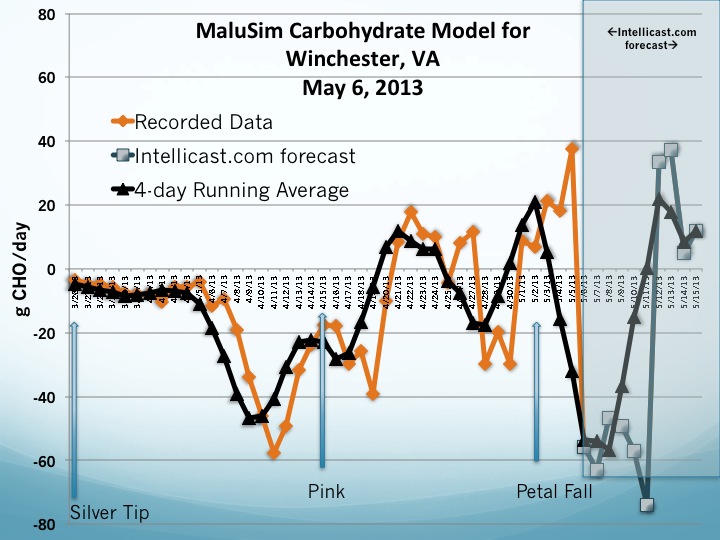
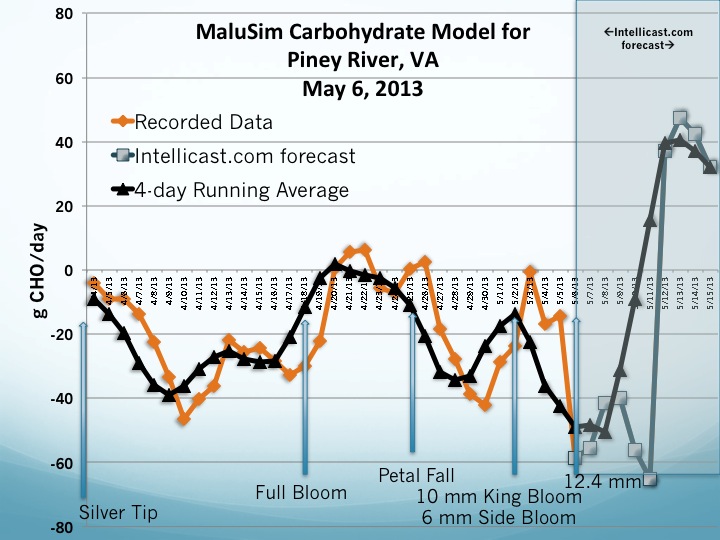
MaluSim models were run on Monday May 6 for Winchester and Central Virginia (Piney River). The outputs from both locations were fairly similar, with carbohydrate deficits predicted over the next six or so days. This is mostly due to the cloud cover from a series of storms that will pass through the region. With sunnier conditions and warmer temperatures, the model predicts a carbohydrate surplus by Saturday.

Apple trees are still at late bloom to 4 mm fruitlet size in the Winchester area, and growers will probably not need to start thinning until later in the week or early next week.

In Central Virginia, fruitlets are ranging from 8 to 15 mm. Growers should consider reducing rates over the next few days as the model is predicting an aggressive response to standard rates of chemical thinners. However, as we move towards the end of the week, growers should use full rates to ensure an effective response.

It is unclear how much “natural” thinning will occur from this prolonged stretch of cloudy weather. However, work by Dr. Byers suggests that 3 days of cloudy weather with temperatures at 70F (this was a controlled study in growth chambers) can cause 50% of the fruitlets to abscise. With the prolonged stretch of cloudy weather that we are experiencing, growers should consider being less aggressive with rates until the end of the week.

Peck Winchester VA MaluSim 5_6_13

Peck Central VA MaluSim 5_6_13

MaluSim Carbohydrate Models for May 2: Winchester and Central Virginia

MaluSim Central VA 5_2_13


MaluSim Wincheter 5_2_2013


Today, I ran the first MaluSim Carbohydrate models for 2013. This includes a simulation for Winchester, and a simulation for Central Virginia (Piney River, VA). Thanks to Bennett Saunders for sending us the data to use for Central Virginia.

The Malusim model was developed by Drs. Alan Lakso and Terence Robinson at Cornell University to estimate the carbohydrate balance in an ‘Empire’ apple tree based upon many years of detailed research and information found in the scientific literature. In recent years, the model has been used by researchers and extension specialists in New York as a tool to help assess the application timing for applying thinning materials at the 10 mm fruitlet size. Carbohydrate status, and therefore the MaluSim model, is not as important for other times when chemical thinners might be applied (i.e., bloom, petal fall, 20 mm), so it is not as clear how well the model does to predict the response of chemical thinners used at timings other than 10 mm.

For the past several years, I have been running trials at the Winchester AREC to see how well the MaluSim model performs under conditions found in Virginia. Many researchers, including myself, are still working towards understanding the best way to use the model. From what we have found, when weather forecasts are used to predict the future carbohydrate status of an apple tree, the MaluSim model can provide a warning as to when there might be a chance for severe under- or over-thinning. This is particularly true when there are three- or four-day trends with large carbohydrate surpluses or deficits predicted. For this reason, in addition to the data points for each day, I show a four-day running average (the black line on the charts). To be consistent with other researchers and extension specialists, the four-day running average is calculated from the date the data is show to three days into the future.

Please keep these caveats in mind if you are using the MaluSim model to guide your thinning application timing:

  • We’re still learning how to best use the model. At this point, it is just one more tool in the toolbox. There is no tool that is better than your own experience with chemical thinning on your own farm.
  • Future predictions of carbohydrate status are based upon weather forecasts from Intellicast.com for Winchester and Piney River. Temperature forecasts are probably pretty good for 3-5 days, but cloud cover (which is how I calculate the future solar radiation) is much less reliable. Although I show predictions out 10 days, my confidence that they are correct decreases significantly after 5 days. Nonetheless, it is useful information–just remember to keep looking for updated models so that you have the most up-to-date information. I will do my best to post a model for Central Virginia and Winchester twice a week.
  • Look at the day that you want to spray, and the 2-3 days after that. If there are periods of severe surplus or deficit, consider adjusting the rates or timing of your thinning applications.
  • The model is based upon the phenology of ‘Empire’. This is because the researchers in NY had a large body of data on Empire to use when they created the model. Of particular note, you should be aware that the model “clock” starts at silver tip for Empire. Cultivars with much earlier or later bud break may not correlate as well with the model values.
  • The models that I am running use data from the Winchester AREC, and Saunders Brothers Orchards in Piney River, VA. You need to consider whether or not those locations represent the weather in your orchard.
  • The model only accounts for temperatures and sunlight. Other weather events, such as rainfall or frosts may cause other impacts on the efficacy of your thinning materials that are not going to be represented in the model.

In the below pdf files, I provide a chart of the weather data that are used to run each model (daily maximum temperature, daily minimum temperature, and daily solar radiation), a chart of the MaluSim model with day-by-day data and a four-day running average, and a chart with the potential response a chemical thinner might have for different levels of carbohydrate balance in the tree.

So, what do today’s models show? Some very advanced blocks of early blooming apple cultivars in Central Virginia are getting close to the 10 mm thinning stage. From applications that occur today and tomorrow, you should expect “normal” to “slightly aggressive” response from your standard thinning rates, but nothing that suggests sever overthinning. However, there is a period of unsettled weather predicted for Mon-Wed of next week that could cause the carbohydrate levels to drop in the trees. It all depends on the amount of cloud cover we get over those days. Temperatures are going to remain moderate over that period, so even with the potential for some cloud cover, it doesn’t look like a severe carbohydrate deficit. Cloud cover is the hardest thing to predict, and predictions are only good for 3 days at best.

In Winchester, we are still at late bloom to petal fall, so there’s probably another week before the carbohydrate model data needs careful interpretation.

I will talk more about the model at tonight’s In-depth fruit school in Winchester.

Peck Central VA MaluSim 5_2_13

Peck Winchester VA MaluSim 5_2_13

MaluSim Carbohydrate Model for May 14

Here is the final MaluSim simulation for 2012 (pdf). Please let me know if you have any questions or feedback.

Also, we’re starting to see larger (+25 mm) fruit coming off of apple trees. Some of this fruit is abscising as a result of chemical thinning, but there also appears to be fruit that had either poor pollination (not all carpels have seeds) or had seeds that started to grow but died soon thereafter, possibly as a result of freeze damage. As you monitor your blocks for thinning responses, make sure to cut into the fruitlets and look at the seeds. Many of the fruitlets that have damaged or missing seeds are falling off the trees at the same time as those that were chemically thinned.

MaluSim Carbohydrate Model for May 10

Today’s MaluSim simulation for Winchester (pdf) confirms that the cloudy weather from the cold front that hung over the region for the past few days caused a carbohydrate deficit. The deficit was somewhat less severe than originally predicted, but resulted in similar enough data that I would not have changed the interpretation I provided on Monday. The difference in the predicted and the actual data was due to cooler daily max temps and more solar radiation than forecasted.  As I’ve mentioned previously, cloud cover forecasts are the least accurate and the most difficult to interpret.

Over the coming weekend, the model is showing a period of carbohydrate surplus, then another storm system is predicted for next week, which could cause another carbohydrate deficit.

On Monday, I will run the MaluSim model one last time for this season so that you can have a final version to reflect on as you assess the thinning in your orchards. Please provide me with feedback on how you used the model this season. Did it predict what you are seeing in your orchards? I would appreciate any comments that you think would be useful for improving the model for future years.