Having some snow on trees and ground, even if it is not that heavy like the one we had last night, is not bad at all. Having a layer of dry snow on the ground should provide good insulation for soil and roots against the expected low temperatures we will face tonight and tomorrow morning. Also, large limbs that are still loaded with snow should get some protection. Using sprinklers will worsen the situation as wet snow works as a good thermal conductor and will transfer these freezing temperatures to roots much faster than dry snow.
Sprinklers for frost protection: are they worth using?
The simple and direct answer is YES, BUT you have to consider the right time/conditions.
When you use sprinklers to reduce frost damage, you are simply using the internal (latent) energy of water molecules as a source of heat to your trees. Simply, water exists in three forms (liquid, solid (ice) and gas (vapor), and the transition among these forms can produce energy (exothermic) or consume energy (endothermic) as appears in the diagram below. So, when the air temperature is below freezing points (< 32 oF), and you use sprinklers, you indeed encourage the transition of water from its liquid phase into ice in order to release the latent energy into sensible energy (heat) that plant tissues can use to warm up. Great! Where is the problem?
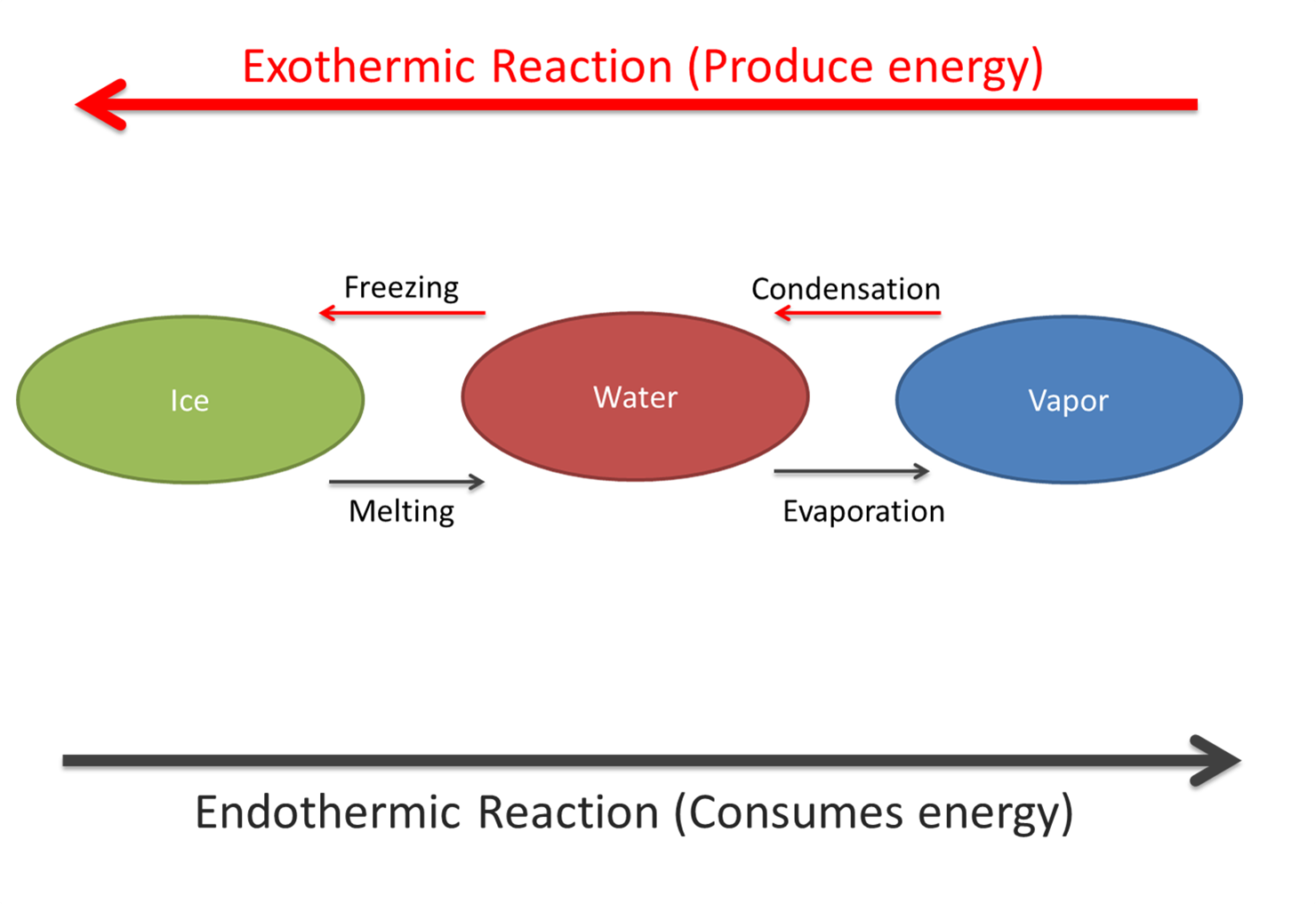
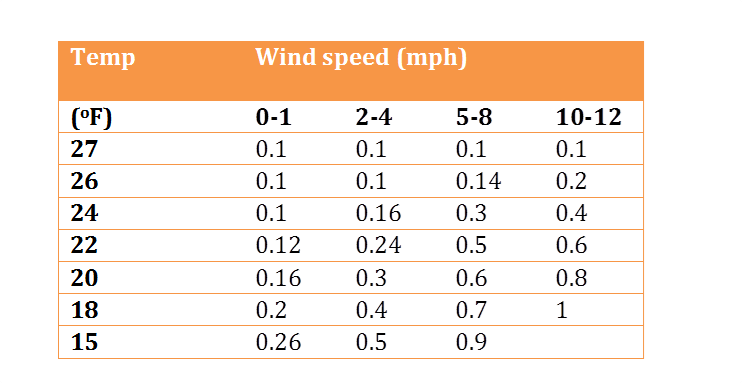
There are three things you have to understand and consider in order to get this positive effect of sprinklers and not to harm your plants. First, you have to watch the wind. The Wind encourages the transition of the water from the liquid phase into the gaseous phase (vapor) and while this happens, heat in the air and around your plants will be consumed in an endothermic reaction. So, it’s always recommended that you don’t use sprinklers if the wind is above (10 mph). The table below (Table 1) should help you decide the amount of water needed (inches/h) under different wind conditions (mph) and under different temperatures.
Table (1): Amount of water (inches/h) that should be provided for frost protection under different wind speeds (mph). (U of Florida Ext. Circ. 287)
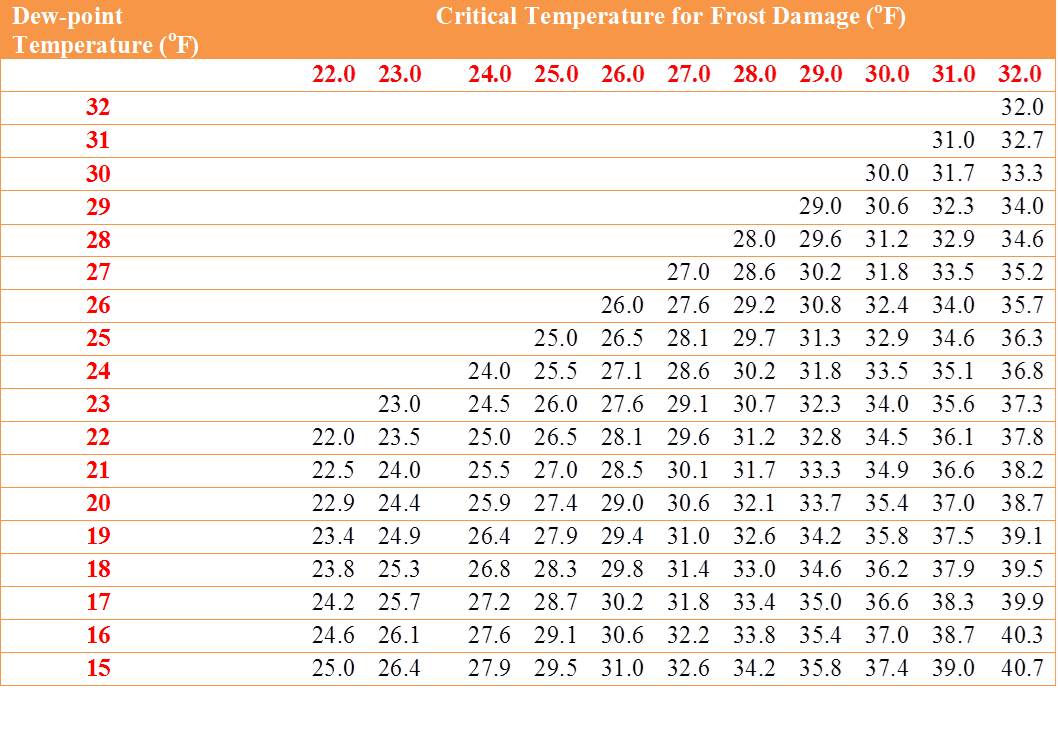
Second is the dew point: without putting complication to the topic, low dew points implies low humidity and if the dew point is too low, the water you add through sprinklers will be soon evaporated to compensate for the low air humidity and consequently cools down air around your plants. So, under moderate dew points, a part of water you add through sprinklers will turn into vapor and consumes heat and another part will turn into ice and produces heat, but AFTER SOME TIME, the net energy will be positive and you will get the benefit of using sprinklers. However, if the dew point is too low, it means that the air is too dry and it will take MUCH TIME to be saturated with vapor. During this time, the air temperature might reach to the critical temperature at which your buds/flowers will be damaged. In this case, sprinklers will cause more damage to your plants than without sprinklers. To help you decide whether sprinklers will be useful for your case or not, use the following table (Table 2) to determine the temperature at which you should turn on/off your sprinklers. If the dew point and the critical damage temperatures are not in the range shown in the table, don’t use sprinklers.
Table (2) shows the minimum temperature at which sprinklers should be turned on/off (UC-Davis, FP005 Quick Answers).
Simply, select the critical temperature for frost damage (the columns) and the dew-point temperature (the rows). The temperature where the row value crosses with the column value is the minimum air temperature at which you can turn on/off your sprinklers.
– you can use this tool to determine the dew point (https://www.weather.gov/epz/wxcalc_rh).
Or, you can get the dew points from Intellicase (use your zip code) http://www.intellicast.com/Local/Weather.aspx?location=USVA0837
The third thing to consider is the amount of water that your sprinklers can provide. If you are not sure that your sprinklers can provide sufficient amount of water, don’t use them at all. Table (1) should help you determine the amount of water required under different conditions.
2017 Tree Fruit Research Priorities Questionnaire
Orchard management and profitable production of tree fruits has become driven by robust science and thorough research. In light of this fact, this multidisciplinary questionnaire has been put together by a group of AHS Jr.-AREC scientists to help them identify and set research questions that reflect the interests of Virginia tree fruit growers and stakeholders. A similar questionnaire was distributed 6 years ago and has served to guide AHS Jr.-AREC scientists designing their field-blocks and shaping their research directions. Based on this survey, many experiments in pomology, plant pathology and entomology have been initiated. This includes, but is not limited to, experiments on crop load management practices, orchard tree planting density, variety and rootstock evaluation, physiological disorders, fungicides and insecticide efficacy trials, mating disruption trials and organic practices. This year’s questionnaire is meant to investigate the new trends and interests of Virginia fruit producers that may ignite new ideas or further promote researching the existing ones.
We are expecting responses from tree fruit growers, private agricultural consultants, agribusiness field representatives, VCE specialists and VCE extension educators in Virginia. An online version of the 2017 questionnaire can be accessed here (https://virginiatech.qualtrics.com/SE/?SID=SV_ezHdupTmKNcdO05). Please complete before March 15th.
A paper version of this questionnaire will be distributed during the upcoming fruit school meetings (Feb 13-17).
2017 Tree Fruit Schools
Carroll Patrick Fruit School in Cana, Virginia: Monday, February 13, 2017 – agenda and registration details: ( carroll-patrick-fruit-school )
Botetourt-Roanoke Fruit School : Tuesday, February 14, 2017 – agenda and details ( roanoke-area-fruit-school )
Southside Fruit School in Blackstone, Virginia: Wednesday, February 15, 2017 – agenda and registration details: ( southside-fruit-school )
Nelson-Albemarle (Central Virginia ) Fruit School : Wednesday, February 15, 2017 – agenda and details ( 2017-fruit-school-registration-lovingston )
Rappahannock-Madison Fruit School in Syria, Virginia: Thursday, February 16, 2017 – agenda and details: ( rappahannock-madison-fruit-school )
Winchester Fruit School in Winchester, Virginia: Friday, February 17, 2017 – agenda and registration details: ( winchester-fruit-school )
Mid-Atlantic Fruit and Vegetable Convention in Hershey, PA
Save the dates, January 31 – February 2, 2017, for the Mid-Atlantic Fruit and Vegetable Convention in Hershey, PA. The conference schedule is now available at the website: www.mafvc.org/index.php?id=Home
Registration through the Virginia State Horticultural Society should be available soon. Contact Liz White (540.667.9101 or lwhite@green-inc.com) for VSHS registration information.
FDA Food Safety Modernization Act (FSMA) Produce Safety Rule Training – December 9, 2016
Virginia Cooperative Extension will be holding an FDA approved FSMA Produce Safety Rule Training on Friday, December 9, 2016, at MidAtlantic Farm Credit – Winchester Office. This building is located at 125 Prosperity Drive, Winchester, Virginia 22602. The program will run from 8:30am to 4:30pm with registration starting at 8:00am.
Space is limited for this training and is geared towards operations that are covered by the FDA FSMA Produce Safety Rule. See the attached flowchart to help determine if your operation is covered by the ruling and thus requires compliance. “Covered” farm operations are required by law to have at least one “supervisor or responsible party” complete a training utilizing FDA approved curriculum. Full details regarding FSMA can be found on the U.S. Food & Drug Administration website: http://www.fda.gov/Food/GuidanceRegulation/FSMA/ucm334114.htm
There will be a $150.00* registration fee for the primary attendee from each operation. This will include program materials, certificate, and lunch. Registration for additional attendees from an operation will be $50.00* each and include a completion certificate and lunch. Pre-registration is required. Please complete and return the enclosed registration form with payment (checks made payable to: Treasurer, Virginia Tech) by December 2, 2016. Walk-in attendees will not be permitted. If you have any questions, I can be reached at the Frederick Office or by email: mark.sutphin@vt.edu.
Registration form and details: fsma-produce-safety-rule-training-12-9-16
*Cost reduction may apply for Virginia operations through VDACS grant funding. Please contact Mark Sutphin (mark.sutphin@vt.edu or 540.665.5699) for specifics.
AREC Open House – August 13th
Please find info attached regarding the public open house that will be held at Virginia Tech’s Alson H. Smith, Jr. Agricultural Research and Extension Center (AREC) near Winchester, VA. You may come and go as you please throughout the 1:00pm – 5:00pm open house. Weather permitting, wagon tours of the farm and research plots will be at 1:30pm and 3:30pm.
This is a hidden resource that greatly supports Virginia’s agriculture industry. Feel free to attend and bring a friend for the rare opportunity to see behind the scenes and the workings of the center.
Alson H. Smith, Jr. Agricultural Research and Extension Center (AREC)
595 Laurel Grove Road
Winchester, VA 22602
Virginia Fruit & Orchard Day Tour (Timberville Area) – Wednesday, July 13th
We have a fantastic day tour of several Mt. Jackson/Timberville area fruit operations scheduled for Wednesday, July 13, 2016. The tour will include orchards, a retail market, a packing operation, a processing operation, a cidery, a catered lunch, and dinner. We plan to arrange a coach for participants traveling from the Winchester area. There will also be other transportation and carpooling options planned as the need dictates. If you are interested in this day tour, please complete the registration on the attached brochure and send in the registration fee of $35.00/each by July 1, 2016. Timberville VA Tour
Feel free to contact me for additional information or any clarifications.
We continue to thank our Tree Fruit Program Sponsors for making this educational tour possible:
Adams County Nursery, Inc.
Andros Foods North America
Bank of Clarke County
BASF Technical Service
Certis USA, LLC
Crop Production Services
DuPont Crop Protection
First Bank & Trust Company
Frederick County Fruit Growers Association
Gowan Company, LLC
Helena Chemical Company
Knouse Foods Co-Op., Inc.
MidAtlantic Farm Credit, FLCA
Southern States
The Valley Fertilizer & Chemical Company, Inc.
True North Foliar
Valent U.S.A. Corporation
Virginia Farm Bureau
Winchester Equipment Company
Mark Sutphin
Associate Extension Agent | Agriculture and Natural Resources, Horticulture | Unit Coordinator (Frederick)
Serving the counties of Frederick, Clarke, Page, Shenandoah, & Warren
Virginia Cooperative Extension – Frederick County Office | 107 North Kent Street | Winchester, VA 22601
Phone – 540.665.5699 | Fax – 540.722.8380 | Cell – 540.398.8148 | Email – mark.sutphin@vt.edu
http://offices.ext.vt.edu/frederick/ | http://vacoopext.blogspot.com/
2016 Carroll-Patrick Orchard Tour – May 26th
The 2016 Carroll-Patrick Orchard Tour will be on Thursday, May 26 from 9:00am to 12:00pm. Tour begins at the Levering Orchard packinghouse: 2324 Orchard Gap Road, Ararat, VA 24053.
RSVP to 276.730.3110 for a lunch count. Lunch donated by W. O. Hill & Son.

Suzanne Slack
Commercial Horticulture Extension Agent
Virginia Cooperative Extension
205 Oak Street- Suite 102
Hillsville, VA 24343
(276)-730-3116
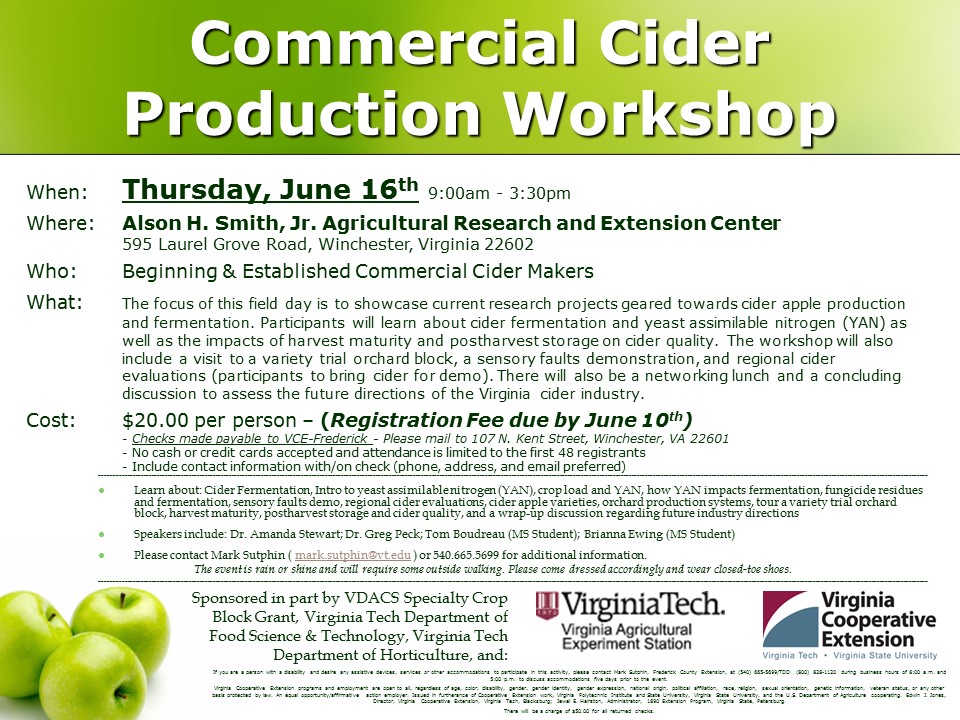
Commercial Cider Production Workshop: June 16, 2016 in Winchester, VA
When: Thursday, June 16th 9:00am – 3:30pm
Where: Alson H. Smith, Jr. Agricultural Research and Extension Center
595 Laurel Grove Road, Winchester, Virginia 22602
Who: Beginning & Established Commercial Cider Makers
What: The focus of this field day is to showcase current research projects geared towards cider apple production and fermentation. Participants will learn about cider fermentation and yeast assimilable nitrogen (YAN) as well as the impacts of harvest maturity and postharvest storage on cider quality. The workshop will also include a visit to a variety trial orchard block, a sensory faults demonstration, and regional cider evaluations (participants to bring cider for demo). There will also be a networking lunch and a concluding discussion to assess the future directions of the Virginia cider industry.
Cost: $20.00 per person – (Registration Fee due by June 10th)
– Checks made payable to VCE-Frederick – Please mail to 107 N. Kent Street, Winchester, VA 22601
– No cash or credit cards accepted and attendance is limited to the first 48 registrants
– Include contact information with/on check (phone, address, and email preferred)
- Learn about: Cider Fermentation, Intro to yeast assimilable nitrogen (YAN), crop load and YAN, how YAN impacts fermentation, fungicide residues and fermentation, sensory faults demo, regional cider evaluations, cider apple varieties, orchard production systems, tour a variety trial orchard block, harvest maturity, postharvest storage and cider quality, and a wrap-up discussion regarding future industry directions
- Speakers include: Dr. Amanda Stewart; Dr. Greg Peck; Tom Boudreau (MS Student); Brianna Ewing (MS Student)
- Please contact Mark Sutphin ( mark.sutphin@vt.edu ) or 540.665.5699 for additional information.
The event is rain or shine and will require some outside walking. Please come dressed accordingly and wear closed-toe shoes.
If you are a person with a disability and desire any assistive devices, services or other accommodations to participate in this activity, please contact Mark Sutphin, Frederick County Extension, at (540) 665-5699/TDD (800) 828-1120 during business hours of 8:00 a.m. and 5:00 p.m. to discuss accommodations five days prior to the event.
Virginia Cooperative Extension programs and employment are open to all, regardless of age, color, disability, gender, gender identity, gender expression, national origin, political affiliation, race, religion, sexual orientation, genetic information, veteran status, or any other basis protected by law. An equal opportunity/affirmative action employer. Issued in furtherance of Cooperative Extension work, Virginia Polytechnic Institute and State University, Virginia State University, and the U.S. Department of Agriculture cooperating. Edwin J. Jones, Director, Virginia Cooperative Extension, Virginia Tech, Blacksburg; M. Ray McKinnie, Interim Administrator, 1890 Extension Program, Virginia State University, Petersburg.
There will be a charge of $50.00 for all returned checks.