
Measuring the nutrient needs of orchards should be done by using both soil and leaf (also known as foliar) nutrient analyses. For mature fruit trees, leaf mineral content is a more accurate measure of the nutrient status than soil analyses. Leaf analysis can help determine if additional fertilizers are needed before there are any visual signs of deficiency in the tree. Leaf samples should be taken when most vegetative growth has subsided (terminal buds are set), which for most bearing apple trees happens in late July or early August. For the most part, by the time leaf samples are taken and analyzed there is little that can be done to impact the current season’s crop and next year’s flower buds. Therefore, to maintain optimal performance of your orchard, it is recommended to perform a leaf analysis for each block once every three years to ensure that you are consistently maintaining adequate nutrient levels.
Predicted 2014 Apple Harvest Dates
Predicting harvest date depends upon many factors, including full bloom date, accumulated heat units (growing degree days) over the course of the growing season, physiological stressors (e.g., disease and insect damage or drought), day to night temperature differentials as harvest approaches, and the amount of precipitation. However, the number of days between full bloom and harvest has been shown to be the most reliable predictor of harvest date.
Click here to learn more about pre-harvest drop management.
More than two decades ago, researchers in Michigan determined that there there are an average of 143 days between full bloom and the first commercial pick of Red Delicious apples that are to be held in controlled atmosphere storage (i.e., firmness between 17-18 lbs; starch between 2.5-4 on the 8-pt scale Cornell Starch Chart). Additional seasonal adjustments above or below the average number of days until harvest are made based upon the average daily minimum temperatures for the 15 days after full bloom.
For the past several seasons I have tested the Michigan model using fruit from a block of Bisbee Red Delicious on MARK rootstock. Results to date have shown that this model is very good at predicting harvest maturity in Virginia.
Based on the Michigan model, here are the predictions for 2014:
In Winchester, Bisbee Red Delicious full bloom was April 27 and average minimum temperature for the 15 days after full bloom was 0.5°F more than 50°F. Using this data in the Michigan model, harvest is predicted to be 143 days after full bloom. This puts the predicted harvest date for the first CA pick of Red Delicious at September 16.
In Central Virginia (Tyro), full bloom for Red Delicious was estimated to be April 20 and the predicted harvest is September 9.
If you want to compare the model to your own situation, here are the previous years’ predicted harvest dates:
2011 Winchester: September 10
2012 Winchester: August 26
2012 Central VA (Batesville): August 25
2013 Winchester: September 18
2013 Central VA (Piney River): September 15
Since most growers have Red Delicious trees in their orchards, other cultivars (and strains of Red Delicious that ripen earlier than Bisbee) can be estimated based upon experience on their picking date relative to Red Delicious.
Another method for estimating harvest date uses the rule-of-thumb that says, “for each 2-3 days departure for the normal bloom date, there will be a one-day departure from the normal harvest date.” (Blanpied and Silsby, 1992).
You can find more information about harvest maturity indices in this post.
Starting in August, I will start conducting maturity evaluations of fruit from the Winchester AREC and surrounding orchards.
References
Blanpied, G. and K. Silsby. 1992. Predicting Harvest Date Window for Apples. Cornell Information Bulletin 221. <<pdf>>
Beaudry, R., P. Schwallier, and M. Lennington. 1993. Apple Maturity Prediction: An Extension Tool to Aid Fruit Storage Decisions. HortTechnology 3(2): 233-239.
Upcoming Tree Fruit Programs
Rappahannock In-Orchard Meeting
Wednesday, August 13
11:00am – 1:00pm
Graves’ Mountain Lodge
Rte 670
Syria, VA 22743
Contact: Kenner Love or 540.675.3619
Winchester AREC Public Open House
Saturday, August 16
1:00pm – 5:00pm
Alson H. Smith, Jr. Agricultural Research and Extension Center
595 Laurel Grove Road
Winchester, VA 22602
Contact: Debbie Marple or 540.869.2560 x10
Winchester Area Tree Fruit Twilight Meeting
Tuesday, August 19
Time TBD
Timber Ridge Fruit Farm (Cordell & Kim Watt)
311 Muse Road
Gore, VA 22637
Contact: Mark Sutphin or 540.665.5699
Hard Cider Production Short Course
Thursday, Nov. 6 and Friday, Nov. 7 (2-day workshop)
Virginia Tech Campus
Blacksburg, VA
Contact: greg.peck@vt.edu or 540.869.2560 x19
Alson H. Smith, Jr. AREC (Winchester) Public Open House
July 21, 2014
Winchester, VA—The faculty, staff, and students at Virginia Tech’s Alson H. Smith, Jr. Agricultural Research and Extension Center and Virginia Cooperative Extension’s Frederick County Office will be hosting a public open house on August 16 from 1:00 PM to 5:00 PM. The Center’s scientists will provide an overview of their research projects and outreach efforts through hands-on activities, posters, and guided tours of the experimental vineyards and orchards.
This is an open event—all are welcome! Come meet the scientists who work at the Center. Cold drinks and locally made desserts will be provided. The open house will be held rain or shine.
Contact: For more information contact Debra Marple at: 540-869-2560 or dmarple@vt.edu.
About the The Alson H. Smith, Jr. Agricultural Research and Extension Center: This Virginia Tech laboratory serves Virginia’s commercial fruit and value-added, horticultural food crops industries through research, educational programs, development of sustainable production systems and technologies, and increased public knowledge of horticultural opportunities and benefits. Please visit our website to learn more about our current research and information on tree fruit and grapes. http://www.arec.vaes.vt.edu/alson-h-smith/
Directions: The facility is located at 595 Laurel Grove Road, Winchester, VA 22602.
From I-81: take the Stephens City exit (Exit 307). Go west into Stephens City on Fairfax Street. Proceed straight through Stephens City onto Rt. 631 (Fairfax Street becomes Marlboro Road). Continue west on Marlboro Road for approximately 3.5 miles. When Marlboro Road dead-ends at a “T”, turn right (north) onto Middle Road (Rt. 628). Proceed on Middle Road for 1.5 miles. Turn left (west) onto Laurel Grove Road (Rt. 629). Travel 0.8 miles to the Center, which will be on your left.
If you are a person with a disability and desire any assistive devices, services or other accommodations to participate in this activity, please contact Debra Marple (AHS AREC) at (540-869-2560 X19*) during business hours of 7:30 am and 4:00 p.m. to discuss accommodations five days prior to the event. *TDD number is (800) 828-1120.
Virginia Cooperative Extension programs and employment are open to all, regardless of race, color, national origin, sex, religion, age, disability, political beliefs, sexual orientation, genetic information, marital, family, or veteran status, or any other basis protected by law. An equal opportunity/affirmative action employer.Central Virginia Orchard & Tree Fruit Day Tour – July 15, 2014
We have a fantastic day tour of several Central Virginia orchards scheduled for Tuesday, July 15, 2014. The tour will include high density (tall spindle) apple orchards, vineyards, retail markets, a packing operation, a cidery, a box lunch, and an evening meal on top of Carter Mountain overlooking Charlottesville, Virginia. We will likely be traveling by coach from the Shenandoah Valley and there will be other transportation and carpooling options planned as the need dictates. If you are interested in this day tour, please complete the registration on the attached brochure and send in the registration fee of $15.00/each by July 1, 2014.
Feel free to contact me for additional information or any clarifications.
We continue to thank our Tree Fruit Program Sponsors for making this educational tour possible. Please see the attached flyer listing our many faithful industry partners.
Download the registration form: Central VA Tour Brochure <pdf>
Mark Sutphin
Associate Extension Agent | Agriculture and Natural Resources, Horticulture | Unit Coordinator (Frederick)
Virginia Cooperative Extension – Frederick County Office | 107 North Kent Street | Winchester, VA 22601
Phone – 540.665.5699 | Fax – 540.722.8380 | Cell – 540.398.8148 | Email – mark.sutphin@vt.edu | http://offices.ext.vt.edu/frederick/ | http://vacoopext.blogspot.com/
9:30 am Stop 1: Silver Creek Orchards (The Flippin Family)
John & Ruth Saunders
5529 Crabtree Falls Highway, Tyro, VA
11:30 am Stop 2: Saunders Brothers (box/sandwich lunch)
Bennett Saunders & Family
2717 Tye Brook Highway, Piney River, VA
1:30 pm Stop 3: Crown Orchard Packing House*
Chiles Family
5861 Piedmont Apple Ln., Covesville, VA
3:00 pm Stop 4: Albemarle Ciderworks
Charlotte Shelton & Chuck Shelton
2545 Rural Ridge Ln., North Garden, VA
5:00 pm Stop 5: Carter Mountain Orchard (catered supper)
Chiles Family
1435 Carters Mountain Trail, Charlottesville, VA
The itinerary above is the proposed schedule and subject to change.
* This is a GAP certified packing house and will require all visitors to abide by the following policies: guest sign-in, long pants must be worn, and no jewelry
MaluSim Carbohydrate Model for May 27, 2014
I ran a MaluSim model using data from the weather station located at the Alson H. Smith, Jr. AREC in Winchester. This will be the last model run for the year.
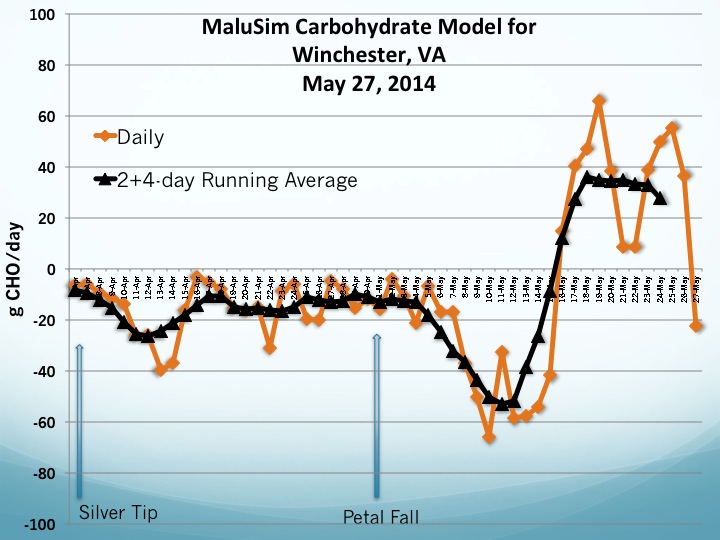 No forecast data was used in this run. Based on the output, I would expect chemical thinners that were applied May 14-16 to have an average response, while thinners that were applied on and after May 17 to have minimal effect. The effectiveness of thinners is greatly influenced by fruit size, so if the model showed a carbohydrate status that was greater than 20 g per day, and fruitlets were greater than 15 mm at the time of application then chemical thinners may not have been particularly effective.
Growers should compare the results of their chemical thinning program with the modeled carbohydrate status to determine if the model accurately predicted the level of thinning you expected from your applications.
I would appreciate hearing from growers about how they used the model to make chemical thinning decisions. Both positive and negative feedback is appreciated. You can use the comment feature in the blog site, or just send me an email.
Download the full report:
Central Virginia In-Orchard Meeting to be Held on June 3 at 7K Farms in Rustburg
From Michael LaChance:
May 23rd, 2014
To People Interested in Virginia Fruit Production:
The fifth in-orchard production meeting of the 2014 Central Virginia Orchard Meeting series will be held on Tuesday, June 3rd at 11:00 a.m. at 7 K Farms, located at 837 Red House Rd, Rustburg, Virginia 24588. The event is hosted by farm manager Bill Beni and the rest of the staff at this most interesting entrant into the Virginia fruit industry. It is open to all but will be especially interesting to new and established fruit growers, people considering conversion of some of their acreage to higher value crops, and regional decision makers. You will have an opportunity to tour the farm and have your questions addressed by our hosts and Drs. Chris Bergh, Greg Peck and Keith Yoder, Extension tree fruit specialists based at the Alson H. Smith Jr. Agricultural Research and Extension Center near Winchester.
If you are bringing specimens of insects pests or plant disease for diagnosis and control recommendations, please follow good sanitation practices by putting the material in sealed plastic bags and properly remove your material away from the host orchard after the meeting.
The program begins at 11:00 a.m. so plan on arriving sometime soon after 10:30 a.m. This is an excellent opportunity to see:
- This rapid development of over 200 acres of commercial fruit in central Virginia
- Use of “sleepy eye” propagation technique
- Meeting the need for adequate irrigation and deer control
- Innovative high density fruit tree training
A nice lunch for everyone is being prepared plus water and other cold drinks will be provided that day. Register by Thursday, May 29. To assist us with our planning Please contact either Lucinda MacRae at the Nelson County Extension Office: 434 263 4035 / lmacrae@vt.edu or 7 K Farms main office. Your contact there is Melanie Mahone, (434) 332-4460 / mel7kfarms@centurylink.net.
Directions from Lynchburg: Rustburg is located southeast of Lynchburg. Take Route 501 off of Highway 29 and continue 10 miles to the stoplight in Rustburg, turn left onto Hwy 24 toward Concord and travel 0.5 miles to the next stoplight and turn right onto Red House Road. Travel 0.8 miles to the farm entrance, extra signage will be put up to help you.
Please email us, fax or phone us today so we can get a head count for this very informative meeting. For more information on Extension programs to assist with your fruit growing interests go to: www.anr.ext.vt.edu/tree-fruit/
Sincerely,
Michael W. Lachance
Extension Agent
If you are a person with a disability and desire any assistive devices, services or other accommodations to participate in this activity, please contact the Nelson County Extension Office at (434)263-4035 to discuss accommodations five days prior to the date of the meeting.
|
‘Sleeping eye’ describes a summer-budded rootstock cut above the dormant scion bud and stored for planting in a nursery or orchard. |
|
|
ADVANTAGES |
DISADVANTAGES |
| A good quality tree can be produced in
one season as opposed to two for a summer- budded tree |
Costs more than twice that of unbudded
rootstock
|
| Simpler for grower than benchgrafting,
yet can produce a tree of similar quality in same period of time |
Quality of root and bud important for success of this method |
Source: http://www.al.gov.bc.ca/treefrt/product/Tree_Fruit_Home_Nurseries.pdf
Late thinning of apple, return bloom, and peach hand thinning
LATE (“RESCUE”) THINNING
Where late (14-25 mm) thinning is still possible growers can use the following materials and combinations of materials in order of greater thinning potency:
- ethephon (0.5 -1.5 pints/100 gal)
- ethephon + carbaryl (1 pint)
- ethephon + carbaryl + oil (1 quart)
- ethephon + carbaryl + oil + NAA (5 ppm)
Ethephon applications can cause over thinning, so use the lowest rates and tank mix with the least number of other materials unless significant fruit removal is desired.
PROMOTING RETURN BLOOM IN APPLE
Ethephon (sold under the trade names Ethrel and Ethephon 2) can promote flower bud formation when applied from petal fall to about 6 to 8 weeks after full bloom. The greatest effect is from applications made 0 to 4 weeks after bloom. However, since ethephon can cause substantial fruit thinning, multiple weekly applications at rates 1/2 that of the thinning rate are recommended starting when fruitlets are greater than 30 mm. When possible, it is best to wait until after “June” drop has occurred. At a minimum, wait 7-10 days after the last thinning application before starting ethephon return bloom sprays. Additionally, do not apply ethephon to trees that are stressed or trees that are low in vigor.
A single ethephon application can be used at a high rate (up to 900 ppm). However, more consistent results are often obtained from multiple (3-4) applications made at 10-14 day intervals using lower rates (150-300 ppm). One common, and often effective strategy, is to make two applications in June and two applications in July.
Another strategy is to make 2-4 applications of ethephon at 150 ppm tank mixed with NAA at 5-10 ppm (or 2.5-5 ppm when tank mixed with spray oil). This approach has been beneficial for strongly biennial cultivars.
Sensitivity to ethephon is very different amongst cultivars, thus it is important to choose a rate specific to each variety. Do not exceed 8 pints per acre per year. If trees are over-cropped ethephon may not effectively give adequate return bloom the following season. Higher soluble solids and lower starch levels at harvest may be expected with some cultivars, particularly with high rates and/or late season applications. No loss of firmness has been detected with ‘Red Delicious’ at the optimum harvest date.
Ethephon sprays can reduce tree growth (dependent on timing and amounts used) and thus may not be desirable for young non-bearing trees if maximum tree growth is desirable.
HAND THINNING PEACHES
Hand thinning peaches to 6-8 inches apart on the branch will result in increased final fruit size and help prevent limb breakage. This activity will be most effective when completed over the next couple-few weeks. Hand thinning peaches later in the season will not have as much of an impact on final fruit size.
MaluSim Carbohydrate Model for May 22, 2014
On Thursday, I ran the MaluSim model for Winchester.

As I suggested in my last post, the strongly negative carbohydrate balance forecasted for May 20 and 21 were a product of poor cloud cover forecasting. In fact, since May 16 the carbohydrate status has been in the positive range. Chemical thinning applications made from May 17 through the next several days will likely have an moderate to poor response. Now that fruitlets are 15 to 20 mm in diameter, NAA and 6-BA will have minimal thinning efficacy. Growers who need to thin additional fruit from their trees should consider ethephon applications.
Table 1. Fruitlet sizes at the Alson H. Smith, Jr. AREC in Winchester, VA.
| Variety | 12-May | 15-May | 20-May | 22-May |
| Empire | 10.4 | 12.2 | 15.1 | 17.9 |
| Fuji | 7.0 | 9.0 | 12.1 | 14.8 |
| Gala | 8.7 | 11.3 | 13.9 | |
| Goldens | 8.0 | 9.5 | 12.7 | 14.9 |
| Idared | 8.1 | 9.5 | ||
| Pink Lady | 9.2 | 11.0 | 13.6 | 16.6 |
| Red Delicious | 8.0 | 10.1 | 11.4 | |
| York | 7.9 | 10.7 | 13.8 | 16.1 |
As I did for the Central Virginia models, I will run one more season recap model early next week.
Download the full report:
MaluSim Carbohydrate Model for May 19, 2014
On Monday, I ran the MaluSim model for Winchester and a season recap for the Central Virginia region.

For the Winchester area, the carbohydrate status has been in the -20 to 20 g CHO/day range since May 15. This means that thinning sprays made between last Thursday and today are predicted to have an average response. For the next couple of days, the model is showing a significant carbohydrate deficit. This is being caused by the cloudy weather that is predicted, as neither day nor night temperatures are forecast to be very high. Cloud cover remains the hardest variable to forecast. If the next two days are sunnier than forecast, or if the rain showers occur at night, then I would not expect the actual carbohydrate balance to go into such a low deficit. However, if the weather forecasts that I used in the model are accurate, then growers should avoid thinning on Wednesday. Either way, the best predictor of the potency of chemical thinners is the 2 days before, day of, and 3 days after (2+4-day) running average (the black line). As you can see, the running average remains between 0 and 20 g CHO/day, meaning that chemical thinners will have an average response.
For the Central Virginia region, I’ve run a recap of the season using weather station data through Monday, May 19. Growers should compare their thinning results to the carbohydrate status at the time they made their application to see how well the model predicted the potency of thinners this year. From my experience, using the MaluSim model as a forensic tool can really help explain why chemical thinners work so differently from one year to the next. As I repeatedly have said, the most difficult part of using the MaluSim model to make real time decisions is having accurate weather data to use as inputs. As I mention above, cloud cover can really impact the carbohydrate status in the tree, and thus the responsiveness of thinners, but it is the hardest variable to forecast. Additionally, weather can be very local. We experienced this issue with the major differences between Tyro and Piney River weather forecasts. We also saw a lot of variable temperature data, with several days between May 8 and 14 being 5 or more degrees Fahrenheit warmer than forecast.
Even with these issues, I hope that the model is providing useful information that helps you make sound management decisions. If you have any feedback, please don’t hesitate to contact me.
I will continue to run the Winchester model until fruit size is too big to thin with NAA and 6-BA.
Download the full reports: