Reducing pre-harvest drop, extending harvest timing, and increasing storage life

Three chemicals are available for reducing pre-harvest drop, extending harvest timing, and increasing storage life:

1) Aminoethoxyvinylglycine, AVG (ReTain)

  • Delays maturity and thus fruit drop by inhibiting ethylene production.

2) Napthaleneacetic acid, NAA (Fruitone N, Fruitone L, PoMaxa)

  • Decreases abscission of the fruit stem from the bud but can advance maturity especially when used at high rates or with repeated applications.

3) 1-Methylcyclopropene, 1-MCP (SmartFresh, Harvista)

  • Blocks the ethylene receptors, thereby preventing the autocatalytic climacteric process of fruit ripening.
  • SmartFresh is used in storage rooms on pre-climacteric fruit.
  • Harvista, the sprayable formulation of 1-MCP, is not yet commercially available for growers in Virginia.

Below are some suggested strategies for using ReTain and or NAA in your orchards this year. Applications should be based upon the predicted harvest date for each cultivar.

  • 1) ReTain (AVG) applied alone
  • Used at 1 pouch/acre [333 g (50 g a.i.) or 11.7 oz]. Apply to full coverage (~100 gal/acre). Use with an organosilicone surfactant (e.g. Sylgard 309 or Silwet L-77). Allow at least six hours of drying time. ReTain has a 7 day PHI.
  • For single pick cultivars, apply ReTain four weeks ahead of anticipated harvest date.
    • Standard approach for single pick varieties—reduces fruit drop and delays the harvest period by reducing ethylene production. Can also allow more time for the fruit to color on the tree.
  • For multi-pick varieties (e.g., Gala and Honeycrisp), apply ReTain one to two weeks ahead of the first harvest date.
    • Will not delay maturity, of the first harvest, but will do so for the later picks.
    • Ethylene suppression effect can last for up to 4 months in regular air storage.

2) NAA applied alone

  • Use at 10-20 ppm. High rates (>= 20 ppm) may advance maturity and reduce storage life. See the 2014 Spray Guide for cultivar specific recommendations.
  • Do not make more than two applications per year.
  • Do not apply more than at 3X concentration.
  • Organosilicone or nonionic surfactants are recommended.
  • Don’t tank mix NAA with calcium (a water conditioner might be needed if you have hard water).
  • Use maturity indices (starch rating) and limb tapping to determine timing.
  • Takes 2-4 days for the material to become active in the tree.
  • Apply single applications at 14 to 5 days before harvest; or two applications between 10-14 and 5-7 days before harvest.
  • Or use the branch tap method to decide when to apply NAA
    • As you get close to harvest, firmly strike a 3-4” diameter branch with the palm of your hand.
    • Do this on a daily basis.
    • If more than two fruit per limb fall, then apply NAA or consider harvesting within the next few days.
  • Single applications last about 7 days; split applications (two 10 ppm applications about five days apart) last about 12 days. Fruitone L has a 2 day PHI; PoMaxa has a 7 day PHI.
  • For apples that produce a lot of ethylene, NAA alone may not provide sufficient drop control. This is especially true in hot, dry years.

3) Combined sprays of ReTain and NAA

For the past several years, I have been evaluating the combination of ReTain with NAA at various timings and rates on Red Delicious, York, and Rome. Analysis of these experiments is still underway, but my initial assessment is that the combined sprays are especially effective at reducing pre-harvest drop while not reducing storage potential especially in hot, dry years.

When ReTain (AVG) was tank mixed with NAA, I found decreased ethylene production in stored fruit, and increased fruit quality (firmness–though differences were often 1 lb pressure or less). Additionally, the closer ReTain is applied to harvest, the better the fruit quality in storage. By using both materials (AVG and NAA), growers have the option of improving drop control without losing storage potential.

Some of my treatments included:

  • ReTain (full-rate) at 4 weeks before harvest, followed by NAA (10 ppm) at two weeks before harvest. (Provided good drop control and storage life.)
  • ReTain (half-rate) at 4 week before harvest, followed by NAA (10 ppm) at two weeks before harvest. (Provided good drop control and storage life, but did not extend harvest window or storage life as long as using the full rate.)
  • ReTain (full-rate) at 2 weeks before harvest, plus NAA (10 ppm) at 2 weeks before harvest. (This provided the best drop control and storage life.)
  • ReTain (half-rate) at 2 weeks before harvest, plus NAA (10 ppm) at 2 weeks before harvest. (This was not as effective at reducing pre-harvest drop compared to the full rate, but is a cost effective option when treatment is needed on a large acreage.)

I suggest growers consider the market destination for their fruit prior to applying either ReTain or NAA. With the multiple combinations and permutations of chemistries, rates, and timings, growers can manage harvest date, fruit drop, and storage quality with a fair amount of precision.  While combined ReTain and NAA applications are effective at decreasing pre-harvest drop, this approach is not necessary for all cultivars, storage plans, or market destinations.

Here are some examples: For apples that are going to be sold through direct markets, NAA alone may be sufficient to prevent drop. However, PYO operations may want to consider ReTain to delay the harvest of early ripening cultivars until the peak apple picking crowds arrive in September. For apples that are going to be treated with SmartFresh, the additional ethylene suppression from ReTain may not be necessary, and NAA alone might be sufficient to reduce pre-harvest drops. For growers who have significant acreage of a single cultivar, or who have multiple cultivars that overlap in harvest timing (or otherwise expect to have limited labor available for harvest), applying ReTain to part of the orchard can help delay harvest and stretch out harvest window.

For additional reading, Dr. Duane Greene (University of Massachusetts) recently wrote this article about his experiences with pre-harvest drop materials.
Predicted Harvest Dates for Winchester and Central Virginia

Predicting harvest date depends upon many factors, including full bloom date, accumulated heat units (growing degree days) over the course of the growing season, physiological stressors (e.g., disease and insect damage or drought), day to night temperature differentials as harvest approaches, and the amount of precipitation. However, the number of days between full bloom and harvest has been shown to be the most reliable predictor of harvest date.

More than two decades ago, researchers in Michigan determined that there there are an average of 143 days between full bloom and the first commercial pick of Red Delicious apples that are to be held in controlled atmosphere storage (i.e., firmness between 17-18 lbs; starch between 2.5-4 on the 8-pt scale Cornell Starch Chart). Additional seasonal adjustments above or below the average number of days until harvest are made based upon the average daily minimum temperatures for the 15 days after full bloom.

For the past several seasons I have tested the Michigan model using fruit from a block of Bisbee Red Delicious on MARK rootstock. Results to date have shown that this model is very good at predicting harvest maturity in Virginia.

Based on the Michigan model, here are the predictions for 2013:

In Winchester, Bisbee Red Delicious full bloom was April 23 and average minimum temperature for the 15 days after full bloom was 8.0°F less than 50°F. Using this data in the Michigan model, harvest is predicted ~8 days more than 143 days between full bloom and harvest. This puts the predicted harvest date for the first CA pick of Red Delicious at September 19.

In Central Virginia (Piney River), full bloom for Red Delicious was estimated to be April 20 and the predicted harvest is September 14.

Since most growers have Red Delicious trees in their orchards, other cultivars (and strains of Red Delicious that ripen earlier than Bisbee) can be estimated based upon experience on their picking date relative to Red Delicious.

Another method for estimating harvest date uses the rule-of-thumb that says, “for each 2-3 days departure for the normal bloom date, there will be a one-day departure from the normal harvest date.” (Blanpied and Silsby, 1992).

You can find more information about harvest maturity indices in a post from last year.

In the next week or two, I will start conducting maturity evaluations of fruit from the Winchester AREC and surrounding orchards.

References

Blanpied, G. and K. Silsby. 1992. Predicting Harvest Date Window for Apples. Cornell Information Bulletin 221. <<pdf>>

Beaudry, R., P. Schwallier, and M. Lennington. 1993. Apple Maturity Prediction: An Extension Tool to Aid Fruit Storage Decisions. HortTechnology 3(2): 233-239.

Correction: There is no charge for soil samples sent by commercial growers to the Virginia Tech Soil Testing Lab

Correction: For commercial growers within Virginia, the Virginia Tech Soil Testing Lab conducts soil analyses at no charge. However, there is an additional charge for measurement of soluble salts ($2) and organic matter ($4). For the quickest processing time, be sure to use the official soil sampling boxes. Sample boxes are available from your local Virginia Cooperative Extension office. Also, new this year the Virginia Tech Soil Testing Lab will send you results via email. Please use the most recent submission form when submitting samples.

(Thanks to Mark Sutphin for catching my error.)

Soil and leaf sampling for nutrient analysis by Greg Peck

Measuring the nutrient needs of orchards should be done by using both soil and leaf (also known as foliar) nutrient analyses. Soil analysis is best done before planting a new orchard so that lime and fertilizers can be incorporated deeper into the soil profile. Adjusting soil pH and getting less mobile nutrients into the rootzone is difficult once the orchard has been established, though there are times when these practices can and should be done. Soil sampling should continue throughout the life of an orchard every five or so years to monitor soil pH. In peach blocks where sulfur has been repeatedly applied for disease control, soil pH should be checked more frequently to ensure that the pH hasn’t fallen out of the acceptable range.

Since soil pH and nutrient content changes through the soil profile, soil samples should be taken from a consistent depth. Many labs will recommend a soil depth to sample, and then use that depth to calculate fertilizer and lime recommendations. The Virginia Tech Soil Lab recommends samples be taken from the top 6-8 inches of soil. When soil sampling prior to planting, it is recommended to take separate top- and sub-soil samples. Additional information on soil sampling can be found in the Virginia Tech Agronomy Handbook.

Soil nutrient analysis is a measure of the “plant available” minerals in the soil. However, due to the complex nature of the soil-root interface, minerals that are “plant available” are not necessarily taken up by plants and therefore soil testing does not always provide an accurate measure of the nutrient status of the trees in the orchard. Additionally, most soil analyses do not directly measure nitrogen content, but instead base nitrogen fertilizer recommendations on soil type and organic matter content. Additional information on soil nutrient analyses for orchards can be found in the following Virginia Tech publications

For commercial growers within Virginia, the Virginia Tech Soil Testing Lab conducts soil analyses at no charge. However, there is an additional charge for measurement of soluble salts ($2) and organic matter ($4). For the quickest processing time, be sure to use the official soil sampling boxes. Sample boxes are available from your local Virginia Cooperative Extension office. The Virginia Tech Soil Testing Lab will send you results via email. Please use the most recent submission form when submitting samples.

For mature fruit trees, leaf mineral content is a more accurate measure of the nutrient status than soil analyses. Leaf analysis can help determine if additional fertilizers are needed before there are any visual signs of deficiency in the tree. Leaf samples should be taken when most vegetative growth has subsided (terminal buds are set), which for most bearing apple trees happens in late July or early August. For the most part, by the time leaf samples are taken and analyzed there is little that can be done to impact the current season’s crop and next year’s flower buds. Therefore, to maintain optimal performance of your orchard, it is recommended to perform a leaf analysis for each block once every three years to ensure that you are consistently maintaining adequate nutrient levels.

Below are some additional recommendations for taking accurate leaf samples.

  • Collect 60-100 leaves to get a representative sample. Leaves should be taken at about the midpoint of the new growth and from all actively growing parts of smaller trees and between waist and head high on larger trees.
  • Choose between 8 and 10 separate trees that are representative of the block.
  • Don’t mix leaves from different varieties, rootstocks, ages, soil types, blocks, or farms.
  • Sample poorly growing or otherwise problematic trees separately from healthy trees, so that a comparison can be made between them.

Unfortunately, the Virginia Tech Soils Lab does not perform plant tissue analysis. Below is a partial list of regional service labs that perform leaf tissue analysis (this is not an endorsement of these labs and other labs may provide similar services):

1. Penn State Agricultural Analytical Services Laboratory (State College, PA)

  • Plant Analysis Kit, $24
  • N, P, K, Ca, Mg, Mn, Fe, Cu, B, Zn + crop specific interpretations

2. A&L Eastern Laboratories, Inc. (Richmond, VA)

  • PT2 package, $26.20 ($24 without recommendations)
  • N, S, P, K, Mg, Ca, Na, Fe, Al, Mn, B, Cu, Zn

3. Agro-One Soils Laboratory (Ithaca, NY)

  • Plant Tissue Analysis (#180), $24
  • N, P, K, Ca, Mg, Zn, Cu, Fe, B, Mn + recommendations based on Cornell University guidelines

4. North Carolina Dept of Agriculture (Raleigh, NC)

  • Plant Tissue Analysis, $25
  • N, P, K, Ca, Mg, S, Fe, Mn, Zn, Cu, B + recommendations

AREC to Host Field Tour and Twilight Meeting

The faculty and staff of Virginia Tech’s AHS Jr. AREC and Virginia Cooperative Extension invite you to a Field day and Twilight Meeting on Thursday, July 18, 2013. In addition to a traditional twilight meeting, there will be a comprehensive tour of the research plots at the AHS Jr. AREC. Growers from throughout Virginia, as well as nearby states are invited to attend. Please note that the mealtime is earlier than in past years.

2:30pm – 5:15pm: Tour of Research Orchards (Entomology, Horticulture & Pathology) – Meet at the main building

5:30pm – 7:00pm: Catered Supper & Seasonal Updates – Equipment Shed

Registration is required.  To ensure that you are provided with a meal, you must email Mark Sutphin at mark.sutphin@vt.edu or call his office: (540.665.5699) before noon on Monday, July 15th.

Directions: The facility is located at, 595 Laurel Grove Road, Winchester, VA 22602. From I-81: take the Stephens City exit (Exit 307). Go west into Stephens City on Fairfax Street. Proceed straight through Stephens City onto Rt. 631 (Fairfax Street becomes Marlboro Road). Continue west on Marlboro Road for approximately 3.5 miles. When Marlboro Road dead-ends at a “T”, turn right (north) onto Middle Road (Rt. 628). Proceed on Middle Road for 1.5 miles. Turn left (west) onto Laurel Grove Road (Rt. 629). Travel 0.8 miles to the AREC, which will be on your left. Parking is available in front of the building.

Drs. Keith Yoder, Chris Bergh, and Greg Peck will be providing seasonal updates at dinner and will be available for discussions and concerns regarding the growing season.

**Please save the date of Tuesday, August 27, 2013 for a joint Twilight Meeting with WVU Extension at Orr’s Farm Market in Martinsburg, WV.**

Many thanks to all of our faithful sponsors for making this event possible!

AgroFresh

Bayer CropScience, L.P.

Bowman Andros Products, LLC

Certis USA, LLC

Crop Production Services

Dow Agro Sciences

DuPont Crop Protection

First Bank & Trust

Frederick County Farm Bureau

Frederick County Fruit Growers

Gowan Company LLC

Helena Chemical Company

Knouse Foods Co-Op., Inc.

MidAtlantic Farm Credit

National Fruit Product Company

Nichino America

Peterson Farms, Inc.

Southern States

Suterra

Syngenta Crop Protection

Trece, Inc.

Valent USA

Valley Fertilizer & Chemical Company

Virginia Cooperative Extension

Virginia Farm Bureau

Winchester Equipment Company


Mark Sutphin

Associate Extension Agent | Agriculture and Natural Resources, Horticulture | Unit Coordinator (Frederick)

Virginia Cooperative Extension – Frederick County Office | 107 North Kent Street | Winchester, VA 22601

Phone – 540.665.5699 | Fax – 540.722.8380 | Cell – 540.398.8148 | Email – mark.sutphin@vt.edu | http://offices.ext.vt.edu/frederick/

Serving the counties of Frederick, Clarke, Page, Shenandoah, & Warren

Upcoming Meetings

The next in-orchard meeting will be held on Wednesday June 12 at 11AM in Fauquier County at Stribling Orchard with a post meeting visit to Heartland Orchard. For more information, contact Kenner Love: klove@vt.edu or (540) 675-3619.

On June 18 at 11AM, we’ll be meeting at Tommy Fitzgerald’s Orchard in Central Virginia. The address is 621 Dillard Hill Road, Lowesville, VA 22967. The main office phone number is (434) 277-5051.

Google map location: http://goo.gl/maps/1UB47

For more information, contact Michael Lachance: lachance@vt.edu or (434) 263-4035.

At both meetings there will be updates from Dr. Peck (horticulture), Dr. Yoder (plant pathology), and Drs. Bergh and/or Pfeiffer (entomology). Horticultural topics will include predicting harvest maturity, pre-harvest drop control, and sampling leaves for nutrient analyses.

These meetings are open to anyone who has an interest in commercial tree-fruit production. A full listing of the tree-fruit meetings being held in Virginia can be found by clicking on the Upcoming programs & events link on the Tree fruit extension and outreach website.

Additionally, the International Fruit Tree Association (IFTA) is still accepting registration for the upcoming Study Tour in and around Adam’s County Pennsylvania. The organizers have put together a fantastic program and growers are highly encouraged to attend.

Reminder: In-Depth Tree Fruit Meeting on May 30

The fifth Winchester Area Tree Fruit Meeting for the 2013 Season will be held this Thursday, May 30th at the Virginia Tech – Alson H. Smith Jr. Agricultural Research and Extension Center (Winchester Fruit Lab) at 7:00 p.m. with Dr. Tracy Leskey (USDA-Kearneysville) offering the program.  Snacks will be provided.

I hope to see you at the meeting Thursday.

Mark Sutphin

Associate Extension Agent

Agriculture and Natural Resources, Horticulture

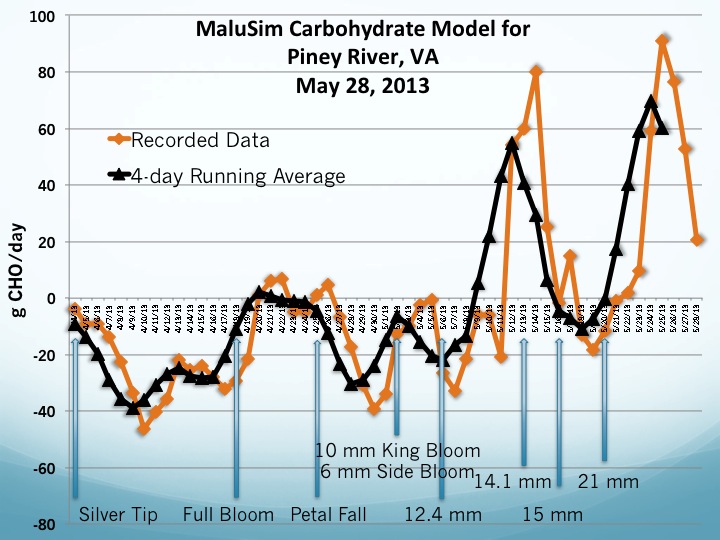
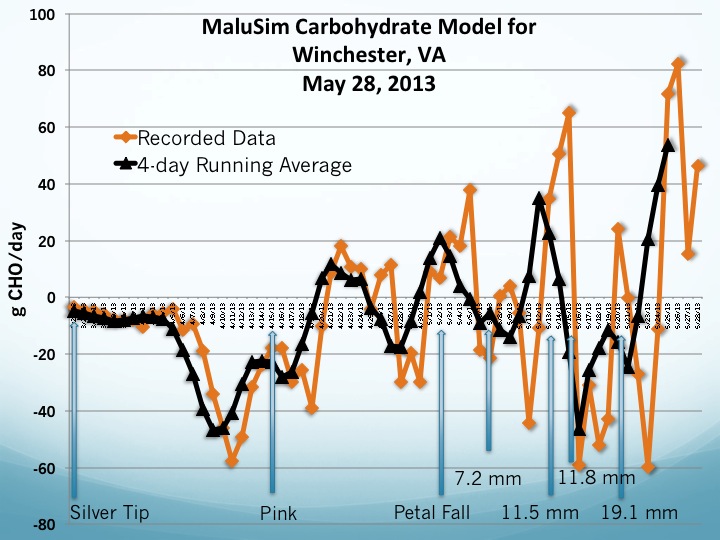
MaluSim Carbohydrate Models: 2013 Season Recap for Winchester and Central Virginia

Slide3 Slide3Attached are the final MaluSim carbohydrate models that I will run for 2013.

Please print out a copy of the below pdf file to add to your records. Later in the season, I will be asking for feedback from you about how you used the model, how well the model predicted thinner response in your orchard, and if I should continue running the model in future years. Please feel free to send me additional feedback at anytime.

Peck Central VA MaluSim 5_29_13

Peck Winchester VA MaluSim 5_28_13

Suggestions for late thinning and return bloom applications

By this time, apples in most of Virginia are 13-20 mm in fruit size. Once apples reach this size, the trees tend to be less responsive to the typical 10 mm (carbaryl plus NAA or 6-BA) applications. However, if additional thinning is needed, growers can still use ethephon (sold under the trade names Ethrel and Ethephon 2). Ethephon is most effective when fruit size is 14 to 28 mm in diameter. In most years, it is difficult to chemically thin apples larger than 24 mm.

Ethephon has variable responses due to air temperature and humidity, as well as spray water volumes. Overthinning is more likely with this material than with other thinners. For this reason, ethephon has been primarily used when earlier thinning applications were not successful, on very difficult to thin cultivars, and/or when return bloom has been a severe problem. Thinning results with ethephon varies amongst cultivars. Ethephon is not very effective on Gala, but it is very effective on Golden Delicious and Rome. Where water is alkaline, buffering the spray solution to a pH of 3 to 5 will increase chemical stability and effectiveness. Do not use before a light rain or dew or when post-application temperatures are predicted to be greater than 90˚F because excessive thinning may occur.

Ethephon is usually combined with carbaryl or oxamyl (Vydate L). For greater thinning activity, ethephon can also be tank mixed with NAA and/or spray oil.

I have several research trials underway to look at alternative and hopefully more consistent late thinning materials. However, at this time, ethephon is still the standard material when fruit size is greater than 14 mm.

Once fruit is larger than 28 mm, hand thinning will need to be used to remove additional fruit. Hand thinning will have a positive impact on final fruit size and return bloom for up to about 45 days after full bloom. In 2013, this is around the first week of June for central Virginia and the second week of June for the Winchester area.

PROMOTING RETURN BLOOM IN APPLE

Ethephon (sold under the trade names Ethrel and Ethephon 2) can promote flower bud formation when applied from petal fall to about 6 to 8 weeks after full bloom. The greatest effect is from applications made 0 to 4 weeks after bloom. However, since ethephon can cause substantial fruit thinning, multiple weekly applications at rates 1/2 that of the thinning rate are recommended starting when fruitlets are greater than 30 mm. When possible, it is best to wait until after “June” drop has occurred. At a minimum, wait 7-10 days after the last thinning application before starting ethephon return bloom sprays. Additionally, do not apply ethephon to trees that are stressed or trees that are low in vigor.

A single ethephon application can be used at a high rate (up to 900 ppm). However, more consistent results are often obtained from multiple (3-4) applications made at 10-14 day intervals using lower rates (150-300 ppm). One common, and often effective strategy, is to make two applications in June and two applications in July.

Another strategy is to make 2-4 applications of ethephon at 150 ppm tank mixed with NAA at 5-10 ppm (or 2.5-5 ppm when tank mixed with spray oil). This approach has been beneficial for strongly biennial cultivars.

Sensitivity to ethephon is very different amongst cultivars, thus it is important to choose a rate specific to each variety. Do not exceed 8 pints per acre per year. If trees are over-cropped ethephon may not effectively give adequate return bloom the following season. Higher soluble solids and lower starch levels at harvest may be expected with some cultivars, particularly with high rates and/or late season applications. No loss of firmness has been detected with ‘Red Delicious’ at the optimum harvest date.

Ethephon sprays can reduce tree growth (dependent on timing and amounts used) and thus may not be desirable for young non-bearing trees if maximum tree growth is desirable.

HAND THINNING PEACHES

Hand thinning peaches to 6-8 inches apart on the branch will result in increased final fruit size and help prevent limb breakage. This activity will be most effective when completed over the next couple-few weeks. Hand thinning peaches later in the season will not have as much of an impact on final fruit size.