I’m sure many of you have noticed how inaccurate the weather forecast was over the past 24 hours. While the minimum temperature was predicted to be 27°F, we recorded temperatures below 24°F for over an hour early this morning (4/9) at the ASH Jr. AREC research farm in Winchester. Unfortunately, this unexpected dip resulted in severe damage to both our apple and stone fruit crops. The extent of injury far exceeds what anyone might have anticipated based on the forecasted temperature profiles from Monday and Tuesday. Following the freeze event we witnessed this morning, my team collected flower samples from multiple cultivars and species across the farm. Below is a summary of our findings:
In stone fruits, Red Haven peaches showed 66% flower mortality, while SunHigh peaches experienced complete (100%) loss. Cherries were also heavily impacted, with 64% of flowers dead. Among apples, Pink Lady suffered total flower loss—100% mortality of both king and lateral flowers. ‘Honeycrisp’ on MM.111 rootstock showed the most severe damage, with 92.5% king and 87.2% lateral flower mortality. On B.9 rootstock, ‘Honeycrisp’ fared slightly better but still showed high injury levels (90% king and 47% lateral mortality). ‘Gala’ trees showed 75% mortality in king flowers and 47% in lateral flowers, while ‘Fuji’ was the least affected—likely due to being slightly behind in development—with only 18% and 15% mortality, respectively. ‘Red Delicious’ experienced consistent and heavy damage, with 100% king flower mortality and lateral flower losses ranging from 75% to 85%, averaging around 81%.
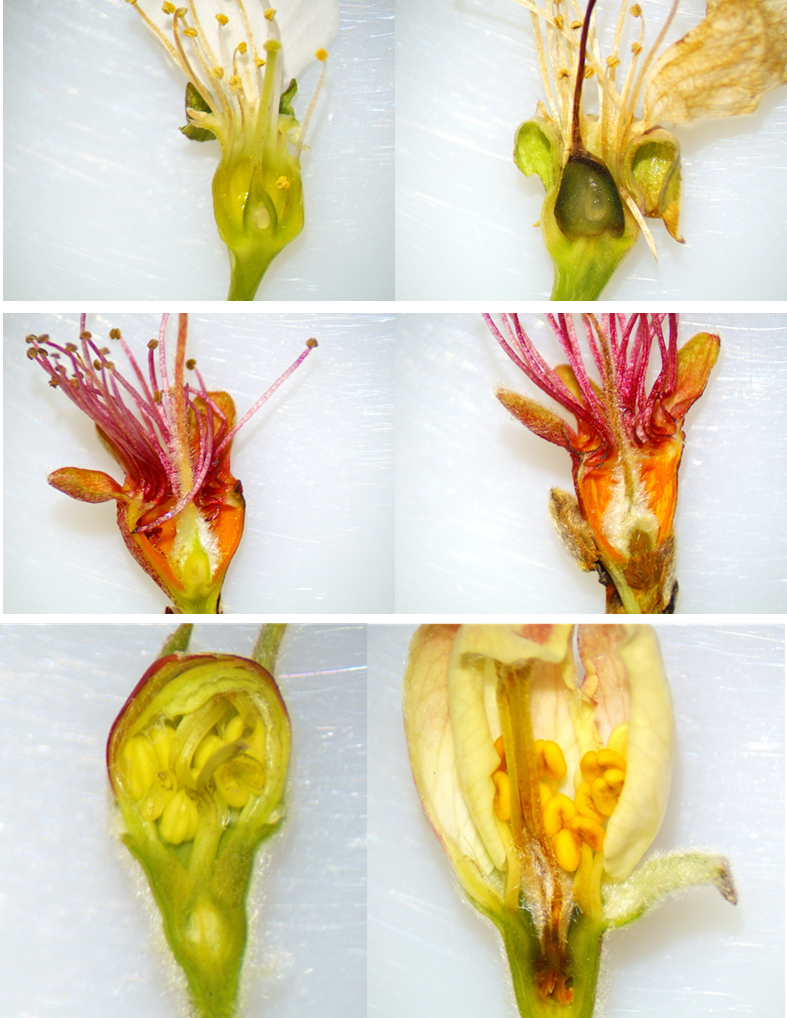
Representative flower buds of cherries, peaches, and apples (top to bottom), showing live (left) and dead (right) flowers. These cross-sections were taken from trees at the AHS Jr. AREC research farm following a brief but intense freeze event on April 9, 2025.
I strongly encourage all growers to carefully assess their own orchards—don’t rely solely on visual inspection from the outside. I was surprised to find that several peach flowers appeared normal until I dissected them, only to find the ovaries completely dead. Keep in mind, your apple thinning decisions will hinge heavily on the extent of damage caused by this freeze. I’ve attached several images (see above) to help illustrate what we’re considering alive versus dead when evaluating flower buds.
It’s that time of year when we all stay on our toes, watching closely for any spring freeze that might harm our delicate pome and stone fruit blossoms. So far, flower development has been progressing slowly but steadily, and everything looks fine. This year is not shaping up to be a heavy bloom year for apple orchards—especially in Frederick County and, to some extent, in southwest Virginia, though for two entirely different reasons.
In Frederick County, I predicted last year that flower development for 2025 would likely be suboptimal. This is due to a severe carbohydrate deficit we experienced around the time of flower bud initiation (mid-April to the first 10 days of May 2024). That deficit not only contributed to fruit abscission last season but also appears to have impacted flower bud development for this year. So if you’re seeing fewer blooms, it’s not your fault. In Southwest Virginia, on the other hand, any reduction in bloom is more likely tied to the secondary bloom that occurred last fall following Hurricane Helene. I don’t expect this to significantly affect all crops or locations, but if you noticed extensive secondary bloom in your blocks last fall, those trees will likely show reduced bloom this spring.
Now, regarding the upcoming frost: I remain optimistic that things will turn out just fine, even with the predicted freeze on Wednesday morning. This will be a typical radiative freeze—clear skies, low wind—which causes cold air to settle near the ground and warmer air to rise. The lowest temperatures are expected right before sunrise, and once the sun is up, things should return to normal quickly. Here in the Winchester area, the forecast shows a low of 26°F lasting for about one hour. Other areas, such as Rappahannock, Madison, and Nelson counties, are projected to reach 28–29°F.
Is that critical? Not really. Even if apples, peaches, or cherries are at full bloom, such a brief dip will likely cause only about 10% blossom damage. That level of damage is often considered a natural and even beneficial thinning. In fact, such frost events can act as a signal to the tree to initiate more flower buds for the following season, helping ensure a strong bloom next year. So—no major concerns, unless you observe temperatures that fall within the critical ranges capable of killing 90% or more of your flowers (refer to the critical temperature table https://irp.cdn-website.com/45c0e18f/files/uploaded/Critical_Temperatures_Frost_Damage_Fruit_Trees_Utah.pdf
Should you turn on wind machines or irrigation (under-tree or over-tree sprinklers)? That’s your call. Personally, I wouldn’t, as long as temperatures stay within the forecasted range. But if you want to play it safe, it wouldn’t hurt—especially in low-elevation or frost pocket areas where these tools can truly make a difference. Since it’s a radiative freeze, both wind machines and sprinklers can be effective. Let’s hope for the best and I look forward to seeing you all at our upcoming orchard meetings!
It’s a beautiful day out there, so let’s enjoy it as it is and stay positive—no need to keep checking the weather station just yet! Since most of our apple cultivars are between tight cluster and full bloom, I wanted to send a quick reminder about some important considerations for early-season nutrient and growth regulator applications during this critical stage.
Pre-Bloom Foliar Nutrient Sprays: The Nutrient Cocktail
A common and effective approach during the tight cluster to pink bud stage is to apply a foliar “nutrient cocktail” of nitrogen, boron, and zinc (if possible). Nitrogen (Urea) A foliar urea spray can boost nitrogen levels in developing buds and spur leaves. This helps strengthen bloom and improve early fruit set. • Apply a low-biuret urea at 3 lb per 100 gallons of water (dilute spray). Make sure the biuret content is below 0.25% to avoid leaf damage. • Nitrogen is vital for rapidly expanding tissues. Pre-bloom applications support both flower and shoot development. Boron If your boron levels were low last season or you’re looking to support flower fertility, now is the time. • Apply a spray-grade boron product (e.g., Solubor®) at 1 lb per 100 gal (~0.2 lb actual B). • Boron is essential for pollen viability and pollen tube growth. Even mild deficiencies can reduce fruit set. Zinc Zinc deficiency is fairly common, especially in certain soils and older blocks. • Include zinc EDTA chelate at label rate in your foliar spray. Avoid zinc sulfate at this timing if frost or oil applications are nearby, as it can cause tissue damage. • Zinc plays a key role in enzyme activation and pollen formation. Early sprays ensure flowers and young leaves develop properly. Pro Tip: Tank-mix this nutrient spray with early-season fungicides but always check for compatibility.
Bloom-Time Nutrient Applications
Boron at Bloom A repeat boron application at pink or full bloom supports fertilization and early fruit development. • Apply 2.5–5 lb/acre of Solubor (equivalent to 0.5–1.0 lb of actual B). • This timing helps secure pollen germination and supports calcium movement into developing fruit. Just be careful not to overdose. Early Calcium Sprays Calcium uptake is critical in the early weeks after bloom, especially for sensitive varieties like Honeycrisp. • What to do: Begin foliar calcium applications at pink or early bloom, and continue through the early cover sprays. • Rates: Use 2–4 lb of calcium chloride (CaCl₂) per 100 gallons of spray. Include a non-ionic surfactant and apply during fast-drying conditions to avoid leaf burn. • Why it matters: Calcium builds strong fruit cells and reduces the risk of bitter pit and other disorders. Early sprays are particularly effective. • Spray safety: Avoid mixing calcium sprays with Apogee or Kudos. Foliar Urea at Bloom Foliar nitrogen can give your fruit set a helpful boost during bloom, especially if your trees are weak or suffered frost damage. • What to do: Apply 3 lb of urea per 100 gal at bloom, and 5–6 lb per 100 gal at petal fall. • Why it matters: Urea helps prolong flower viability and encourages strong fruit development. It supports cell division in young fruit, improving size at harvest. • Caution: Avoid using foliar urea beyond the second cover spray — late-season nitrogen can hurt color development. Prohexadione-Calcium (Apogee® or Kudos®): Managing Tree Growth When applied at the right time, prohexadione-calcium helps you control excessive shoot growth, open up your canopy, and even reduce fire blight risk — all while improving fruit calcium allocation. Application Timing • When to apply: At the pink bud stage, or early bloom at the latest, when shoots are 1–3 inches long. • Split plan: Apply 6 oz/acre at pink, and repeat in 2–3 weeks (e.g., at petal fall). Mixing Tips • If your water is hard, add 1–2 lb of ammonium sulfate (AMS) per 100 gal to condition it. • Add a nonionic surfactant to improve uptake (follow label rates). • Do not mix Apogee with calcium or boron — these reduce its effectiveness. Honeycrisp Consideration Apogee is especially valuable on Honeycrisp. It helps reduce the competition for calcium, lowering the risk of bitter pit. Just be sure there’s enough leaf tissue present before spraying to ensure good absorption.
From the thinning treatments conducted between April 28-30 in the Winchester/Frederick County area, we can now observe a noticeable difference in fruit size within the same cluster. The smaller fruits, which are likely to fall off, can now be easily detached with a gentle touch or slight pull. As for the chemical thinning applied last week (May 2-3), the results are starting to become visible for some, but not all, varieties. It’s important to note that due to several days of low carbohydrate levels, as expected, some fruits have started to drop naturally—without any chemical intervention. These fruitlets measure between 8-11 mm in diameter. The fruits that are responding to our thinning from 10-12 days ago are about 13-15 mm in diameter. Therefore, hold off on deciding whether to apply another thinning treatment based on the smaller fruits under 11 mm. Wait a bit longer to see how the last treatment worked, checking for clear size differences in the same cluster or if the fruits can now be easily pulled off.
Apple fruitlets from a Pink Lady apple tree, displayed in two groups. The upper section shows fruitlets with diameters of 8-11 mm that have either fallen or are about to fall due to natural fruit abscission. The lower section presents fruitlets measuring 13-16 mm, which detach easily upon touch or gentle pull, indicating a response to the chemical thinning applied on April 29th. Some king fruits now measure 24 mm.
If you find that your fruit size is still under 18 mm and you need another thinning pass, you can still use 6-BA and NAA products along with carbaryl and a surfactant—or better yet, oil. For fruits averaging 15-20 mm, Accede can be used. It contains 10% of ACC, a precursor to the ethylene hormone, crucial for this process. You should apply 23-46 fluid ounces per acre, ideally when the king fruit is between 15-20 mm. If the temperature is above 90°F on the day you plan to apply, consider reducing the rate. For best results, apply Accede in slow drying conditions, like early morning or at night.
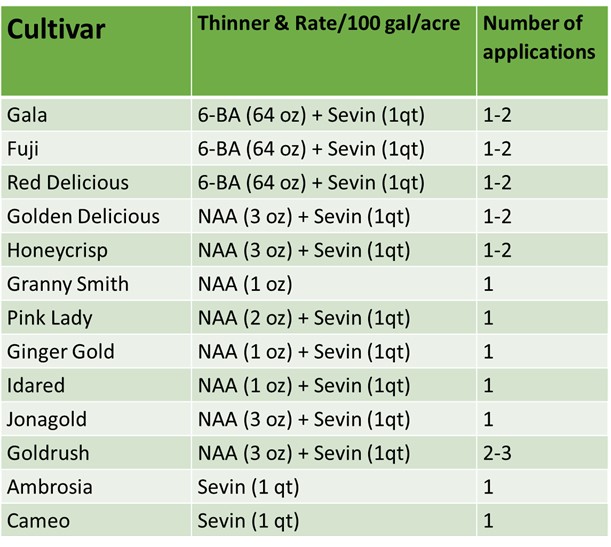
On the other hand, Ethephon is best for ‘rescue thinning’ when your fruits are between 18-25 mm. Ethephon works best when temperatures are between 70-80°F on the day of application and the following two days. Avoid using Ethephon when it’s cooler than 70°F or hotter than 80°F, as it may be ineffective or cause overthinning. Also, don’t use it if the forecast predicts temperatures over 85°F for the application day or the next two days. When applying Ethephon, use at least 100 gallons per acre to ensure effective distribution. Please refer to the attached table for the rates of ethephon and carbaryl for different cultivars, based on the research by Autio and Cowgill (https://ag.umass.edu/fruit/fact-sheets/f-129r-late-season-rescue-thinning-with-ethephon).
In the Winchester/Frederick County area, it appears that apple trees may be overly responsive to thinning treatments applied this week (May 6-10). Therefore, I generally advise against implementing any thinning treatments during this period, especially if you have already done so at petal fall (April 25-26) or the previous week (April 29-May 3). Examining the carbohydrate balance chart below, it’s evident that trees have been consistently deficient since April 24. While this deficiency is typically conducive to chemical thinning treatments, it also poses a risk of natural fruit abscission. Given the forecasted temperatures exceeding 80°F with mostly cloudy days this week, I anticipate further carbohydrate deficiency. If you administered the first thinning treatment on April 25-27, you should observe its effects this week (May 7-8). However, if your initial treatment was conducted last week (April 29-May 2), simply wait until May 12-13. By then, you should notice some fruits dropping off easily upon touch, with a noticeable difference in size between retained and dropping fruits.
Apple Carbohydrate Thinning Model-Weather Station (Winchester, VA), Gala- Green tip (March 7), Full Bloom (April 14)
The situation in Central Virginia presents less risk, with more days of carbohydrate surplus following full bloom. Nevertheless, there has been a significant decline in carbohydrate balance this past week, likely to persist due to high temperatures and reduced solar radiation on certain days this week. Hence, I also advise against thinning treatments this week, recommending waiting until May 10th to ascertain if carbohydrate levels stabilize. Growers who have already applied two thinning treatments (at petal fall and last week) likely have completed thinning for the season, achieving an optimal crop load. For those who applied their first treatment on April 28-30, trees are likely to respond favorably to thinning materials, with a noticeable size separation expected this week (May 8-10).
Apple Carbohydrate Thinning Model-Weather Station (Roseland, VA), Gala- Green tip (March 12), Full Bloom (April 12)
With the high daily temperatures we’re experiencing this week, the degree days for Gala and most other apple cultivars in the Winchester/Frederick County area will likely reach the 200DD mark today. This signals the optimal timing for chemical fruit thinning using 6-BA-carbaryl and NAA-carbaryl mixes. I utilized the carbohydrate thinning model on NEWA (https://newa.cornell.edu/apple-carbohydrate-thinning), based on a green tip date of March 7 and full bloom date of April 14 for Gala in my location. The model indicates a severe carbohydrate deficiency, which is very conducive to thinning conditions. It also recommends reducing the chemical thinning materials by 15% compared to standard rates. Please refer to my previous posts ((https://treefruithorticulturevaes.wp.prod.es.cloud.vt.edu/2024/04/18/apple-fruit-thinning-general-notes-and-specific-recommendations-for-central-virginia/) for the standard rates I’ve recommended and adjust your calculations accordingly. You have a four-day window (April 30 to May 3) to complete your thinning applications. The temperatures over the next few days are expected to be above 80 degrees Fahrenheit, which is ideal for both the uptake and activity of 6-BA and NAA products.
Apple Carbohydrate Thinning Model-Weather Station (Winchester, VA), Gala- Green tip (March 07), Full Bloom (April 14
I believe this is the ideal time to schedule your thinning applications for Gala and other cultivars with a green tip date around March 12 and a full bloom date of April 12. In some areas, Honeycrisp and Fuji reached full bloom a week after Gala. Therefore, make sure to check the Carbohydrate Thinning Model on the NEWA website (https://newa.cornell.edu/apple-carbohydrate-thinning) and input the exact dates for your cultivars. Using the weather station data from Roseland and Gala’s phenology data, I ran the model and here are the outputs: three positive indicators for good thinning conditions. First, the accumulated degree days are expected to reach the optimal range of 200-250 DD by this Sunday, April 28. Second, the 6-D weighted average of tree carbohydrate balance is showing a promising decline as we approach April 28. Third, the current weather forecast predicts next week’s temperatures will exceed 80°F, which is ideal for the effectiveness of 6-BA and NAA treatments, with partially cloudy days contributing to the carbohydrate deficiency needed for effective thinning. If this is your first thinning treatment for Gala this year, aim for Sunday, April 28 through Tuesday, April 30. However, if you have already applied a thinning treatment at petal fall, delay your next treatment until the end of next week, around May 2 and May 3, to observe the effects of the initial application.
Apple Carbohydrate Thinning Model-Weather Station (Roseland, VA), Gala- Green tip (March 12), Full Bloom (April 12)
In the scenic Winchester/Frederick County area, apple growers are witnessing varied stages of growth across different apple cultivars. Currently, cultivars such as Fuji and Honeycrisp are at the partial petal fall stage, while Gala and Red Delicious have reached complete petal fall. Most notably, the Pink Lady cultivar has reached the critical >6 mm diameter stage, making it the ideal time for fruit thinning.
It’s important to time the application of chemical thinning agents, such as 6-BA and NAA, accurately. According to the Apple Carbohydrate Thinning Model on Cornell’s NEWA website (https://newa.cornell.edu/apple-carbohydrate-thinning), the current predictions for accumulated degree days (DD) for Pink Lady apples in Winchester suggest reaching the 200-250 DD window by Thursday, April 25, and continuing through most of the next week. While the model indicates a daily carbohydrate surplus, which isn’t ideal for thinning, a forecasted drop in carbohydrate levels by April 27 should be closely monitored. This dip, though minor, will likely influence the 6-D weighted average, which is a crucial metric for thinning effectiveness.
If you’re targeting a thinning application for cultivars like Pink Lady, which had a green tip date of March 2nd and a full bloom date of April 8, post-April 25th is advisable for starting treatments. The weather forecast suggests that April 28, April 29, and May 1 will offer optimal conditions—both temperature-wise and in terms of carbohydrate levels—for the effectiveness of 6-BA and NAA treatments.
Apple Carbohydrate Thinning Model-Weather Station (Winchester, VA), Pink Lady- Green tip (March 2), Full Bloom (April 8)
Turning our attention to the Gala cultivar, it hasn’t yet reached the 200-250DD window. However, for those keen on applying a thinning treatment at petal fall, the upcoming Sunday or Monday is recommended. Following this initial treatment, it’s advisable to wait at least 10 days before the subsequent application, ideally timed for when the cultivar enters the 200-250DD window.
Apple Carbohydrate Thinning Model-Weather Station (Winchester, VA), Gala- Green tip (March 7), Full Bloom (April 14)
In various parts of Virginia, apple orchards are currently transitioning through stages ranging from full bloom and petal fall to having fruits about 6-18 mm in size. Given this period of active growth, it’s an ideal time to discuss the crucial practice of apple fruit thinning—especially vital this year due to the heavy bloom and minimal spring frost damage. Proper thinning is essential; without it, the excess blossoms and small fruitlets from this year could negatively impact both next year’s yield and the quality of this year’s harvest. The development of next year’s flowering buds in apples is largely determined during the first four to five weeks post-full bloom. In years with heavy bloom and fruit set, like this one, failing to adequately thin can lead to too many fruits drawing on the tree’s carbohydrates. This overburden can drastically reduce the number of viable buds for the following year, potentially resulting in no crop for varieties prone to alternate bearing, such as Honeycrisp, Fuji, and Winesap.
Moreover, maintaining too many fruits on the tree can also degrade fruit size and overall quality at harvest—particularly for the Gala variety. It’s important to note that fruit size at harvest is primarily influenced by the rate of cell division and the total number of cells per fruit, rather than merely by cell expansion. This cell division occurs mainly in the initial weeks following full bloom, making it critical to reduce competition among the fruitlets so that more resources are directed to fewer fruits, thus enhancing their growth and quality.
With these points in mind, I’d like to offer some specific recommendations for thinning applications at petal fall and the 6-18 mm fruit size window (the main thinning window). At the end of this post, I will also share outputs from the Carbohydrate Thinning Model and my personal advice for apple growers in Central Virginia and other regions currently within the 6-18 mm fruit size stage. For those in the Winchester and Frederick County areas, where orchards are still transitioning between full bloom and petal fall, other posts will follow as needed.
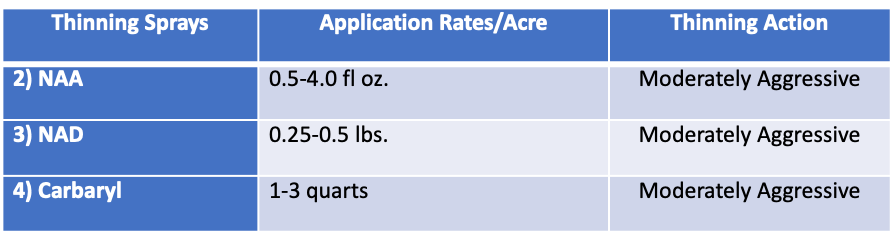
Effective thinning sprays at petal fall to 5 mm fruit diameter.
Notes: • To prevent the formation of pygmy fruit, avoid applying NAD and NAA to Red Delicious and Fuji apples after petal fall. • When using NAD as a thinning spray, ensure that the spray volume is at least 100 gallons per acre, as lower spray volumes may decrease efficacy. • Carbaryl can be used alone as a thinning spray between petal fall and when the fruit diameter reaches 15 mm. However, it is more commonly used in combination with either NAA or 6-BA when the fruit diameter is between 7 and 15 mm. • When using carbaryl alone, increasing the rate of application will not enhance thinning activity, as carbaryl’s effectiveness is not highly responsive to changes in application rate.
Recommended chemical materials and rates for thinning fruits (6-15 mm)
Notes: • Exilis 9.5 SC contains a high concentration of 6-BA (9.51%) compared to Maxcel (1.9%) and Exilis Plus (2%). Refine is available in two concentrations: Refine 3.5 and Refine 6.25, with the latter having a higher concentration of NAA. All dosages in the table are based on the concentrations found in Maxcel (6-BA) and PoMaxa (NAA). • The recommended application rates in the table are for mature trees (6 years or older). For younger trees (4th and 5th leaf), reduce the rate by 25% to 50%. • Do not use less than 100 gallons per acre for thinning treatments. • Thinning is more difficult in the upper parts of the canopy compared to the lower parts. • Thinning is easier when the crop is heavy, as opposed to when the crop is light. • Use the carbohydrate thinning model to time your thinning applications. Alternatively, as a general rule of thumb: Thinning is more challenging when it is sunny; overcast conditions for 2 to 3 days facilitate easier thinning; thinning materials are less effective in cool weather (below 65°F) and more effective in warm weather (above 70°F).
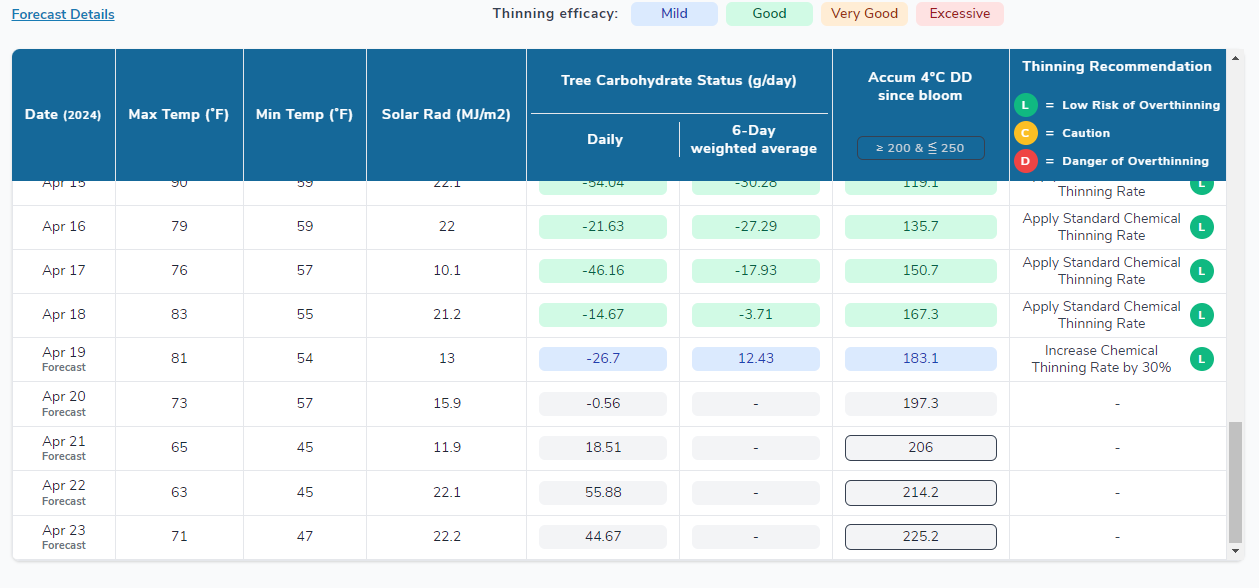
Apple Carbohydrate Thinning Model Outputs-Pink Lady- Roseland-VA
The Carbohydrate Thinning Model uses critical environmental factors such as temperature and solar radiation to assess the carbohydrate status of trees. This status helps determine how trees will respond to chemical thinning agents. When trees are in a carbohydrate-deficient state, they are more likely to shed fruit, making them more receptive to thinning applications. Conversely, when conditions are favorable for photosynthesis—sunny and warm—trees are less likely to respond to thinning as they prefer to retain their fruits. Remember, fruits carry seeds, and seeds represent the future generation of trees—an easy concept to grasp. The model doesn’t rely on a single day’s data; instead, it averages the carbohydrate balance over six days to decide if a tree has a deficiency or surplus. This helps determine whether to apply treatments, how much response to expect from the trees, and whether to adjust the quantity of thinning materials to avoid over- or under-thinning. The model also tracks accumulated degree hours from the time of bloom, which is why knowing the exact day of full bloom is crucial. It predicts the optimal thinning period, which usually occurs between 200 to 250 degree days (DD)—coinciding nearly perfectly with the 6-18 mm fruit size window.
Based on data from the weather station in Roseland, VA, and the growth stages of Pink Lady and Gala apples, the model predicts that by Saturday, April 20, Pink Lady trees will reach about 200DD. This is the ideal time to start applying thinning materials, continuing through the 250 DD mark. However, the model also indicates a carbohydrate surplus on April 19 and the following three days. Therefore, it recommends increasing the thinning material rate by 30% above standard. Since the forecast predicts temperatures above 70°F this Saturday, which enhances the uptake and efficiency of agents like NAA and 6-BA, thinning applications are best done on that day.
Apple Carbohydrate Thinning Model-Weather Station (Roseland, VA), Pink Lady- Green tip (March 4), Full Bloom (April 6)
For Gala apples, which reached green tip on March 12 and full bloom on April 12, the 200-250DD window has not yet been reached. Nonetheless, if you wish to apply chemical thinning now using 6-BA and carbaryl to promote cell division, you can use 48 fl oz of 6-BA and 1 pt/100 gal of carbaryl. However, it’s important to wait at least 10 days to observe the effects of this treatment before proceeding with another. Based on the current weather forecast and degree days, the 6-18 mm fruit size window should still be open in 10 days if you decide on a second thinning application.
Apple Carbohydrate Thinning Model-Weather Station (Roseland, VA), Gala- Green tip (March 12), Full Bloom (April 12)
Apply 4-14 pounds of actual calcium per acre each season to help prevent bitter pit and cork spots. This amount is equivalent to applying 15-50 pounds of calcium chloride (CaCl2) or distributing 2-8 pounds of CaCl2 per cover spray.
For apple varieties that are particularly susceptible to bitter pit, such as Honeycrisp, Golden Delicious, and York Imperial, it is advisable to use the maximum recommended concentration of calcium.
Initiating calcium applications early in the season, starting at the Pink stage of bud development, is more beneficial than applications later in the season.
Foliar applications of calcium nitrate are not advised for Delicious and York apple varieties, as they can induce symptoms similar to cork spot.
In orchards with significantly low calcium levels, applying calcium sulfate (gypsum) in a band beneath the trees at a rate of 3 tons per acre can improve calcium content in the leaves and fruit. However, it may take two years or more to observe positive outcomes.
Avoid applying calcium chloride under conditions that slow drying, such as in the early morning, as it can harm the foliage. This is especially important for apple varieties sensitive to calcium chloride, including Idared and Golden Delicious.
A deficiency in boron can hinder the movement of calcium within the tree, potentially affecting fruit quality.
Boron applications:
Boron plays a crucial role in the development of flowers and the setting of fruit. A lack of boron can adversely affect both yield and the size of the fruit.
Furthermore, boron is necessary for the transportation of calcium within the plant. A deficiency in boron can lead to disorders related to calcium deficiency, such as bitter pit and cork spot in apples.
To avoid these problems, it is recommended to apply 0.5-1 pound of boron per acre, which is equivalent to applying 2.5-5 pounds of Solubor per acre.
Boron should be applied either at the pink or bloom stage of flower development, mixed in the tank with calcium chloride, or 7-10 days following the fall of the petals.
Prohexadion calcium:
Applying prohexadione calcium (PC), found in products like Kudos and Apogee, early in the season at the Pink stage can significantly reduce the incidence of bitter pit and blossom blight, as well as decrease the risk of shoot blight.
For optimal results from PC treatments, consider the following guidelines:
Apply PC at a rate of 6 ounces per acre.
PC’s effectiveness decreases in environments with high pH levels or in water with a high concentration of calcium carbonate (hard water). To counteract this, add ammonium sulfate (AMS) to the spray mixture.
Avoid combining PC with calcium or boron in the spray mix, as interactions may diminish efficacy.
Enhance the performance of PC applications by including a surfactant in the tank mix. This helps in better distribution and adherence of the product on plant surfaces.
Should the surfactant cause foaming, incorporate an anti-foaming agent to mitigate this issue.
Both Kudos and Apogee are approved for application at the Pink stage for apples, indicating a targeted timing for use.
Research by Sherif in 2019 (unpublished) suggests that applying PC concurrently with or before thinning agents like 6-BA or NAA does not compromise the effectiveness of thinning treatments.
Urea applications
Applying urea to the foliage during the bloom period (at a rate of 3 pounds per 100 gallons of water) and subsequently at petal fall and the first cover spray (5-6 pounds per 100 gallons of water) can significantly support cell division. This practice is especially beneficial for Gala apples. Such applications become critical when the primary, or king blooms, which typically produce the largest fruits, are lost to frost damage.
The foliar application of urea at the time of bloom can also improve fruit set by prolonging the period of effective pollination, enhancing the chances of fertilization and subsequent fruit development.
It’s important to note that foliar-applied nitrogen, while beneficial for fruit set and sizing, does not substitute for soil-applied nitrogen fertilizers. Unlike ground applications, foliar-applied nitrogen does not move into the tree’s woody structure but is instead directly utilized for the development of the fruit.
Fruit Russeting in Golden Delicious and Scarf Skin in Gala:
Fruit russeting and scarf skin in apples is often associated with high humidity during the first 30-40 days of fruit development.
To address this issue, apply 2-4 applications of GA4+7 (such as ProVide 10SG or Novagib 10L), starting from petal fall and continuing at 7-10 day intervals.