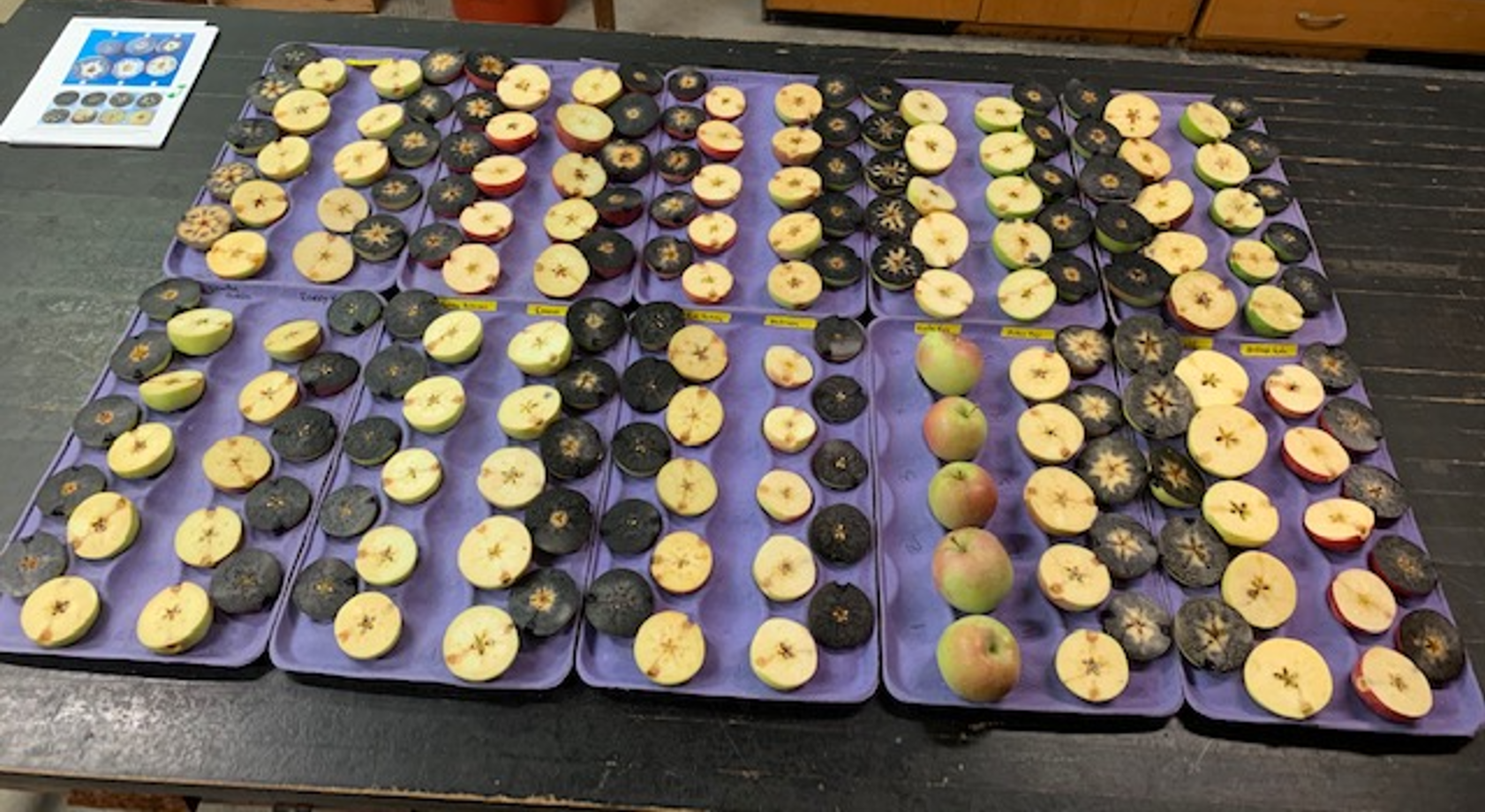
The assessments of fruit maturity parameters were conducted at the AHS Jr. AREC, Winchester, VA. Fruits for CA storage should be harvested at starch index (3 – 5), firmness (> 16 lb), and DA reading (0.60). Fruits intended for fresh consumption should be picked at starch index (5.5 – 7), firmness (13 – 16 lb), DA reading (0.35) and Brix (12-14%). Starch iodine tests for 19 apple cultivars grown at the AHS Jr. AREC, Winchester, VA. Starch values were estimated according to the Cornell starch index (1-8). The recipe for the starch iodine test was described in a previous post ((https://treefruithorticulturevaes.wp.prod.es.cloud.vt.edu/2012/08/23/harvest-maturity-resources/)
Sherif M. Sherif, Assistant Professor of Horticulture at Virginia Tech, School of Plant and Environmental Sciences, AHS Jr. Agricultural Research and Extension Center 595 Laurel Grove Road, Winchester, VA 22602 Tel. 540-232-6035, Email: ssherif@vt.edu
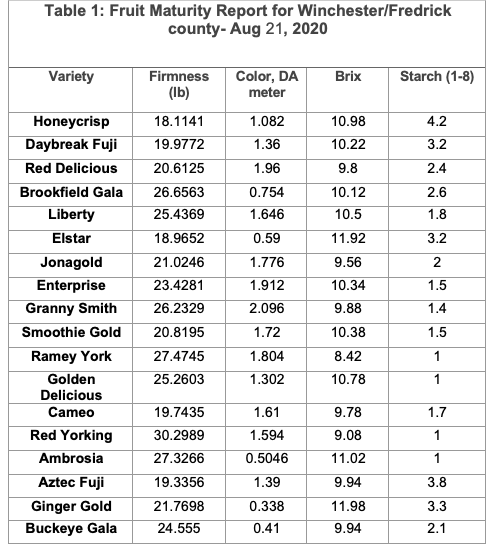
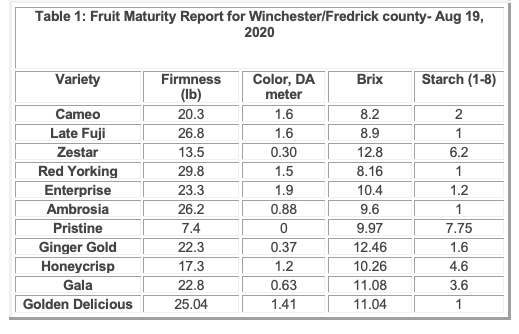
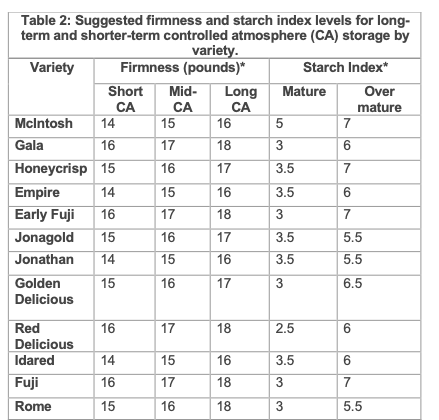
Below is the apple maturity report for the Winchester/Fredrick county area. We measured fruit firmness (lb), fruit color, total soluble solids (Brix), and starch conversion rate (1-8 index) for 11 apple cultivars grown in the AHS Jr. AREC’s and we will keep sending similar reports throughout the harvest season to help you decide the optimal harvest date for your cultivated blocks. More varieties will be added to or dropped from the table below as we move through the harvest season. We have assessed fruit firmness, Brix, and starch index according to the methods we described previously in another blog post (https://treefruithorticulturevaes.wp.prod.es.cloud.vt.edu/2012/08/23/harvest-maturity-resources/). We used a DA meter to assess fruit coloration. The DA device measures the chlorophyll content in the fruit, just below the skin. As the fruit ripens, chlorophyll degrades, and DA readings decline accordingly. Starch index, fruit firmness and, ‘to some degree’, Brix values, are used either alone or in combination to determine the harvest date for most commercial apple varieties. In Table 2, you will find the estimated firmness and starch index values at which apples should be harvested for Controlled atmospheres (CA) storage or fresh consumption. If you don’t see your variety in the list, you can generally pick your fruits at starch index (3-5), firmness (> 16 lb), and DA reading (0.60) for CA storage. But if the crop is intended for fresh market, then wait until the starch index (5.5-7), firmness (13-16 lb), DA reading (0.35) and Brix (12-14%). Again, there are varietal differences, so it’s always recommended to use more than one maturity index to determine the optimal harvest time.
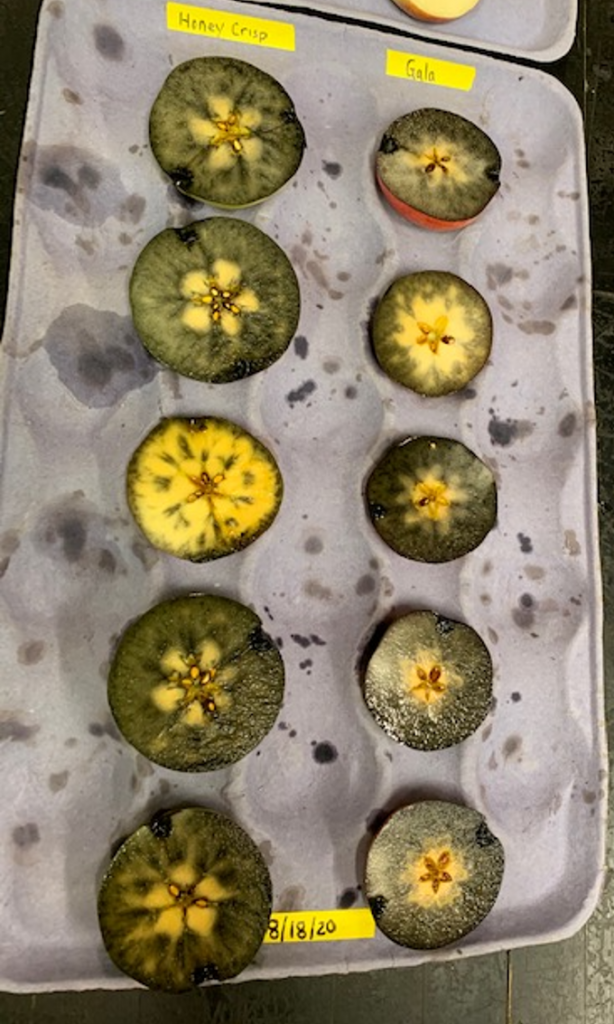
The values represent the average of 5 fruit/each variety. The starch-iodine test for Gala and Honeycrisp apples- Aug 18, 2020This table was adapted from the Michigan State University website
Sherif M. Sherif, Assistant Professor of Horticulture at Virginia Tech, School of Plant and Environmental Sciences, AHS Jr. Agricultural Research and Extension Center 595 Laurel Grove Road, Winchester, VA 22602 Tel. 540-232-6035, Email: ssherif@vt.edu
Sherif M. Sherif, Assistant Professor of Horticulture at Virginia Tech, School of Plant and Environmental Sciences, AHS Jr. Agricultural Research and Extension Center 595 Laurel Grove Road, Winchester, VA 22602 Tel. 540-232-6035, Email: ssherif@vt.edu
Greetings, The weather network predicts a sunny and warm weather this week, and you might feel it’s the time to give thinning your best shot. So, let me remind you that thinning treatments take at least 7 days to show an effect if the weather was warm; and almost two weeks (if not more) if the weather was cold. With all the cold weather we had in the past two weeks, if you applied a thinning treatment two weeks ago, you should start seeing an effect on the tree now. However, if your last thinning treatment was a week ago, you should give it 4 more days (from today) to check your trees and see if more thinning is required.
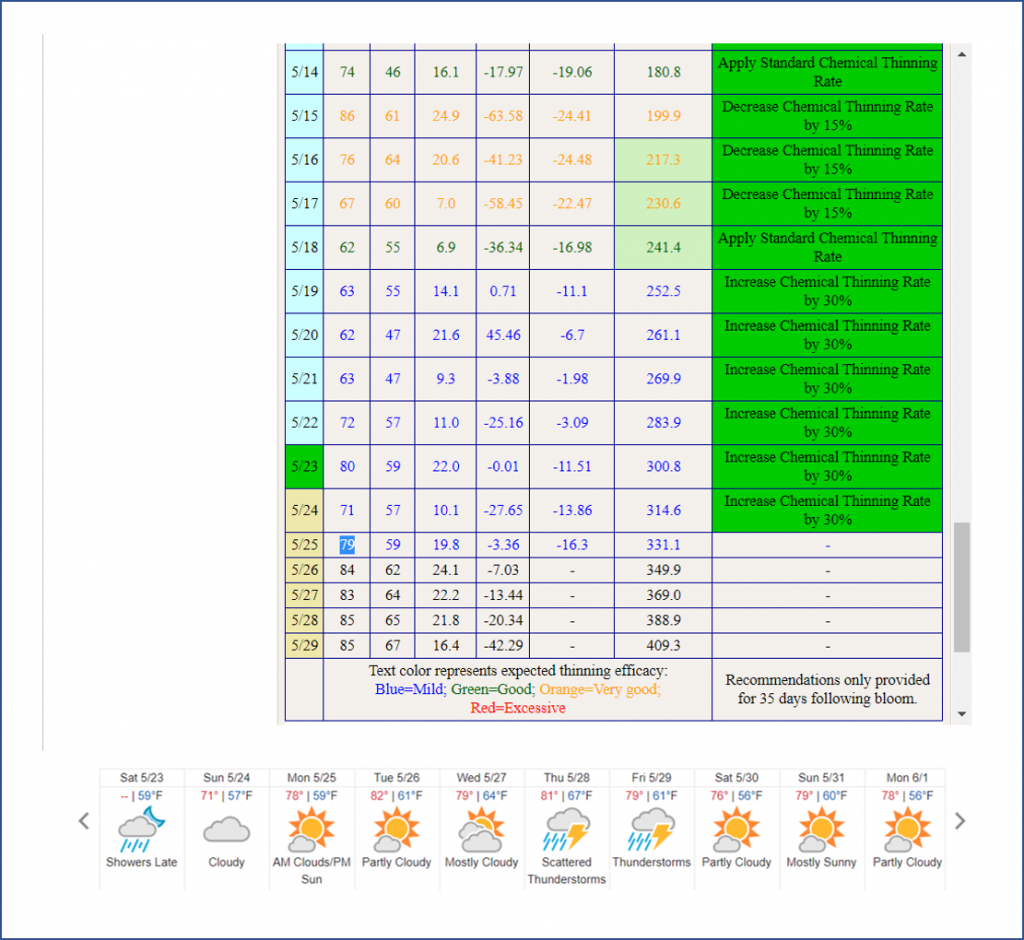
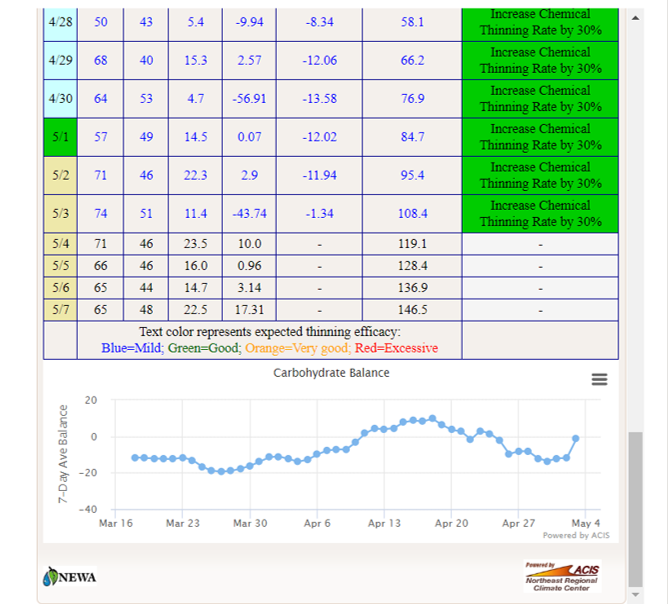
If you will apply any thinning treatment tomorrow or Monday (May 24, 25), the carbohydrate model suggests increasing the rate of thinning materials by 30%. I, however, would recommend applying the standard rate. Temperatures are expected to be above 85 OF for several days by the end of this week, which may put the trees under stress, turning them oversensitive to thinning materials. This year, it’s normal to see on the same tree fruit that are 18-22 mm in diameter and others that range between 11-14 mm. Thinning treatments by 6-BA and NAA will only be effective on fruit that are less than 18 mm in diameter.
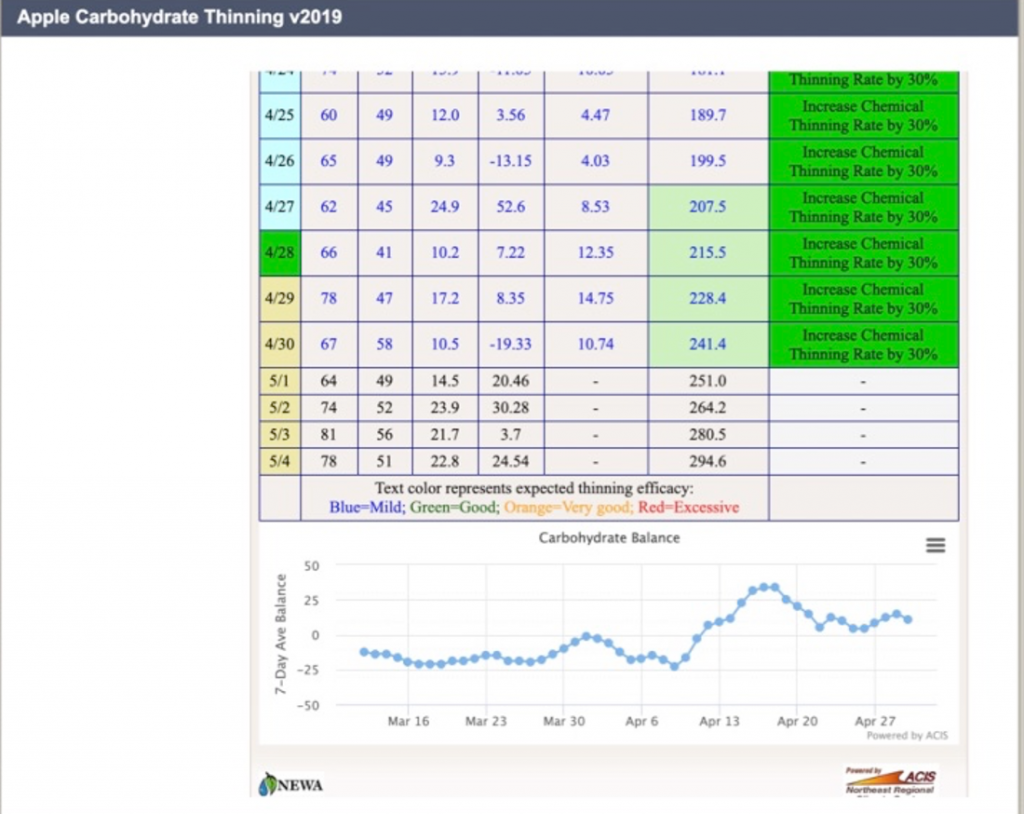
The carbohydrate thinning model for Gala apples in Winchester, VA. Green tip date= 3/16; Bloom date=4/20; Percent flowering spurs (51-75%).
Sherif M. Sherif, PhD Assistant Professor Virginia Tech, School of Plant and Environmental Sciences, AHS Jr. Agricultural Research and Extension Center 595 Laurel Grove Road, Winchester, VA 22602 Tel. 540-232-6035 Email. ssherif@vt.edu
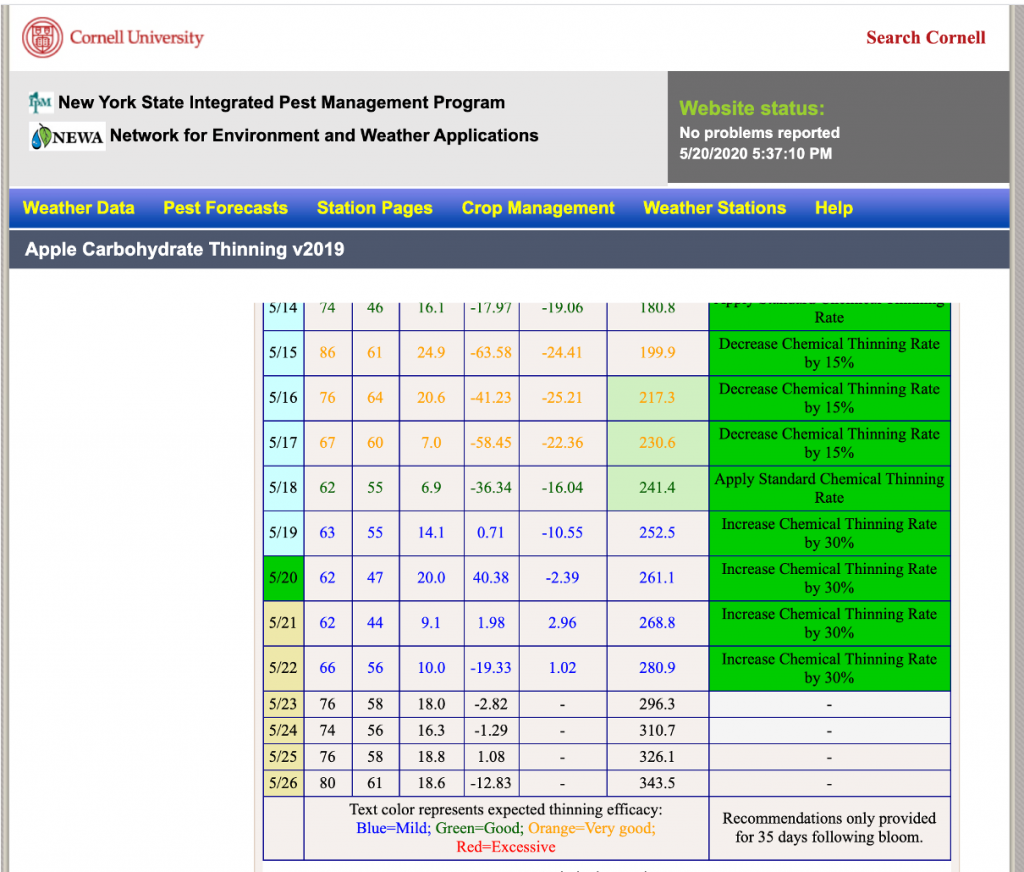
If you plan to put any thinning treatments tomorrow or Friday, the model suggests increasing the chemical thinning rate by 30%. I would recommend postponing thinning treatments until Saturday or any day next week for three reasons: a) 6-BA and NAA treatments will be more effective as average daily temps. are predicted to be above 70 oF. b) only apple clusters from late bloom will be responsive to your thinning treatments whereas those resulted from early bloom and that represents the primary crop would be less affected by thinning next week; and c) Fruits affected by past frost events would be more likely fallen by that time, allowing you to make a better assessment of your crop load and the need for any further thinning.
Sherif M. Sherif, Assistant Professor of Horticulture, Virginia Tech, School of Plant and Environmental Sciences, AHS Jr. Agricultural Research and Extension Center, 595 Laurel Grove Road, Winchester, VA 22602 Tel. 540-232-6035 , Email: ssherif@vt.edu
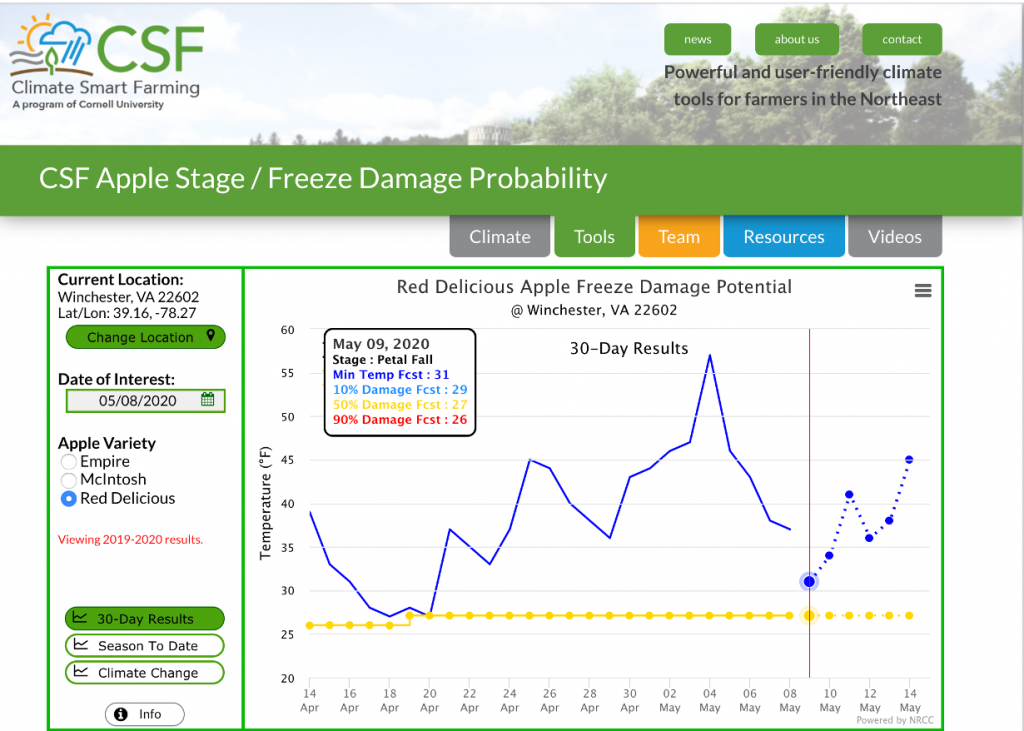
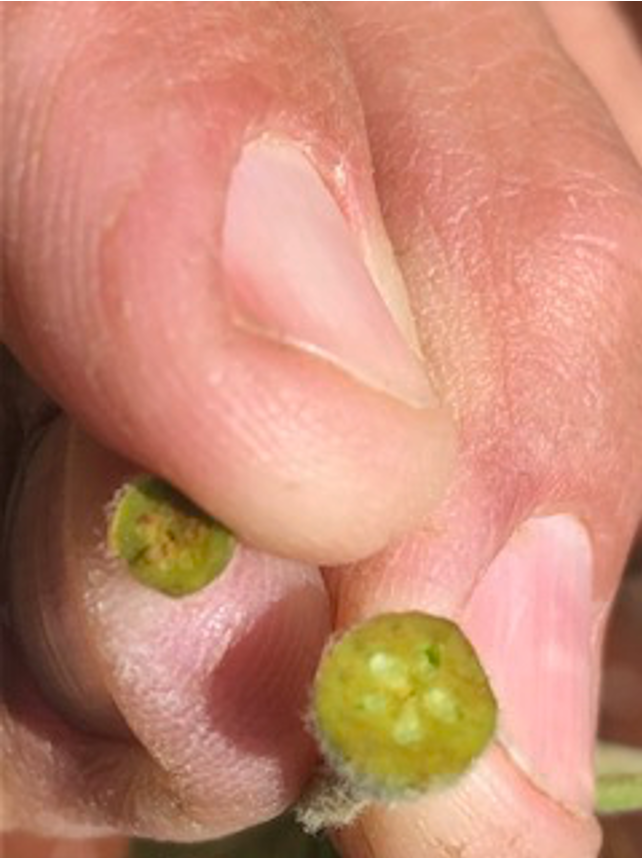
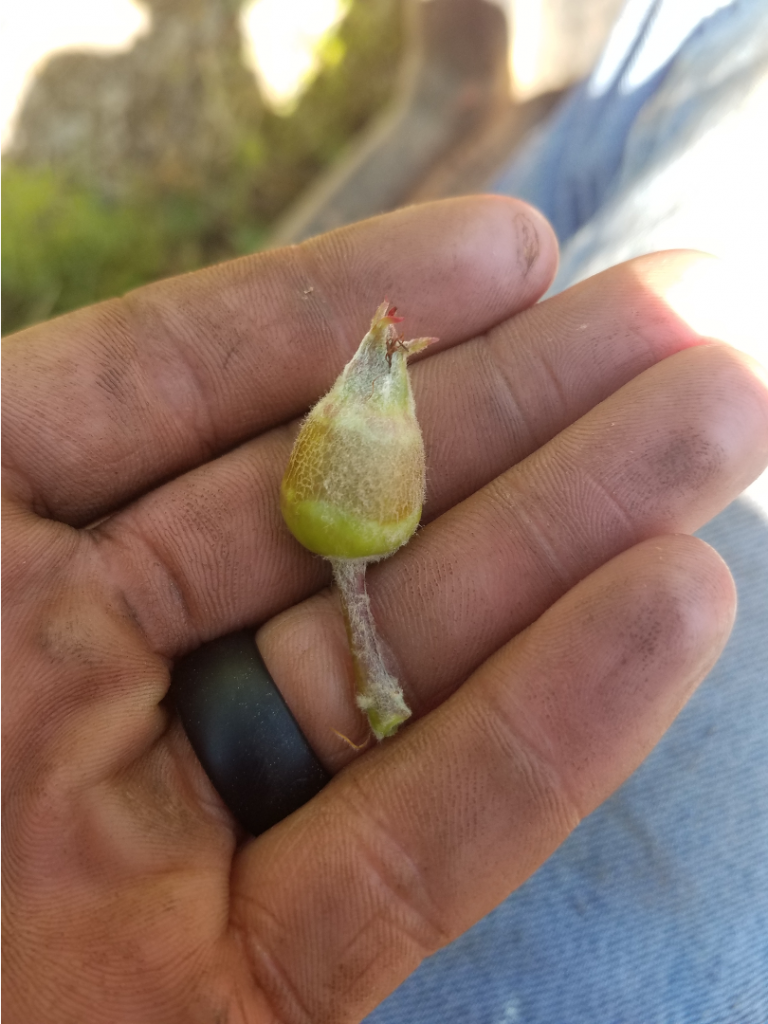
Subfreezing temperatures as low as 30 oF is expected midnight tonight (Friday) to 10:00 am Saturday for northwest and western Virginia. Our cherries, peaches, and most, if not all, apple varieties are at the post-bloom stage now. The critical temperatures that can cause 10% and 90% of damage at this stage are 28 oF and 25 oF, respectively. At this stage of apple crop development, frost can cause damage to the fruits and seeds. Fruits with damaged and aborted seeds stop growing and eventually drop off. Therefore, it’s important to assess your crop first for any frost injury before starting thinning applications this coming week. You can do so by picking a few fruitless from different locations in the orchard and cut them in half by a pocket knife and observe the flesh and seed color. Damaged fruitlets will show brownish flesh and seed color. In most cases, the damage can also be observed on the fruit surface as a frost ring (See images below).
CSF Apple Stage / Freeze Damage Probability on the Climate Smart Farming, a program of Cornell University. The model predicts apple freeze damage potential for the Red Delicious apples in Winchester, VA, at petal fall. However, the date presented in the chart are also suitable for other apple varieties. The yellow horizontal line indicates that temperature at which 50% of fruits can be killed. The blue color refers to the mini temp forecasted, which is 31 oF for Saturday, May 9.Brown flesh color as indication of frost/freeze damage in Gala. Photo courtesy of Bill Mackintosh Frost ring on a Gala apple fruitlets. Photo courtesy of Chester Allen
Sherif M. Sherif, Assistant Professor at Virginia Tech, School of Plant and Environmental Sciences, AHS Jr. Agricultural Research and Extension Center 595 Laurel Grove Road, Winchester, VA 22602 540-232-6035, Email: ssherif@vt.edu
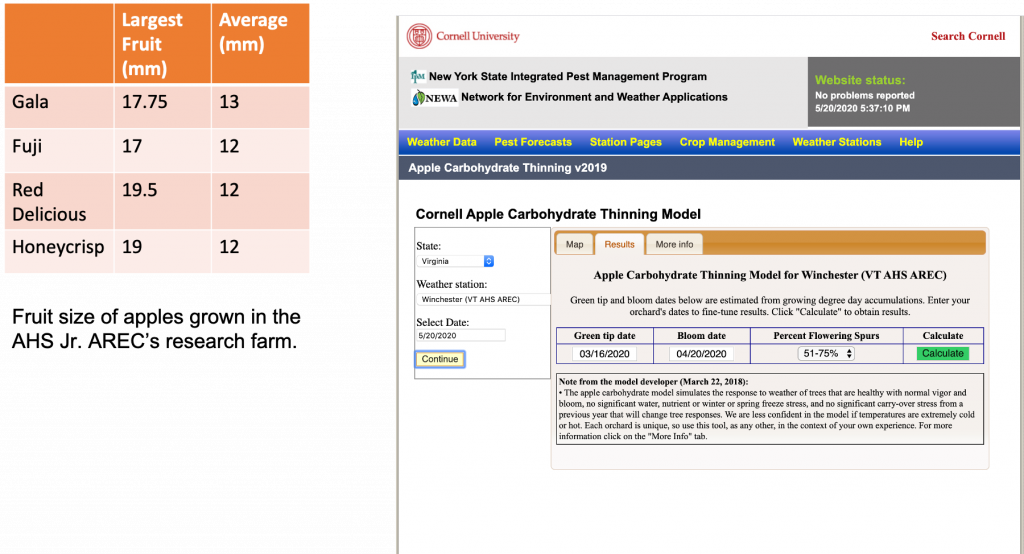
The average fruit size for our Gala, Pink Lady, Red Delicious, Fuji, and Honeycrisp in the Winchester area is 6.00, 6.11, 6.04, 5.72, and 6.37 mm, respectively. So, you may be wondering whether you should put any thinning application this week and if yes, when to spray and at what rate?!
The short answer is yes. You may consider applying chemical thinners, e.g. 6-BA or NAA, for your apple trees this week, preferably tomorrow, May 2nd, and Sunday (if it’s not raining). Based on the 10-d weather forecast for Winchester, it will be only Saturday and Sunday this week with temp. above 70 oF. Both 6-BA and NAA work better when the temp is greater than 65 oF. As for the rate, the carbohydrate model recommends increasing chemical thinning rate by 30%. Two things to consider here: a) Apple cultivars respond differently to thining materials. Golden Delicious, Fuji, and Cameo are usually hard-to-thin, whereas Pink Lady, Gala, Honeycrisp and Granny Smith are easier to thin. For the rates and materials recommended for Gala, Fuji, Honeycrisp, Red Delicious, Pink Lady, and Golden Delicious, use this link (https://treefruithorticulturevaes.wp.prod.es.cloud.vt.edu/2020/04/02/fruit-thinning-scenarios-2020/). b) The rates mentioned on 6-BA and NAA product labels are for dilute applications (100 gal/acre). To convert from dilute to concentrate, please refer to my other post at (https://treefruithorticulturevaes.wp.prod.es.cloud.vt.edu/2020/04/02/how-to-calculate-the-tree-raw-volume-trv-and-chemical-rates-for-concentrate-spraying/).
Apple Carbohydrate Thinning Model for Gala. Winchester (VT AHS AREC) weather station Gala’s green tip and bloom dates are 3/16 and 4/20, respectively. Winchester, VA 10-Day Weather Forecast
Sherif M. Sherif, Assistant Professor at Virginia Tech, School of Plant and Environmental Sciences, AHS Jr. Agricultural Research and Extension Center, 595 Laurel Grove Road, Winchester, VA 22602 , Email: ssherif@vt.edu, Tel. 540-232-6035
Fruit size for Gala apples in the Central Virginia area is
ranging between 10-12 mm now, which is a perfect size window for post-bloom
thinning applications (e.g. by 6-BA and NAA products). Therefore, I ran the
carbohydrate thinning model on NEWA website today, April 28, to predict: a) the
tree carbohydrate level and b) thinning rates. Since 2017, we have been using
the Batesville weather station for the central Virginia area and we will keep
using the same location to help us compare among the year. We did not detect
any considerable differences in the model outputs when we used the Afton
weather station. However, if you have access to the model from your own
computer, I would recommend that you run the model yourself based on the
nearest weather station to your location. As you may be aware, any differences
in the elevation levels would change the average daily temperature which is a
critical input for calculating the tree carbohydrate level, and this will in
turn change model outputs and recommendations.
As you will see on the NEWA website, there are two
carbohydrate models, the old version which we have been using in the past three
years and the 2019 new model (Apple CHO Thinning 2019) which I will use this
year. One of the differences in the new model is the percent flowering spurs as
one of the inputs you have to add to the model. Despite the fact that Gala is
considered as an annual bearing variety and has no major issues with return
bloom, I would recommend setting the model at 50-75% flowering spurs instead of
75-100%. The reason for that is to account for the extended period of cold
weather we had during bloom and the frost damage the has been reported in some
locations. These two factors might have affected flower pollination and total
fruit set to some degree. The other two modifications in the 2019 model are: a)
the tree carbohydrate balance column in the new model is using 7-day average
values instead of 4-day average which makes it more accurate; b) the
accumulated 4 oC degree days (DD) column which predicts the number
of DD since bloom at which thinning would be highly effective. As a rule of
thumb, 200-250 DD from bloom is considered the sweetest spot for thinning
applications. Interestingly, this period often matches with the 6-12 mm fruit
size window that we have long been recommending for thinning.
With all of that in mind, I ran the new model today for Central Virginia based on Gala’s green tip and full bloom dates (March 10 and April 4, respectively) that were kindly provided by our respected growers in the Central Virginia area. As shown in the image below, the model predicts that we have between 214-251 DD between April 28 and May 1st, which is our target window. The model also suggests carbohydrate surplus during that period which on one hand is good for supporting cell division and consequently good fruit size; but on the other hand, it will make thinning a bit harder. Therefore, the recommendation is to increase thinning rates by 30% during that period. For instance, if you would normally use 6-BA at 48 oz/100 gal, you should increase it to 62 oz/100 gal. This is still among the rate range of 48-64 oz/100 gal we were recommending. To convert from dilute to concentrate applications, please refer to my blog post at (https://treefruithorticulturevaes.wp.prod.es.cloud.vt.edu/2020/04/02/how-to-calculate-the-tree-raw-volume-trv-and-chemical-rates-for-concentrate-spraying/). Also, for thinning materials to be used for other varieties, e.g. Fuji, Honeycrisp, Pink Lady, Golden Delicious, Red Delicious, and Ginger Gold, please refer to my other blog post at (https://treefruithorticulturevaes.wp.prod.es.cloud.vt.edu/2020/04/02/fruit-thinning-scenarios-2020/).
One final point to highlight here is the effect of temperature on the activity of thinning materials. It has always been suggested that the best thinning activity by 6-BA and NAA is achieved when temperatures at and after the day of application are greater than 65 oF. By taking this into consideration and based on the 10-day weather forecasting for Batesville, this coming Saturday and Sunday, May 2 and 3, would be good days for thinning applications.
Should you have any questions/comments, please feel free to use the comments box below, call me at 5402326035, or shoot me an email at: ssherif@vt.edu. Wish you all good luck with your thinning applications.
Apple Carbohydrate Thinning Model for Batesville, Virginia. April 28, 2020 Green tip and Bloom dates for Gala are March 10 and April 4, respectively. Batesville, VA 10-Day Weather Forecast
Defruiting newly planted and young apple trees (e.g., 2nd and 3rd leaf) is recommended to allow trees to fill their allotted bearing space, grow to the top wire and become ready to bear a decent crop by the fourth and fifth year. This practice is particularly advisable for trees on dwarfing rootstocks (e.g., B.9, G.41, and G.16). Although defruiting can be achieved manually by removing flower clusters and small fruitlets, several chemical options can make defruiting much easier and less labor-intensive. These include:
a) Using chemical blossom thinners: Two to three applications of lime sulfur at 3% (3 gallons/100 gallon per acre) mixed with oil (e.g., JMS Stylet-oil) at 2% should be enough to prevent the fertilization and fruit set of the majority of king and side blossoms. It is worth noting that blossom thinning applications should be avoided when daytime temperatures are favorable for fire blight infections, e.g., 75° to 85°F, or when fire blight models predict blossom infections. You may also consider applying streptomycin with or after bloom thinning applications to reduce the probability of infection. The two lime sulfur products labeled for blossom thinning in Virginia are Rex lime sulfur and NovaSource lime sulfur. Our research indicated that both products are equally effective.
b) Using post-bloom thinners (recommended): Products containing 6-BA (e.g., Maxcel and Exilis plus) or NAA (e.g., Fruitone L, PoMaxa, and Refine 3.5WSG) can be applied in combination with carbaryl (e.g., Sevin XL plus) to remove apple fruitlets. One application will be sufficient at petal fall and another at fruit size 6-12 mm. 6-BA at 100 ppm (64 fl oz) or NAA at 15 ppm (6 fl oz) combined with carbaryl at 1 qt/100 gal/acre should achieve satisfactory results. Some forms of 6-BA and NAA may contain a higher percentage of the active ingredient. So, it’s always advisable to read the label and use the fl oz amounts that correspond to 100 ppm and 15 ppm of 6-BA and NAA, respectively. It should also be noted that defruiting with 6-BA or NAA is more efficient when trees are under carbohydrate deficit conditions. The carbohydrate thinning model on NEWA (http://newa.cornell.edu/index.php?page=apple-thin) predicts the carbohydrate status of the tree based on daytime temperatures and solar radiation values. The best defruting results are obtained when the 4-day average balance is between -40 to -80 g/day. If the model is not accessible, 6-BA and NAA applications should be made when daytime temperatures are ≥ 85 oF. Cloudy days at and after spray applications should also be targeted. Adding a non-ionic surfactant (e.g., Regulaid) to the spray tank will also enhance the efficacy of defruting applications.
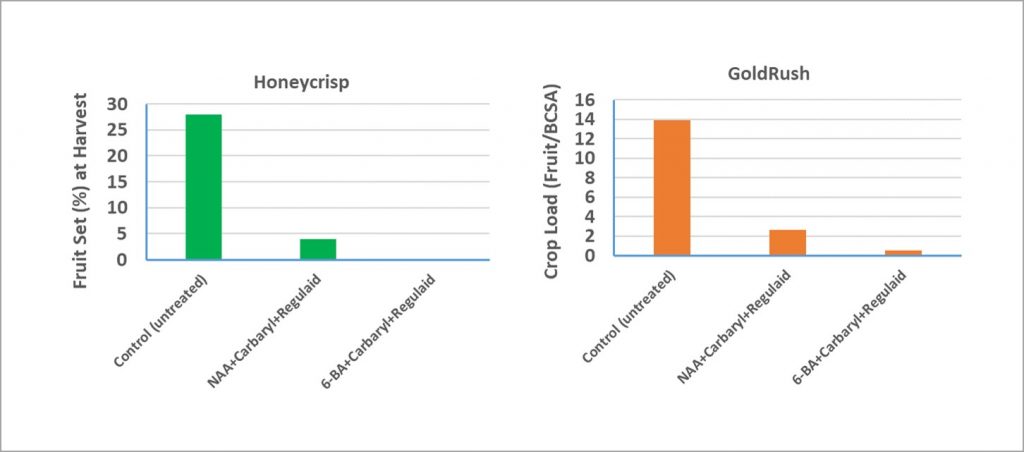
The following figure shows the effect of two defruting treatments on fruit set (%) and crop load (fruit/branch cross-sectional area) of Honeycrisp and GoldRush.
Trees of ‘Honeycrisp’ and ‘GoldRush’ were treated with a mixture of Maxcel+Carbaryl+Regulaid or PoMaxa+Carbaryl+Regulaid at petal all and at fruit size (10 mm). The time of application was determined by the Carbohydrate thinning model on NEWA.
c) Using a mixture of ethephon, carbaryl, and oil: The recommended rate for this application is 1 – 1.5 pt of ethephon tank mixed with 1 qt of carbaryl and 1 qt of Superior oil/100 gal/acre. The best results are achieved when applying this mix at 10-15 mm fruit size and daytime temperatures 75 – 90°F. It should be noted that ethephon can severely inhibit tree growth, and therefore it is not recommended to use it for defruiting weak- and medium-vigor cultivars (e.g., Granny Smith & Honeycrisp) on dwarfing rootstocks (e.g., B.9).